

Artificial Intelligence
India To Get Dedicated AI Law?
Share
TL;DR
Key points to know:
-
India’s AI policy debate now sits between a standalone law and a principle-based, sectoral approach.
-
The Digital India Act remains in draft and is expected to replace the older IT Act when enacted.
-
Legal liability for generative AI in India is still not clearly settled, especially when harm comes from autonomous or hard-to-trace AI outputs.
-
The 2026 IT Rule amendments reduced the takedown window for unlawful content from 36 hours to three hours, with a two-hour window for some intimate imagery and impersonation-related complaints.
-
Indian tech companies broadly prefer voluntary guidance, regulatory sandboxes and risk-based rules over heavy prescriptive legislation.

Introduction
In the 2021 Netflix dark comedy, Don’t Look Up, two astronomers discover a planet-killing comet and then watch leaders debate, delay and deflect instead of acting. India’s AI policy debate has a similar restless energy in 2026.
Artificial intelligence is already reshaping jobs, content, cybersecurity and public trust. The government has also backed the IndiaAI Mission with an outlay of INR 10,372 crore to build the broader AI ecosystem. Yet a dedicated AI law has not arrived.
The real question is not whether AI needs rules. It is whether India should create one horizontal AI statute or keep governing AI through existing laws, guidelines and sector-specific rules.
India’s AI Regulatory Landscape In 2026
As of mid-2026, India has no dedicated AI law. MeitY remains the key ministry for AI governance, but India’s policy direction is still light-touch and innovation-first.
The current framework is a patchwork:
-
The Information Technology Act, 2000 covers cybercrime and intermediary liability.
-
The IT Rules, 2021 now cover synthetically generated information (SGI) after the 2026 amendments.
-
The Digital Personal Data Protection Act, 2023 governs personal data that may be used in AI systems.
-
Consumer, copyright and sectoral laws may apply depending on the harm.

This is why the India AI regulation bill 2026 debate can be misleading. India has not passed a government-backed AI law yet. Instead, it is building enforceable obligations around the outputs of AI systems, especially deepfakes, synthetic media and unlawful online content.
What Changed In 2026?
The biggest shift came through the Information Technology (Intermediary Guidelines and Digital Media Ethics Code) Amendment Rules, 2026, notified on February 10 and effective from February 20. These rules formally brought SGI into India’s intermediary compliance framework.
The practical changes are significant:
-
Intermediaries that enable SGI must use reasonable technical measures to prevent unlawful synthetic content.
-
Lawful SGI must be prominently labeled and, where technically feasible, embedded with permanent metadata or provenance markers.
-
Significant Social Media Intermediaries (SSMIs) must require user declarations and use technical measures to verify whether uploaded content is synthetic.
-
Unlawful content must be removed within three hours of valid court or government notice.
-
Certain complaints involving private areas, nudity, sexual conduct or artificially morphed impersonation must be acted on within two hours.
This is stricter than the earlier 36-hour framework and makes platform response time a compliance risk.
The Other Moving Pieces
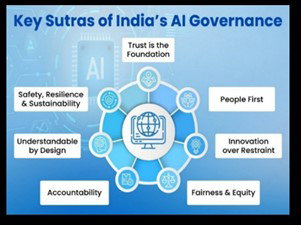
The India AI Governance Guidelines, released under the IndiaAI Mission, remain non-binding but important. They are built around seven principles, including Trust is the Foundation, People First, Innovation over Restraint, Fairness and Equity, Accountability, Understandable by Design, and Safety, Resilience and Sustainability.
A Private Member’s Bill, the Artificial Intelligence (Ethics and Accountability) Bill, 2025, has also been introduced in the Lok Sabha. It proposes an AI Ethics Committee, developer duties, bias audits, transparency requirements and penalties of up to INR 5 crore. However, it has not become law.
Meanwhile, digital India act ai updates remain important because the Digital India Act is still expected to replace the IT Act and regulate digital technologies more broadly, including AI. For now, it remains in draft.
The Debate: One Law Or Many Rules?
The case against a standalone law is practical. AI is moving quickly, India’s enforcement capacity is still developing, and overbroad rules could raise compliance costs for startups.
The case for a dedicated law is also strong. Legal liability for generative AI in India remains unclear. Existing laws usually assign responsibility to people, companies or intermediaries, not to autonomous AI systems. That creates gaps when an AI tool causes harm, produces biased outcomes or generates infringing content without a clear human decision in the loop.
This matters in areas such as:
-
AI-generated copyright and ownership disputes.
-
Algorithmic bias in hiring, lending and public services.
-
Deepfake abuse, impersonation and privacy violations.
-
Harmful AI advice in health, finance or education.
India’s current answer is cautious: regulate the risk, not the technology itself.
What This Means For Foreign Tech Companies
For foreign platforms, the 2026 amendments already answer part of the question: how will India's proposed dedicated AI law impact foreign tech? Even without a standalone law, companies serving Indian users must comply with India’s intermediary rules.
Large platforms classified as SSMIs, generally those above the notified user threshold in India, face stronger obligations. They need user declarations, technical verification, labeling workflows, grievance handling, compliance officers and monthly reporting. Failure to meet due-diligence duties can weaken safe harbour protection under Section 79 of the IT Act.
Foreign companies should therefore treat India-specific AI compliance as a product and operations issue, not just a legal policy note.
How Indian Tech Companies View The Proposed AI Regulations
Indian tech companies generally support responsible AI rules but prefer proportionate regulation.
Their common position is:
-
Use voluntary guidance where risks are low.
-
Use sandboxes to test high-risk AI before imposing strict rules.
-
Keep compliance costs manageable for startups.
-
Create clearer rules for deepfakes, data use, IP and accountability.
-
Avoid treating every AI use case as equally risky.
That approach reflects a familiar tension. India wants to build an AI ecosystem, not slow it down. At the same time, deepfakes, synthetic misinformation and AI-caused harm have made a purely voluntary model harder to defend.
Conclusion
India is not waiting for one perfect AI law before acting. MeitY has issued governance guidelines, updated intermediary rules and tightened synthetic-content enforcement. The Digital India Act may eventually bring broader AI provisions, and Parliament is already seeing proposals for AI accountability. For now, the rules are real even if the law is not yet standalone.
India’s model is therefore clear: innovation first, restraint where harm is visible and stronger obligations for platforms that distribute risky content at scale. Whether this becomes a Global South template or a cautionary tale will depend on one thing: whether the framework actually protects users without choking the AI ecosystem it wants to grow.
Frequently Asked Questions
What Is The 70 30 Rule In AI?
The 70 30 rule in AI usually means using 70% of data to train a model and 30% to test it. It helps check whether the AI can perform well on new data instead of just memorizing old patterns.
What Is The New AI Policy In India?
India does not have a standalone AI law yet. Its current AI policy is based on existing laws, MeitY’s AI Governance Guidelines and the 2026 IT Rules, which focus on responsible AI, synthetic content labeling, faster takedowns and innovation-first regulation.
What Is The 80 20 Rule Of AI?
The 80 20 rule in AI means focusing on the small set of use cases that can deliver the biggest results. It also shows that most AI work often goes into data preparation, governance, and workflow design, not just model building.
Tue, Jul 7, 2026

Enjoyed what you've read so far? Great news - there's more to explore!
Stay up to date with the latest news, a vast collection of tech articles including introductory guides, product reviews, trends and more, thought-provoking interviews, hottest AI blogs and entertaining tech memes.
Plus, get access to branded insights such as informative white papers, intriguing case studies, in-depth reports, enlightening videos and exciting events and webinars from industry-leading global brands.
Dive into TechDogs' treasure trove today and Know Your World of technology!
Disclaimer - Reference to any specific product, software or entity does not constitute an endorsement or recommendation by TechDogs nor should any data or content published be relied upon. The views expressed by TechDogs' members and guests are their own and their appearance on our site does not imply an endorsement of them or any entity they represent. Views and opinions expressed by TechDogs' Authors are those of the Authors and do not necessarily reflect the view of TechDogs or any of its officials. While we aim to provide valuable and helpful information, some content on TechDogs' site may not have been thoroughly reviewed for every detail or aspect. We encourage users to verify any information independently where necessary.
Loading comments...