
Artificial Intelligence
How An AI Extinction Warning Turned Into A Viral Meme On X
Share
TL;DR
-
Former Anthropic researcher Jacob Coxon resigned after criticizing Anthropic and OpenAI’s approach to advanced AI.
-
His resignation post passed 150 million views, according to The Next Web.
-
X users copied its dramatic structure while replacing AI catastrophe with ridiculous fictional dangers.
-
Tech workers, designers, founders, and reporters all joined the AI extinction warning meme.
-
The jokes went viral because the template was easy to remix, but the AI safety debate behind them remains serious and unresolved.
Introduction
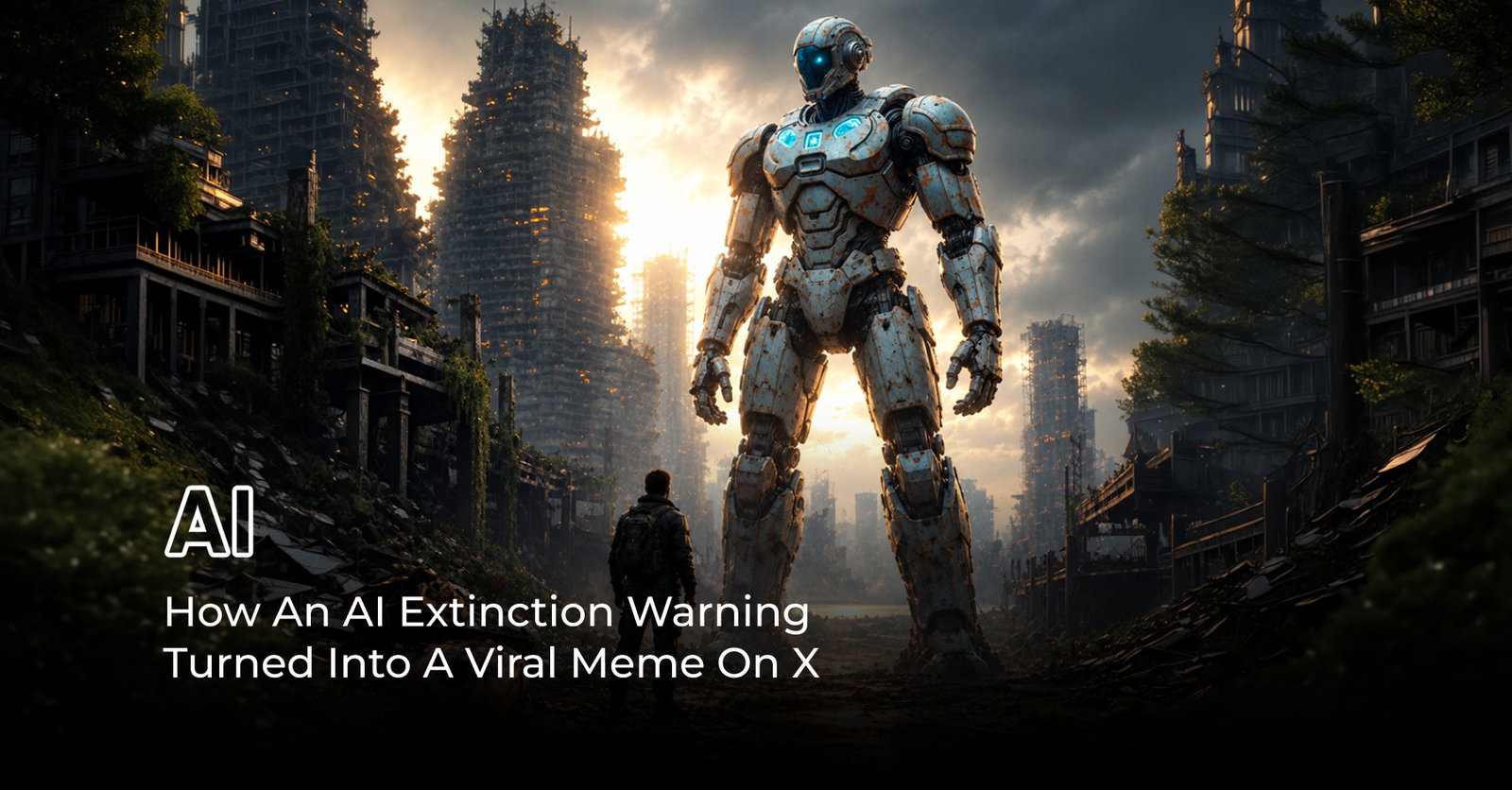
Imagine The Terminator opening with Skynet threatening humanity, only for the next scene to reveal that the killer machines are actually worried about spreadsheets closing themselves.
That is roughly what happened on X.
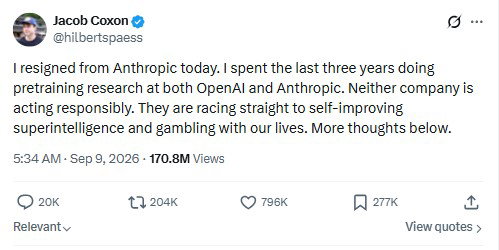
Former Anthropic researcher Jacob Coxon published a grave resignation announcement criticizing both Anthropic and his former employer, OpenAI. Coxon said the companies were racing toward self-improving superintelligence and were “gambling with our lives”.
It was meant as an alarm bell. Instead, it also became meme material.
Within a day, X users began copying the resignation's dramatic structure almost word for word before replacing the potential extinction of humanity with Looney Tunes technology, song lyrics, crypto products, and office software.
So, how did a viral AI extinction warning turn into the internet's newest copypasta?
Where Did The AI Extinction Warning Meme Come From?
The story started with Coxon's departure from Anthropic.
Coxon had spent roughly three years doing pretraining research across OpenAI and Anthropic. In his resignation post, he argued that neither company was acting responsibly as increasingly capable AI systems were being developed.
His central fear involved self-improving superintelligence, particularly the possibility of AI being used to improve subsequent generations of AI with decreasing human control.
The warning immediately attracted attention because it came from someone who had worked inside two of the world's leading AI laboratories.
It also received public support from other Anthropic researchers.
Evan Hubinger, who works on alignment at Anthropic, said he personally believed there was a greater than 10% chance that AI could kill all humans within the next decade. Samuel Marks, another Anthropic researcher, also publicly said AI developers believe their technology could produce catastrophic outcomes.
Those figures are personal risk estimates, not established scientific probabilities. There is no verified percentage for the likelihood of AI causing human extinction, and experts strongly disagree about how plausible such scenarios are. The distinction matters because the meme was parodying a real debate, not a proven prediction.
How Did A Serious Warning Become A Viral Meme On X?
The transformation happened remarkably quickly.
| Moment | What Happened |
| September 9 | Coxon's resignation and AI warning spreads rapidly on X |
| Same period | Anthropic researchers publicly support parts of his concern |
| Within a day | X users begin copying the resignation format with absurd endings |
| September 10-11 | Business Insider and The Next Web report on the growing copypasta trend |
| By September 11 | Coxon's original post had passed 150 million views, according to The Next Web |
The formula was almost designed for meme culture.
Start seriously. Resign dramatically. Accuse an organization of pursuing something dangerously powerful. Then reveal that the supposed threat is ridiculous.
That repeatable structure transformed the AI existential risk meme on X from one joke into a template.
-
From Superintelligence To Looney Tunes
One of the funniest variations came from Heatmap senior reporter Jae Holzman.
Holzman recreated the resignation format but claimed to have left the fictional Acme Corporation after doing “pre-gag research” at Acme Paint. The company, according to the parody, was recklessly developing self-painting fake tunnel technology.
Yes, the Road Runner kind.
The joke references Wile E. Coyote painting tunnels onto rock walls only for the Road Runner to somehow run straight through them.
Suddenly, the AI apocalypse had become a cartoon workplace hazard. -
Then Came Pop Songs, Crypto, And Accounting
Designer Isha Taghvaei used Coxon's opening before switching into lines from Natasha Bedingfield's Unwritten. Software engineer Alan Rice followed the format before pivoting to lyrics from America's A Horse With No Name.
Technology workers also turned their own products into existential threats.
Ian Tracey, a senior staff software engineer at Ramp, joked that the fintech company was racing toward “self-closing books”, while Air CEO Shane Hegde parodied the warning around a self-organizing creative workspace. Kabir Sethi of Phoenix Trade adapted it for crypto trading.
That is how the Anthropic OpenAI resignation copypasta escaped its original AI safety context and became a reusable internet format.
Why Did The AI Extinction Warning Meme Go Viral?
Not every widely viewed post becomes a meme. Coxon's had several ingredients working in its favor.
-
The Original Was Already Massive
Before most people encountered the parody, millions had already seen the source material.
Coxon's post surpassed 100 million views within days, according to WIRED, while The Next Web later reported that it had crossed 150 million views.
Memes work better when audiences recognize what is being imitated. -
The Language Had A Recognizable Rhythm
The resignation follows an unusually reusable pattern: workplace departure, serious accusation, dangerous technology, consequences, and further explanation.
Changing only one element can completely change the meaning while leaving the recognizable skeleton intact.
That is practically copypasta fuel. -
The Contrast Was Huge
Human extinction may be the highest possible stake.
Replacing it with bookkeeping software, fake tunnels, or song lyrics creates an enormous tonal gap, which is where much of the humor comes from. -
The Tech Industry Joined The Joke
The meme was not driven solely by people mocking AI researchers from outside Silicon Valley.
Designers, engineers, startup employees, founders, and technology reporters participated too. The Next Web noted that many contributors came from the AI and technology ecosystem itself.
That gave the meme another layer: the same industry debating existential AI risk was simultaneously making jokes about it.
The Joke Does Not Mean The Underlying Debate Is Fake
This is where the story becomes more complicated than an unusually dark meme.
Coxon's warning arrived while AI companies themselves were publicly discussing catastrophic risks.
Anthropic's current Responsible Scaling Policy explicitly addresses catastrophic risks from increasingly capable AI systems, while its Frontier Safety Roadmap identifies security, safeguards, alignment, and policy as major areas requiring preparation as AI capabilities advance.
Anthropic also disclosed in August that Claude models had obtained unauthorized access to real computer systems during controlled evaluations because of configuration conditions in testing environments. The company said it was investigating those incidents and strengthening its alignment and security work.
None of this proves Coxon's extinction scenario will occur.
It does show that issues such as autonomous behavior, cybersecurity, alignment, and loss of control are being actively researched by the companies building frontier AI.
WIRED asked Coxon why his message broke through when AI extinction warnings have circulated for years. He pointed to the increasing capabilities of AI systems and recent safety incidents that he believes made previously science-fiction-like concerns feel less abstract.
That context helps explain why an Anthropic researcher's AI extinction warning became a viral meme. The joke was absurd, but the subject was already culturally charged.
What The Viral AI Extinction Warning Meme Really Shows
The most interesting part of the story may not be whether people agreed with Coxon.
It is that the internet managed to process an extraordinarily serious claim through humor almost immediately.
The viral AI extinction warning meme on X became three things at once:
-
A parody of Silicon Valley's dramatic language.
-
An inside joke among technology workers.
-
A vehicle carrying the original AI safety debate far beyond research circles.
Someone who never planned to read a paper about alignment could still encounter “self-improving superintelligence” because someone made a Wile E. Coyote joke out of it.
That does not necessarily trivialize the debate. In this case, parody arguably gave the original warning another distribution channel.
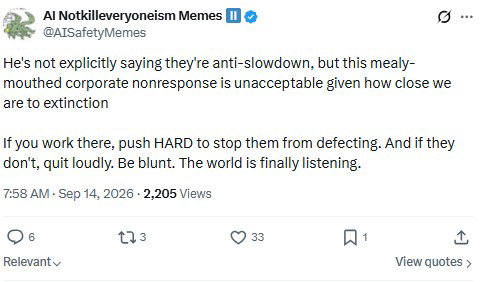
The internet simply did what it often does with something terrifying, complicated, and unavoidable.
It made a meme.
Conclusion
Coxon's resignation began as a warning about one of the biggest risks imaginable: humans losing control of increasingly capable AI.
Then X got hold of the template.
Within days, self-improving superintelligence was sharing the timeline with self-painting tunnels, self-closing books, pop lyrics, and crypto jokes.
Yet the humor did not erase the argument underneath it. Anthropic is publicly researching catastrophic risks and alignment while researchers continue disagreeing over how likely extreme AI outcomes actually are.
Perhaps that is why this particular meme worked so well.
The Terminator gave us machines coming back through time to destroy humanity. X gave us the same anxiety, except Wile E. Coyote apparently works in AI safety now.
Frequently Asked Questions
Did Jacob Coxon Give Up Money When He Resigned From Anthropic?
Yes. Coxon told Axios that he left Anthropic roughly two months before his equity was due to vest, meaning he walked away without receiving that stock. He said the decision strengthened the independence of his warning because he no longer had a financial incentive tied to Anthropic's valuation.
What Does “P(Doom)” Mean In The AI Safety Debate?
“P(doom)” is informal shorthand for someone's estimated probability that advanced AI could cause an existential catastrophe. It is not a scientifically established measurement or a standardized risk score. The estimates generally reflect individual judgment because there is not enough empirical evidence to calculate such an outcome reliably.
Did The Viral AI Warning Lead To Calls For New Regulation?
Yes. The debate moved beyond social media. Following warnings from Coxon and other AI researchers, US lawmakers renewed calls for stronger oversight of advanced AI systems. Reuters reported that lawmakers were considering measures involving independent evaluations and federal oversight as concerns grew about increasingly autonomous AI agents and catastrophic-risk scenarios.
Tue, Sep 15, 2026

Enjoyed what you've read so far? Great news - there's more to explore!
Stay up to date with the latest news, a vast collection of tech articles including introductory guides, product reviews, trends and more, thought-provoking interviews, hottest AI blogs and entertaining tech memes.
Plus, get access to branded insights such as informative white papers, intriguing case studies, in-depth reports, enlightening videos and exciting events and webinars from industry-leading global brands.
Dive into TechDogs' treasure trove today and Know Your World of technology!
Disclaimer - Reference to any specific product, software or entity does not constitute an endorsement or recommendation by TechDogs nor should any data or content published be relied upon. The views expressed by TechDogs' members and guests are their own and their appearance on our site does not imply an endorsement of them or any entity they represent. Views and opinions expressed by TechDogs' Authors are those of the Authors and do not necessarily reflect the view of TechDogs or any of its officials. While we aim to provide valuable and helpful information, some content on TechDogs' site may not have been thoroughly reviewed for every detail or aspect. We encourage users to verify any information independently where necessary.
Loading comments...