

Artificial Intelligence
Horizontal AI Vs. Vertical AI: Differences, Benefits & Applications
Share
Introduction
As more and more people have started relying on AI, the expectations have also changed. People don’t just need speed. They need accuracy and efficiency.
Over time, two distinct styles of AI use emerge. Some are designed to tackle a particular issue exceptionally well. You know, both styles are actually being used in real businesses these days, and each has its own pros and cons.
Let’s dive into two different approaches: Horizontal AI and Vertical AI.
What is what? What’s the difference?
Let’s break it down.
TL;DR
-
AI is now embedded in daily work, and the real challenge is choosing the right AI approach.
-
Horizontal AI offers speed and flexibility across functions but struggles with precision, compliance, and niche expertise.
-
Vertical AI delivers high accuracy, compliance, and clear ROI for specific industries, though it costs more and scales slower.
-
Speed without domain context can introduce risk, especially in regulated or high-stakes workflows.
-
The strongest AI strategies combine intent, risk awareness, and long-term value, treating AI as a core capability rather than a quick fix.
What Is Horizontal AI?
They are general-purpose AI systems that can be used for a wide range of tasks and industries. A Horizontal AI is not made for just one area; it is a flexible type of intelligence that can be used in many ways.
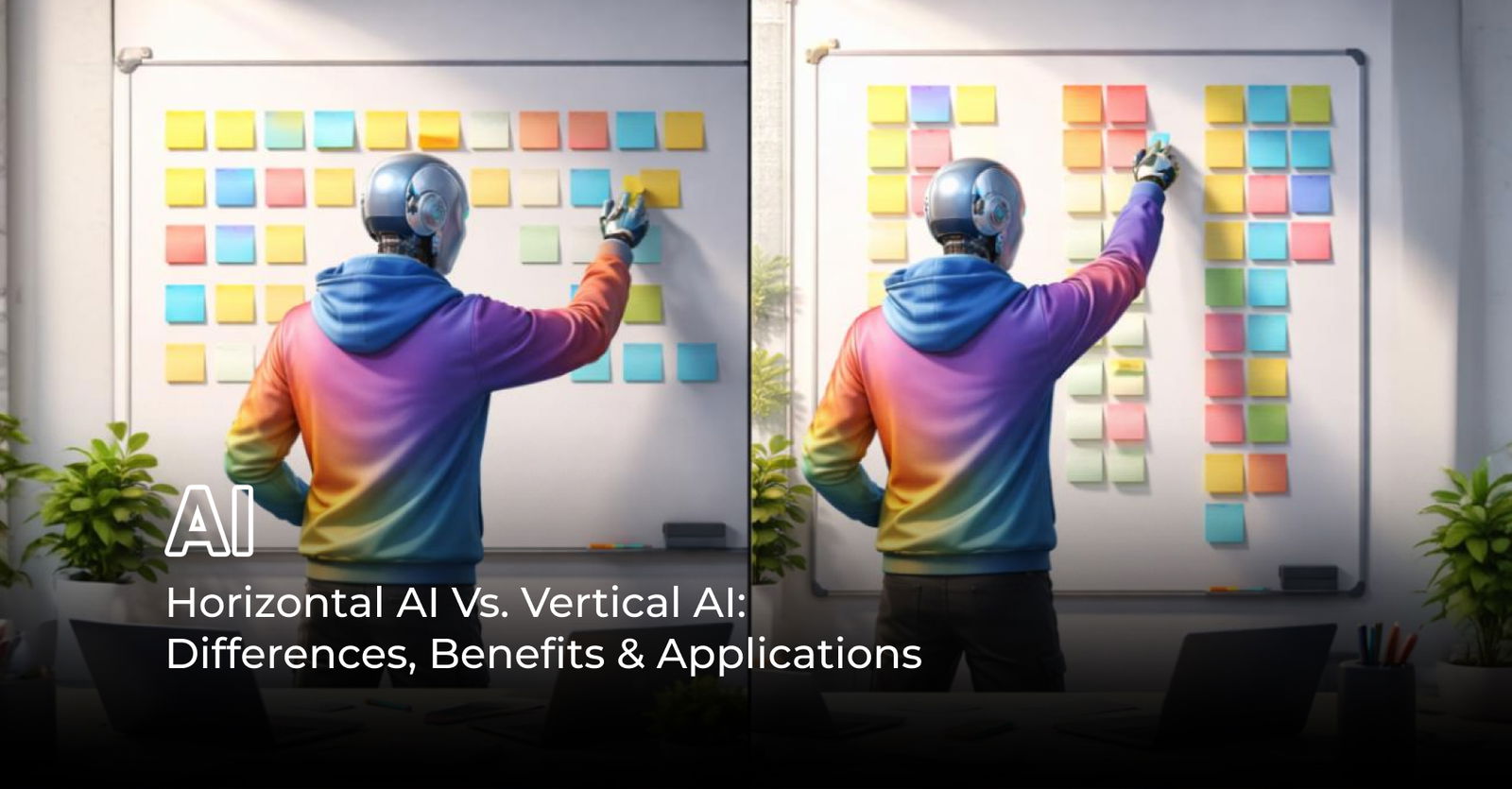
They act as highly adaptable generalists or utility players. A Horizontal AI, like a versatile person, may be repurposed and retrained for new roles as business needs change.
Now, let’s turn to Vertical AI and how it approaches problems differently.
What Is Vertical AI?
Vertical AI refers to AI agents or systems designed for a single domain or industry. These agents are built with strong subject understanding and narrowly focused capabilities. Unlike broad platforms, Vertical AI is specifically designed to address difficulties, workflows, or use cases within a certain industry.

Vertical AI refers to AI agents or systems that specialize in a single domain or industry. These agents are designed with deep domain knowledge and specialized capabilities. Vertical AI, unlike wide platforms, is specifically designed to handle industry-specific issues, workflows, or use cases.
Now that we know what Horizontal AI and Vertical AI are, let’s get to the benefits and limitations of both.
Benefits Of Horizontal AI
Here are the benefits of Horizontal AI:
-
Rapid Cross-Functional Scalability
A single Horizontal model can easily support various departments, like HR and sales, without needing any specialized setups. This flexibility helps organizations quickly ramp up AI use across the whole business, getting the most out of a single investment.
-
Immediate Speed To Pilot
Organizations can initiate Horizontal AI projects in weeks rather than months since these tools do not require carefully curated industry data from the beginning. This speed promotes quick experimentation and lowers the initial barriers to entry for digital transformation initiatives.
-
Widespread User Adoption
Because Horizontal tools, such as general-purpose assistants, are versatile and intuitive, employees frequently accept them with minimal process modification. Their "move fast" approach aligns with the 78% of firms that reported using AI in 2024.
Limitations Of Horizontal AI
Here are the limitations of Horizontal AI:
-
Precision Gaps
Broad AI frequently lacks the deep industrial expertise required for complicated activities, resulting in higher error rates in specialized sectors such as law and medical. Without domain-specific expertise, generalist models may overlook key policy limitations or industry-specific background.
-
High Proof-Of-Concept Abandonment Risk
Gartner expects that 30% of GenAI initiatives will be abandoned by the end of 2025 owing to low data quality, unclear value, or rising expenses. Horizontal pilots frequently fail to transition to production when governance and data discipline are insufficient.
-
Severe Security and Compliance Stress
Broad tools raise the potential of inadvertent data leaks; in 2025, companies reported an average of 223 GenAI-related incidents every month. Moreover, more than half of these events involved regulated data, putting considerable legal and security burden on IT and compliance departments.
Topics For More Insights
Now that we have understood Horizontal AI, let’s get to Vertical AI.
Benefits Of Vertical AI
Here are the benefits of Vertical AI:
-
Exceptional Accuracy And Precision
Designed for particular workflows, Vertical AI offers specialized expertise and greater accuracy compared to generalist models. The design is all about focus, making sure the output is super predictable and easy to audit. This is really important for those crucial tasks in regulated industries.
-
Production-Ready For Regulated Sectors
Vertical AI comes with built-in domain rules, like those for healthcare or finance, right from the beginning. This built-in compliance makes it a better fit for high-stakes situations where mistakes can lead to serious outcomes.
-
Direct And Quantifiable ROI
Focusing on specific bottlenecks, such as insurance claims or medical triage, Vertical AI makes it easier to see how financial gains can be achieved. These in-depth solutions often become essential operating systems, delivering incredible long-term value even if the initial costs are higher.
Limitations Of Vertical AI
Here are the limitations of Vertical AI:
-
Costly And Slower Implementation
Creating Vertical AI takes a good amount of investment in specialized data, experts in the field, and intricate system integrations. It usually takes quite a bit of time to see the value, often stretching from 6 to 12 months before everything is fully ready for deployment.
-
Inflexible And Narrow Scope
A model that is well set up for one task, like helping with radiology, cannot be used for other corporate tasks, like HR. The AI may need a lot of expensive and time-consuming work if corporate goals or industry rules change.
-
Integration Complexity
Scaling Vertical AI across an entire enterprise is tough because the deep customization that makes it so efficient also isolates it. Each new procedure usually necessitates a new deployment, which prevents the easy "spread" found with Horizontal platforms.
How these approaches are used in real life. Let’s take a look.
Real-World Applications Of Horizontal AI
-
Automates everyday knowledge work such as writing emails, generating content, summarizing meetings, and answering internal questions across teams.
-
Helps marketing, sales, HR, and support teams analyze data, prepare documents, and move faster without specialized training.
-
Integrates directly into common tools like documents, chat, and CRM systems to boost productivity at scale.
Real-World Applications Of Vertical AI
-
Supports healthcare workflows, including clinical documentation, patient triage, and operational planning under strict compliance requirements.
-
Powers finance, insurance, and legal processes such as fraud detection, claims processing, compliance monitoring, and contract analysis.
-
Enables industrial and security use cases like predictive maintenance, quality inspection, cybersecurity alert triage, and incident response.
What to consider when choosing an AI approach? Let’s look at that.
Which AI Model Is Right For Your Business?
Choosing between Horizontal AI and Vertical AI depends on your business goals, industry needs, and budget.

-
Use Horizontal AI If:
-
You need a scalable AI solution that works across multiple business functions.
-
You want a cost-effective way to automate customer service and content creation tasks.
-
Your business requires a general-purpose AI that does not need deep industry knowledge.
-
-
Use Vertical AI If:
-
Your industry has unique challenges, regulations, or workflows that require a tailored solution.
-
You need highly accurate AI solutions designed for a specific market.
-
You want an AI system that integrates with industry-specific tools and databases.
-
Businesses often combine both approaches, using Horizontal AI for general tasks and Vertical AI for industry-specific processes.
Conclusion
As AI becomes more embedded in everyday work, the real challenge is not adoption but alignment. Teams need to be clear about where speed is enough and where precision cannot be compromised. Different AI approaches exist because business problems are not all the same.
The smartest organizations focus on intent, risk, and long-term value rather than chasing trends. They experiment, learn from early outcomes, and invest where impact is measurable. Over time, AI stops being a standalone tool and becomes part of the decision-making process. Success comes from choosing thoughtfully, scaling responsibly, and treating AI as a strategic capability, not a shortcut.
Frequently Asked Questions
What Is The Main Difference Between Horizontal AI And Vertical AI?
Horizontal AI is designed to work across many tasks and industries, offering flexibility and scalability. Vertical AI is built for a specific industry or function, providing deeper expertise, higher accuracy, and better compliance for specialized workflows.
Which Type Of AI Is Better For Regulated Industries Like Healthcare Or Finance?
Vertical AI is better suited for regulated industries because it is trained on domain-specific data, built with compliance rules, and designed for high accuracy and auditability.
Can Businesses Use Both Horizontal And Vertical AI Together?
Yes. Many organizations use Horizontal AI for general tasks, such as content creation or internal support, and Vertical AI for specialized processes, such as claims processing, medical documentation, or fraud detection.
Wed, Jan 21, 2026

Enjoyed what you read? Great news – there’s a lot more to explore!
Dive into our content repository of the latest tech news, a diverse range of articles spanning introductory guides, product reviews, trends and more, along with engaging interviews, up-to-date AI blogs and hilarious tech memes!
Also explore our collection of branded insights via informative white papers, enlightening case studies, in-depth reports, educational videos and exciting events and webinars from leading global brands.
Head to the TechDogs homepage to Know Your World of technology today!
Disclaimer - Reference to any specific product, software or entity does not constitute an endorsement or recommendation by TechDogs nor should any data or content published be relied upon. The views expressed by TechDogs' members and guests are their own and their appearance on our site does not imply an endorsement of them or any entity they represent. Views and opinions expressed by TechDogs' Authors are those of the Authors and do not necessarily reflect the view of TechDogs or any of its officials. While we aim to provide valuable and helpful information, some content on TechDogs' site may not have been thoroughly reviewed for every detail or aspect. We encourage users to verify any information independently where necessary.
Loading comments...