

Financial Management Solutions
Elon Musk Unveils New Payment Platform X Money: Everything You Need To Know
Share
TL;DR
-
X Money began rolling out on July 27, 2026, to select US Premium and Premium+ users aged 18 or older.
-
The service combines peer-to-peer transfers, direct deposit, bill payments, checks, wires, and a Visa debit card.
-
Premium+ users can earn up to 6.00% APY while eligible card purchases receive 3% cashback.
-
Cross River Bank holds deposits, with standard FDIC coverage and up to $10 million through a multi-bank sweep program.
-
Key questions concern privacy, variable rewards, regulatory oversight, and linking financial access to an X account.

Introduction
Elon Musk's long-promised "everything app" has taken its clearest step into financial services. X Money brings payments, savings features, and card spending into the same platform people already use for posts, videos, messages, and creator activity. The proposition is simple: reduce the need to switch between a social app, digital wallet, and banking service.
On July 27, 2026, X began rolling out the service to eligible US subscribers. The launch combines a digital wallet, peer-to-peer transfers, an interest-bearing account, and a Visa debit card. X Money is not a complete bank replacement, but it moves Musk's broader vision beyond communication and content.
The bigger question is whether users will trust a social platform to hold and move their money.
What Is X Money?
X Money is an embedded financial service inside the X app. It lets eligible users hold US dollar balances, receive deposits, send money to other X users, and spend through the X Money Card.
The important distinction is that X Money is not a bank. X Payments LLC provides the interface while regulated banking services are supplied by Cross River Bank and partner institutions. That makes the service closer to a fintech wallet or neobank experience than a newly chartered bank.
Its features are familiar. Venmo and Cash App handle peer-to-peer payments while digital banks offer cards, early direct deposits, and interest. The different proposition is distribution: the payment identity sits beside a user's X handle, social graph, creator activity, and conversations.
X Money Launch Details: Who Can Use It?
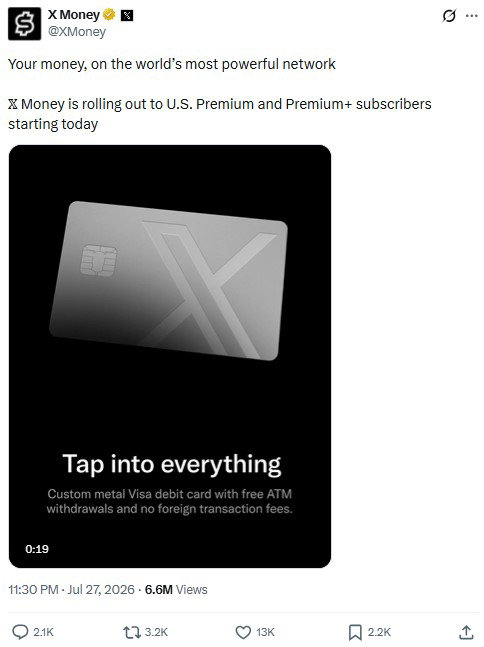
X says the service is rolling out to select users in the United States who are at least 18 years old. The official launch post says access is opening to X Premium and Premium+ subscribers, although access may not appear immediately.
Premium+ users qualify for the advertised 6.00% annual percentage yield. Premium users may receive the same boosted rate after meeting qualifying direct-deposit requirements. X states that the rate was accurate on July 27, 2026, and can change.
The launch is US-only. X has not announced a date for India or other markets. Its materials focus on dollar deposits, bank transfers, and card payments. They do not announce cryptocurrency trading or stablecoin support.
How Does The Elon Musk X Money Platform Work?
At launch, Elon Musk's new app offers payments through several connected features.
-
Users can send money instantly to other people on X. The company markets these transfers as free, turning a username into a payment address instead of requiring a separate wallet handle.
-
Direct deposit can deliver paychecks up to two days early. Users can also send wires, mail checks, and pay bills from the app. This moves X Money beyond casual reimbursements.
-
The X Money Card is a Visa debit card that can display the user's X username. It works wherever Visa is accepted, supports Apple Wallet, has no foreign transaction fees, and includes global ATM fee reimbursement within three calendar days.
-
Eligible card purchases earn 3% cashback. The word "eligible" matters because reward exclusions apply, so users should review the terms before treating every purchase as guaranteed to earn rewards.
-
X also advertises passkeys, adjustable transaction limits, privacy controls, and 24/7 support. These controls help social identity and financial activity coexist in one account.

How Do Cross River Bank And Visa Power X Payments Financial Services?
Cross River Bank is the regulated banking backbone behind the service. It holds the primary deposit accounts, connects X to banking rails, and supports the interest-bearing account and card infrastructure. Visa provides the card network and Visa Direct capabilities used for moving money.

This division matters because X does not need to become a bank to offer bank-like features. Cross River handles regulated infrastructure while X controls the consumer experience and access to its social network.
Deposits at Cross River are insured up to the standard $250,000 limit. X automatically enrolls deposits in a cash sweep program that can spread funds across participating banks and provide up to $10 million in aggregate pass-through Federal Deposit Insurance Corporation coverage. That coverage protects against the failure of participating banks, not X Payments itself, and applies only when program conditions are met.
What Are The Risks Of X Payments Financial Services?
The headline benefits come with fine print. The 6.00% APY is variable, and subscription eligibility affects who receives it. Cashback applies only to qualifying purchases. The $10 million insurance claim depends on a multi-bank sweep structure rather than one account receiving a larger standard FDIC guarantee.
Privacy is another concern because financial activity is being added to a platform that already processes social, device, location, and advertising data. X's privacy policy says it may receive transaction details such as timing and amounts and may share information with payment providers and fraud-detection services. Users should review privacy settings instead of assuming payment activity is isolated from the wider X ecosystem.
Account dependence also deserves attention. X says users suspended for Child Safety or Violent and Hateful Entities violations lose Money access and receive remaining funds by check. Other policy suspensions should not interrupt Money features. That link between a social account and a financial interface is unusual and worth understanding before using X Money as a primary account.
Cross River has also faced FDIC scrutiny, including a 2023 consent order concerning unsafe or unsound fair-lending compliance practices. The bank did not admit or deny the charges. This does not mean current deposits are uninsured, but it explains why regulators have asked questions about oversight, fraud controls, and consumer protection.
What Does Elon Musk's New Payment Platform Change?
X owner Elon Musk told employees in 2023, "If it involves money, it'll be on our platform." X Money now turns that line into a product by combining familiar financial tools with publishing, messaging, selling, subscriptions, and creator income.
That could reduce friction for tips, creator payouts, subscriptions, and peer-to-peer commerce. It could also deepen X's knowledge of user behavior and make trust more important than any cashback rate. The real test is not whether users order the metal card. It is whether they are comfortable making a social platform part of their financial routine.
Conclusion
X Money is the most concrete version yet of Musk's everything-app ambition. Its payments, advertised yield, cashback, and Visa card make a strong opening offer while Cross River supplies the regulated foundation.
Still, the product is a limited US rollout with variable benefits, privacy questions, and an unusually close link between social identity and money. X has built the Iron Man suit. Now it must prove people trust it with their wallet.
Frequently Asked Questions
Does Using The X Money Card Help Build Credit?
No. The X Money Card is a debit card, not a credit card. Since users spend money already held in their account rather than borrowing funds, normal card activity is not reported to credit bureaus and does not build a credit history.
Is The Interest Earned Through X Money Taxable?
Yes. Interest credited to a US bank account is generally considered taxable income. Users who receive at least $10 in interest would typically receive Form 1099-INT, although the income must still be reported even when no form is issued.
What Should Users Do If They Notice An Unauthorized X Money Transaction?
Users should report the transaction through X Money support immediately. Under US electronic transfer rules, reporting a lost card within two business days can limit liability, while unauthorized transactions shown on a statement should generally be reported within 60 days.
Wed, Jul 29, 2026

Enjoyed what you've read so far? Great news - there's more to explore!
Stay up to date with the latest news, a vast collection of tech articles including introductory guides, product reviews, trends and more, thought-provoking interviews, hottest AI blogs and entertaining tech memes.
Plus, get access to branded insights such as informative white papers, intriguing case studies, in-depth reports, enlightening videos and exciting events and webinars from industry-leading global brands.
Dive into TechDogs' treasure trove today and Know Your World of technology!
Disclaimer - Reference to any specific product, software or entity does not constitute an endorsement or recommendation by TechDogs nor should any data or content published be relied upon. The views expressed by TechDogs' members and guests are their own and their appearance on our site does not imply an endorsement of them or any entity they represent. Views and opinions expressed by TechDogs' Authors are those of the Authors and do not necessarily reflect the view of TechDogs or any of its officials. While we aim to provide valuable and helpful information, some content on TechDogs' site may not have been thoroughly reviewed for every detail or aspect. We encourage users to verify any information independently where necessary.
Loading comments...