
Marketing Solutions
Common Mistakes Marketers Make With AI (And How To Fix Them Fast)
Share
Overview
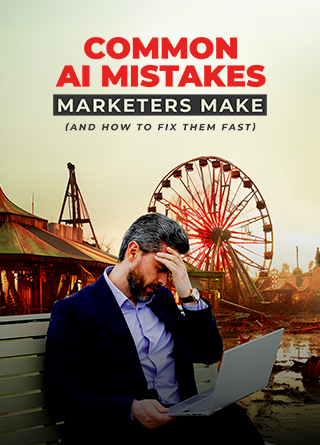
Just like this epic marketing flop, a single botched campaign leaves your audiences feeling duped and disconnected—almost as if you offered them a stale sandwich and overpriced ticket to the Fyre Festival.
Unfortunately, most marketers believe that AI tools are the answer to crafting successful marketing campaigns. They’re not entirely wrong, but before you let Skynet run your next campaign, understand this: overhyping or misunderstanding what AI can do is a recipe for disaster. Much like poor Fyre Festival attendees who fell for celebs overhyping the event without realizing what they were getting into!
So, strap in as we unpack eight common AI marketing mistakes and their fixes—so you never have to face a Fyre Festival-style faceplant. Dive in!
It’s 2025 and AI is part of every marketer’s toolkit (we hope!).
From generative AI and LLMs to predictive churn models, marketing seems to be AI-powered now. Yet Jasper’s The State of AI in Marketing 2025 revealed something shocking: while 63% of marketing teams now use generative AI, only 49% of teams actually measure its return on investment. A silver lining is that 22% of marketing teams plan to measure their AI marketing efforts in 2025.
Today, we see too many brands treat AI like a fast-food order: it delivers instant gratification, without any long-term nutrition. This leads to campaigns that underdeliver or, worse, erode consumer trust in the brand. After all, SurveyMonkey's State of Marketing 2025 found that 46% of consumers dislike AI-generated content, with 43% saying they’re less likely to purchase from such businesses.
The point is Artificial Intelligence can be an effective tool for marketers—if they know how to leverage it.
So, in this blog, we’ll spotlight the eight most common AI marketing mistakes and rapid-fire fixes that will help you right the ship. So, are you ready to give your marketing campaign an AI shine?
Let’s roll!
8 Common Mistakes Marketers Are Making With AI
While every professional is currently banking on AI tools to perform day-to-day tasks, marketers are leaning heavily on generative AI to craft social media content, automate marketing campaigns, deliver personalized responses and more.
Yet, they often end up making common mistakes, including:
Overestimating AI’s Superpowers
The Mistake
We won’t really blame marketers for this one, but the biggest mistake they make is assuming AI solutions are a magic genie that can replace strategy, effort, and creativity. When brands expect purely AI-generated campaigns to account for everything from audience insights and market trends to personalization and engagement without any human guidance, well, it often leads to disappointment.
The Fix
Marketers need a shift in mindset: treat AI as a high-octane car engine, not a whole car. What we mean is that you need to fuel it with human creativity, test drive it with iterative prompts and perform regular maintenance with strategic refinements. Although we have self-driving cars now, this is one car that needs humans in the driver’s seat to lead it to the right destination!
Jumping On The AI Bandwagon Without A Plan
The Mistake
“Our competitors are doing it, and so should we!” declares the CMO after reading the latest AI case study about a rival brand. However, if there’s no alignment with business goals, budget, or KPIs, it is never going to be a successful implementation. This “shotgun-wedding” approach also wastes marketing resources, leads to fragmented outputs, and demands re-training and upskilling of the marketing team.
The Fix
Before you open the gates for AI solutions, define your mission. Is it to boost conversions, slash churn rates, or boost engagement? Then, map each objective to specific AI tools (e.g., slash churn rates by using AI-powered personalization engines or boost engagement by deploying a 24x7 AI chatbot). Finally, remember to set a budget and milestone check-ins after onboarding a new AI tool.
Letting Dirty Data Drive The Ship
The Mistake
Guess we’ll go back to the car analogy. Feeding your AI models outdated, incomplete, or biased data is like trying to run a BMW on unrefined kerosene. Your AI tools will struggle to deliver value without clean, relevant data inputs—as the saying goes, garbage in, garbage out.
The Fix
Well, start by investing in data hygiene strategies and data cleansing tools. Next, audit your data sources, standardize their formats, and enrich data gaps by adding new sources. Lastly, implement a continuous validation pipeline to ensure AI-powered marketing outputs are informed by accurate and reliable information.
Ignoring Ethics And Transparency
The Mistake
This is a big one, folks. Marketers who blindly deploy AI (mistake #2) without ensuring the data sources are up to the mark (mistake #3) will often observe their AI churning out misleading claims. Apart from nonsensical outputs, ignoring ethical AI practices can erode trust and alienate consumers. Just ask Google about its “Dear Sydney” Olympic ad backlash!
The Fix
The best way to introduce artificial intelligence into marketing is by adopting an “AI-plus-human” strategy. Plus, ensure you label AI-generated content, images, and videos to promote transparent communications with customers, and disclose when AI chatbots are behind interactions. Finally, embed ethical guardrails to prevent bias and ensure fairness in existing and future AI deployments.
Neglecting Human Oversight
The Mistake
Another myth about AI in marketing is that it can run on autopilot. While AI automation can be a game-changer, letting chatbots call the shots is a perfect recipe for disaster. Without real-time human intervention, assessments, and oversight, things can go south quickly. You don’t want rogue chatbots and tone-deaf AI messaging to become the brand’s standard, right?
The Fix
Set up a “human-in-the-loop” review process for any task that relies on AI tools. From scheduling spot-checks and sentiment audits to deploying rapid feedback and edit loops, marketers must ensure they catch and correct misfires before they go live. Always remember: a human needs to be accountable for AI’s work output, and not the other way around!
Picking The Wrong AI Tools
The Mistake
Another common misstep is choosing an AI platform based on hype rather than fit—like buying the shiniest new sports car on the market without checking if it fits your driveway. Once you realize that the misaligned tool won’t integrate with your tech stack or solve your problems, you’ll realize your marketing strategy is back to square one–only now there’s a massive hole in your wallet.
The Fix
Before you finalize an AI tool to support your marketing initiatives, start by vetting vendors for your specific use case. Then, assess your priorities, such as integration requirements, data security, scalability, and support, to further narrow down the list. Lastly, take advantage of demos to run pilot tests and validate tool-wise performances before you lay the red carpet for a proper roll-out.
Focusing On Technology Over Value
The Mistake
Talking about picking the right tool, marketers often get dazzled by the fancy features of AI tools—deep learning this, generative that. All the while losing sight of what really matters: addressing customer pain points and enhancing productivity. It’s the equivalent of your local pizza delivery guy arriving in a brand-new Tesla: looks cool, doesn’t add any value!
The Fix
Let’s be honest, you’re probably adopting an AI tool to deliver better value to customers more effectively, right? So, start with them—map the customer journey and identify pain points ripe for AI intervention—for instance, churn prediction, dynamic content recommendation, or sentiment analysis. Only then should you layer in the complex features while keeping an eye on addressing the real needs.
Skipping ROI Measurement
The Mistake
Most marketers are guilty of celebrating vanity metrics—likes, impressions, and shares—while forgetting or ignoring to track revenue impact, cost savings, or KPIs for process improvements. As we mentioned earlier, as of March 2025, 51% of marketers aren’t even measuring the ROI of their AI deployments. If you’re not measuring, how are you prioritizing what needs to improve?
The Fix
Once you’ve made sure you’re not falling prey to the above missteps and have adopted a bang-for-your-buck cutting-edge AI tool, adopt hybrid ROI frameworks. That means you blend traditional financial KPIs (e.g., revenue uplift, cost reductions, etc.) for marketing with leading AI indicators (model accuracy, process cycle time, etc.). Plus, you should leverage multi-touch attribution and AI-powered analytics platforms across the customer journey to accurately correlate impact and contributions.
Well, those were the eight most common mistakes marketers make when adopting or deploying AI solutions. Knowing where you’re faltering will help you make the best out of your AI investments, while also boosting marketing outcomes. Even if you’re guilty of a few mistakes, don’t feel bad—at least you did not promote a fraudulent luxury music festival!
Conclusion
AI can make or break your marketing strategy, and to make sure it’s the former, audit yourself against these eight pillars: don’t overhype AI’s prowess; plan before you launch; clean your data; stay ethical and transparent; ensure human oversight; choose AI tools that align with your business; focus on customer problems and not features, and keep measuring ROI.
We assure you, if you keep these best practices in mind, you’ll turn those “uh-ohs” into “oh-yes” faster than an LLM can spit out a tailored subject line. So, go forth and make your marketing smarter—your customers (and CMO) will thank you!
Frequently Asked Questions
What Are The Biggest AI Marketing Mistakes Businesses Make In 2025?
In 2025, the most common AI marketing mistakes include overestimating AI’s capabilities, deploying tools without a clear strategy, using low-quality data, ignoring ethical considerations, removing human oversight, choosing the wrong AI platforms, focusing on technology instead of customer value, and failing to measure ROI.
How Can Marketers Ensure They’re Using The Right AI Tools?
Marketers should first align potential AI selections with specific business goals, such as boosting engagement or reducing churn. They must also assess compatibility with their existing tech stack, data security requirements, and scalability needs. Running pilots or taking vendor demos can help validate the tool’s performance before a full rollout, ensuring the investment delivers both strategic and operational value.
Why Is Measuring AI ROI Important In Marketing?
Measuring AI ROI is crucial because it helps marketers understand which tools and tactics are actually driving business results beyond vanity metrics. Without ROI tracking, marketers can't make data-driven improvements or justify continued investments. Blending financial KPIs with AI performance indicators provides a clearer picture of AI’s real impact across the customer journey and overall marketing strategy.
Thu, Jun 26, 2025

Liked what you read? That’s only the tip of the tech iceberg!
Explore our vast collection of tech articles including introductory guides, product reviews, trends and more, stay up to date with the latest news, relish thought-provoking interviews and the hottest AI blogs, and tickle your funny bone with hilarious tech memes!
Plus, get access to branded insights from industry-leading global brands through informative white papers, engaging case studies, in-depth reports, enlightening videos and exciting events and webinars.
Dive into TechDogs' treasure trove today and Know Your World of technology like never before!
Disclaimer - Reference to any specific product, software or entity does not constitute an endorsement or recommendation by TechDogs nor should any data or content published be relied upon. The views expressed by TechDogs' members and guests are their own and their appearance on our site does not imply an endorsement of them or any entity they represent. Views and opinions expressed by TechDogs' Authors are those of the Authors and do not necessarily reflect the view of TechDogs or any of its officials. While we aim to provide valuable and helpful information, some content on TechDogs' site may not have been thoroughly reviewed for every detail or aspect. We encourage users to verify any information independently where necessary.
Loading comments...