
Enterprise Solutions
Amazon's Project Rainier: Its Boldest AI Infra Move?
Share
Overview
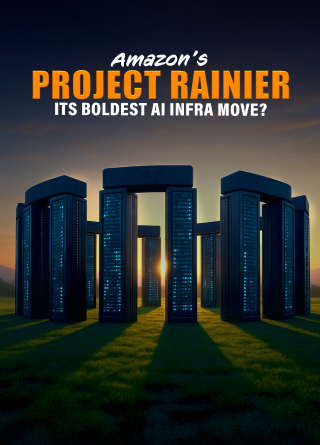
This popular prehistoric megalithic structure consists of two 13-foot-tall and 7-foot-wide rocks, each weighing around 25 tons, standing below a connecting horizontal stone called a lintel. Such structures are called “trilithons” or “triliths,” and for whatever reason humans constructed this structure, we may never know.
What we do know is that construction on Stonehenge commenced around 3100 BC and continued until about 1600 BC.
Its alignment towards the sunrise on the summer solstice and sunset on the winter solstice suggested deep astronomical or spiritual significance, and regardless of its intended purpose, it represents the strength, innovation, and craftsmanship of our ancestors.
That’s a characteristic that’s not lost on us even in modern times.
Humans are still obsessed with building structures that stand strong, infusing ingenuity, and conveying creativity, from smartphones to buildings, bridges to airplanes, libraries to data centers.
This is exactly what Amazon has aimed for with Project Rainier, its massive-scale AI compute, AKA supercomputer initiative. In fact, this project gets its moniker from Seattle’s Mount Rainier and is meant to represent “a project that similarly dwarfs any comparable endeavor.”
So, what is Amazon’s Project Rainier? Let’s explore!
-(1)-224.jpg.aspx "TechDogs-\"Amazon's Project Rainier: Its Boldest AI Infra Move?\"")
Big Tech has been buzzing about AI breakthroughs for some time. From AI chips to cloud services, companies are racing to grab the lead in building more intelligent and faster infrastructure for AI models.
Currently, Amazon is making waves with its bold new project Rainier.
This move isn’t just about keeping up with the competition but Amazon doubling down on what could shape the future of cloud-based AI infrastructure.
So, what exactly is Project Rainier, and why are experts calling it Amazon’s most serious play in the AI infrastructure game?
Let’s break it down.
What Is Project Rainier?
Amazon Web Services (AWS), Amazon's cloud subsidiary, has embarked on an innovative journey with Project Rainier, which represents a bold leap into next-generation AI infrastructure. This initiative is designed to deliver an extraordinarily powerful computing platform tailored for training large-scale AI models.

As per Amazon, Project Rainier is designed as a massive “EC2 UltraCluster of Trainium2 UltraServers.” EC2 or Amazon Elastic Compute Cloud is an AWS service that lets customers rent virtual computers in the cloud rather than buying and maintaining their own physical servers.
Drawing its name from the majestic Mount Rainier, the project embodies a spirit of ambition and magnitude. Rainier consists of an expansive, distributed AI compute cluster that integrates thousands of Trainium2 chips across multiple data centers in the United States.
This marks a major shift for Amazon as it aims to control the entire AI training process, from building its own custom chips to designing the data centers that run them.
This comprehensive approach not only promotes increased speed and efficiency but also enables the scaling of AI workloads to groundbreaking levels.
The strength of Rainier lies in how its architecture is built to scale AI workloads. What makes it so unique, you ask? Time to explore!
What Does Project Rainier's Architecture Consist Of?
What sets Rainier apart is not just its size, but its design principles. The system is built around several core innovations:
-
Trainium2 Chips
The Trainium2 chips, created by AWS’s Annapurna Labs, are made specifically for training machine learning models. Each chip can handle trillions of operations per second and is designed for fast, efficient AI tasks.
-
UltraServers
Each UltraServer has four physical servers, with 16 Trainium2 chips in each server, totaling 64 chips. These chips are linked together using NeuronLink, a fast communication system that helps reduce delays and improve performance.
-
UltraClusters
Thousands of UltraServers are linked together in data centers to create a huge cluster. They communicate with each other using Elastic Fabric Adapter (EFA) networking, which provides high speed and low delay, even over long distances.
-
Deployment Locations
One confirmed location is St. Joseph County, Indiana, where several data centers are being upgraded to support the Rainier infrastructure.

This vertically integrated architecture allows AWS to have complete control over all layers of the stack, ranging from silicon to network design to cloud services, enabling extensive optimization at every level.
Now, let’s look at its implications for AWS clients and businesses.
What Does It Mean For AWS Users?
Project Rainier’s impact on AWS customers is substantial. Whether you're a startup experimenting with AI or an enterprise deploying production models, the benefits include:
-
Faster Training
Anthropic, an AI safety and research company, is using Project Rainier for a new compute cluster with five times more computing power than its previous setup, helping it build and train future versions of Claude language model significantly faster.
-
Cost Efficiency
By using specialized hardware and reducing reliance on third-party GPUs, Project Rainier delivers more cost-effective solutions for intensive AI workloads.
-
Service Integration
Rainier is built to work seamlessly with core AWS services such as Amazon SageMaker, Amazon Bedrock, and Amazon Titan. This tight integration gives AI developers more flexibility and easier deployment, accelerating innovation.
-
Enterprise-grade Scalability
Rainier’s architecture supports the training of complex, large-scale AI models, offering customers infrastructure that rivals the internal systems of top-tier AI firms.

It's time to explore the efficiency and sustainability highlights of Project Rainier. Dive in!
What Makes Rainier So Efficient And Sustainable?
Project Rainier highlights Amazon's dedication to sustainability and energy efficiency in designing data centers.
-
Energy
AWS uses entirely renewable energy for its operations with Amazon investing in nuclear power, battery storage, and solar projects for future growth.
-
Cooling Systems
Rainier’s data centers in Indiana use outside air for cooling most of the year, greatly reducing water use. In fact, during cooler months, they don't use any water or cooling at all.
-
Water Efficiency
AWS data centers achieve a water usage rate of 0.15 liters per kilowatt-hour, more than twice as efficient as the industry average and represents a 40% improvement from 2021.
-
Design Innovation
New data center components for Project Rainier reduce mechanical energy consumption by up to 46% and lower the embodied carbon in concrete by 35%.
Now,, let’s take a look if Amazon is ready to challenge its AI rivals NVIDIA and Google with Project Rainier. Dive in!
Is Amazon Ready To Compete With NVIDIA And Google?
Nvidia leads in AI hardware, providing GPUs for most major AI models, while Google has a strong position with its custom TPUs and AI tools. However, Amazon Web Services is taking a different approach.
By using its vast cloud platform, custom chips, and complete control over its infrastructure, AWS aims to support and scale next-gen AI workloads.
With a large customer base and experience in chip deployment (such as Inferentia and Trainium), AWS is well-prepared for large-scale operations. Project Rainier enhances this competitive advantage even further.

Now that we’ve explored the details, let’s wrap it up!
Final Thoughts
Project Rainier is an important step for AWS in the AI race. It shows that massive tech companies are not just using ready-made tools anymore; they’re creating their own systems to support their AI innovation goals.
With Trainium2-powered UltraClusters, enhanced networking, and energy-saving data centers, AWS is moving from being a leading cloud provider to becoming a key part of the AI landscape.
For businesses and developers, Project Rainier provides easy access to powerful and affordable AI training tools, helping spark innovation in various industries. Whether this bold AI move will pay off remains to be seen, but surely it will endure in history the same way Stonehenge did.
Frequently Asked Questions
What Is Amazon’s Project Rainier?
Project Rainier is AWS’s next-gen AI infrastructure project, designed to deliver high-performance compute power using custom Trainium2 chips and UltraClusters for training large AI models efficiently and sustainably.
How Does Project Rainier Benefit AWS Users?
Rainier offers faster model training, reduced costs through custom silicon, seamless integration with AWS services like SageMaker and Bedrock, and scalable infrastructure for enterprise-grade AI workloads.
How Is Project Rainier Sustainable?
Rainier’s data centers use renewable energy, advanced cooling systems that minimize water usage, and eco-friendly building materials—making it more energy and water efficient than industry standards.
Mon, Aug 11, 2025

Enjoyed what you've read so far? Great news - there's more to explore!
Stay up to date with the latest news, a vast collection of tech articles including introductory guides, product reviews, trends and more, thought-provoking interviews, hottest AI blogs and entertaining tech memes.
Plus, get access to branded insights such as informative white papers, intriguing case studies, in-depth reports, enlightening videos and exciting events and webinars from industry-leading global brands.
Dive into TechDogs' treasure trove today and Know Your World of technology!
Disclaimer - Reference to any specific product, software or entity does not constitute an endorsement or recommendation by TechDogs nor should any data or content published be relied upon. The views expressed by TechDogs' members and guests are their own and their appearance on our site does not imply an endorsement of them or any entity they represent. Views and opinions expressed by TechDogs' Authors are those of the Authors and do not necessarily reflect the view of TechDogs or any of its officials. While we aim to provide valuable and helpful information, some content on TechDogs' site may not have been thoroughly reviewed for every detail or aspect. We encourage users to verify any information independently where necessary.
Loading comments...