
Artificial Intelligence
5 Use Cases Of Google's Nano Banana Image Editing AI Model
Share
Overview
That would be awesome, right?
Well, that’s the visual dream Barbie sold us in 2023 with saturated hues, flawless costumes, hyper‑real textures, and the magic of design that always feels intentional.
From Jacqueline Durran’s hot pink Barbie inspiration and vintage Chanel touches to vs. the gritty colors of the real world, the film offered a striking contrast. It taught us a lesson: aesthetics aren’t just decoration—they tell stories.
So, welcome Google’s Nano Banana—an AI image editing model that promises to let you be the director of your own visuals, costumes and world, so you can tell your own stories.
Whether you want Barbie’s flawless pink lighting, dramatic outfit swaps, or character consistency across edits, Nano Banana gives you a level of control that feels like stepping inside the surreal Barbie Land (or [your name] Land!).
So, let’s take a closer look at how this image editing AI model by Google is redefining image editing. Dive in!
It’s almost the end of 2025 and nearly 58% of users are turning to AI-powered tools to edit photos. Not just for fun but to save time, maintain consistency, and explore entirely new styles.
On social media alone, half of all users admit to tweaking images before hitting “post,” while in the U.S., 58% of smartphone owners regularly use AI editing apps to refine everything from lighting to outfits as per Pincel AI Survey 2023.
After all, visual storytelling has become more effective than ever, and the tools we use are evolving faster than ever!
Right now, Google’s Nano Banana is at the forefront of this trend.
So, What Is Google’s Nano Banana?
It’s an advanced AI model that doesn’t just generate images—it intelligently edits them. Whether you want to swap an outfit without touching your face, add a product to a real-life photo with natural shadows, or create multiple poses with the same expression. Well, Nano Banana can do it in seconds!
Instead of replacing an image entirely, it understands what’s already there: the face, the background, the objects in the frame, allowing it to swap outfits, change lighting, or blend two pictures—all while keeping the subject’s identity intact.
Built on the Gemini 2.5 Flash backbone, it delivers ultra-fast, highly contextual, and photorealistic edits using just image prompts and short instructions. It works through natural prompts as well, so you can upload a photo, type what you want changed, and Nano Banana delivers edits almost instantly!
Since its launch in mid 2025, the tool has powered millions of edits globally, making it one of Google’s fastest-adopted creative AI models.
In the sections ahead, we’ll explore 5 use cases where Nano Banana is flipping the script on what image editing can do.
Use Case 1: Virtual Try‑Ons And Fashion Visualization
Try imagining your online shopping cart with a personalized mirror. That’s exactly what Nano Banana brings to the table, transforming static clothing product photos into immersive virtual try-on experiences.
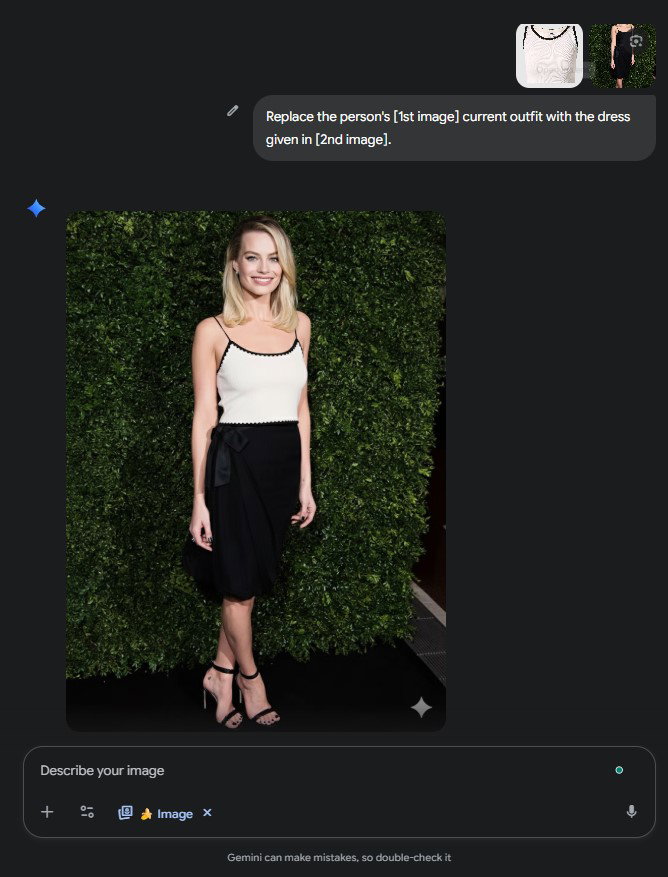
According to a 2025 Statista report, 68% of consumers say they are more likely to buy apparel online if a virtual try-on tool is available, and 40% of Gen Z users prefer brands that offer image-based personalization during the purchase journey. That’s a massive opportunity for fashion retailers and marketplaces!
Nano Banana’s standout ability is its character-consistent editing—meaning the AI can swap outfits, poses, or accessories in a user’s uploaded photo without warping the face or surroundings.
Whether you're testing how a leather jacket looks on you or previewing a festive saree for a traditional event, it maintains realism while enabling experimentation.
Use Case 2: Interior Furniture Design
Interior design is no longer just a field for architects and decorators—it’s now in the hands of AI models that understand visual context better than ever. Google’s Nano Banana offers the ability to modify room layouts, insert furniture, and redesign entire spaces by editing existing photos with uncanny precision.
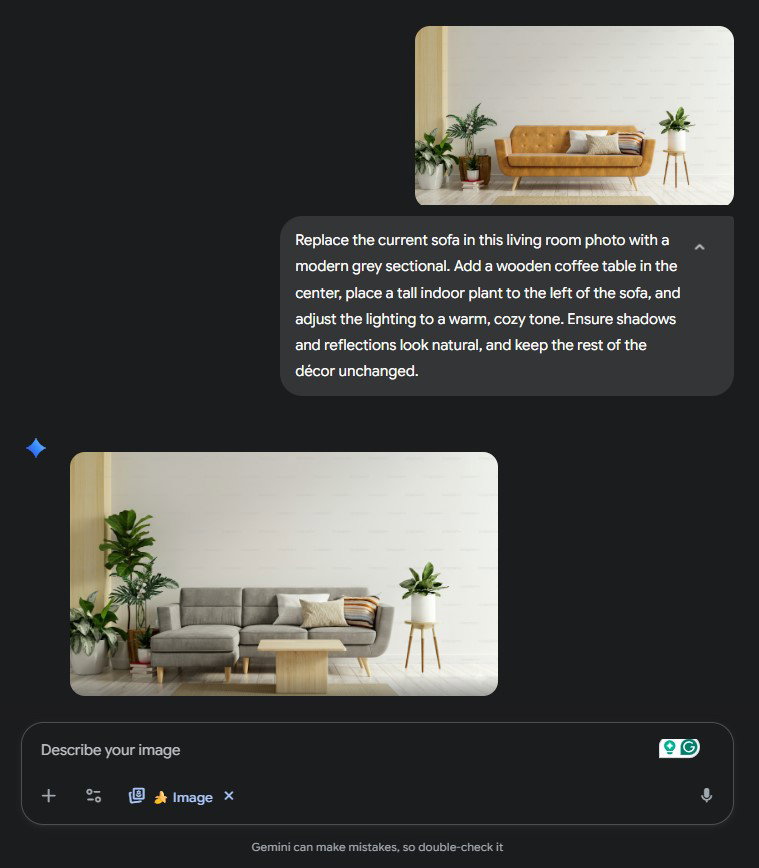
According to a 2024 Houzz survey, 75% of homeowners said that seeing visual renderings before a purchase significantly influenced their decision to buy furniture or décor. Meanwhile, a survey by Modsy found that nearly 70% of users abandoned online cart purchases because they couldn’t visualize the product in their space.
That’s where Nano Banana stands out. Whether it’s swapping out sofas, testing new lighting, or blending a product photo seamlessly into an interior shot, the model can intelligently handle shadowing, angles, and even texture matching.
It’s a game-changer for real estate agents, interior designers, and e-commerce furniture brands, allowing them to showcase possibilities without staging a single piece of furniture in real life.
Use Case 3: Social Media Content Creation
In 2025, roughly 5.45 billion people—or roughly 67% of the world’s population—are active on social media platforms, spending on average 2 hours 24 minutes per day consuming content, according to Sonary.
It seems like most users don’t just want to scroll and consume content but want visuals that stop them in their tracks. That’s creating a gold rush for brands, creators, and marketers.
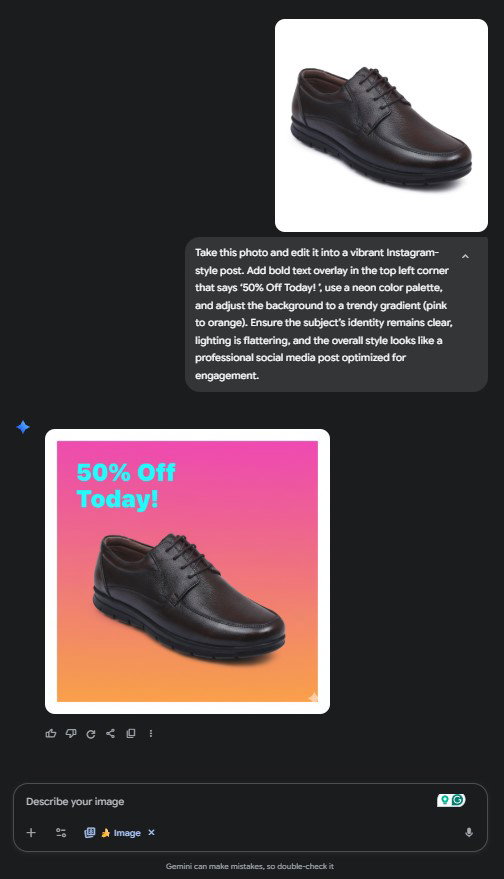
Nano Banana can be a secret weapon here, because it allows you to edit images with consistency and creativity—from swapping outfits to changing the lighting. You can also produce high‑quality visuals suited for Instagram carousels, Reels thumbnails, TikTok content, or YouTube banners without hiring a designer for every task.
With Nano Banana, the workflow is streamlined: less time on formatting, touching up, and consistency checks; more time for creating. For social media creators and brands, it turns “post‑ready visuals” from a tedious bottleneck into a scalable advantage.
Use Case 4: Artistic Style Transfer And Creative Experimentation
If you’re an artist or creator looking to push boundaries, Nano Banana offers way more than just fixed‑edits. It lets you experiment with styles in completely new ways. Whether you want your photo to echo the brush strokes of Impressionism, the bold geometry of Cubism, or the neon pop vibes of synthwave, style transfer powered by Nano Banana makes that possible—while retaining your subject’s identity.
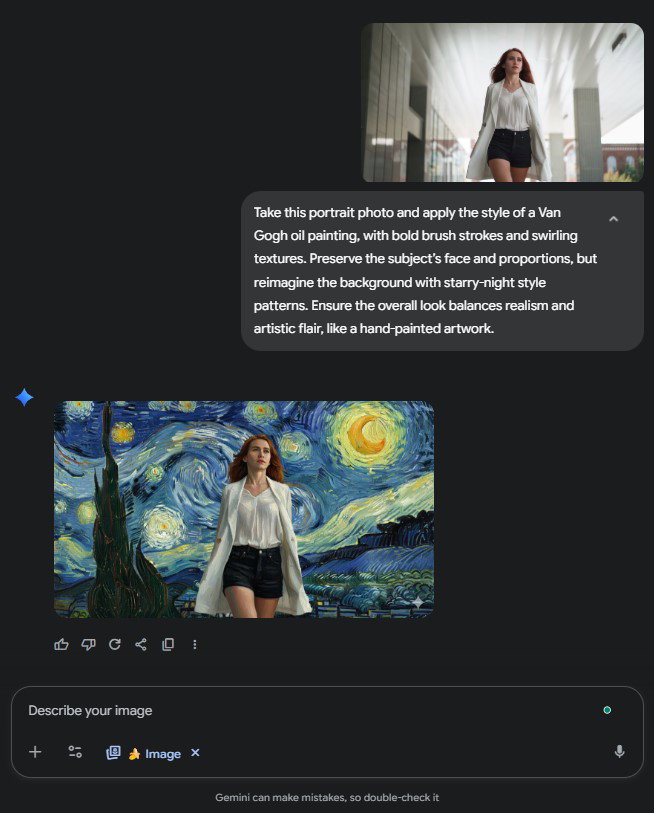
Recent studies by Artsmart show that about 29% of digital artists are already using AI in their creative process. Also, nearly 35% of surveyed artists say they employ text‑to‑image or style transfer tools specifically to explore new ideas or rough sketches. In addition, research into neural style transfer has advanced to the point where mobile devices can now process high fidelity style effects in real time without cloud servers—a big win for creators who want spontaneous, on‑the‑go experimentation.
You see, Nano Banana’s ability to preserve content (faces, lighting, angles) while applying style transformations makes it ideal for concept art, mood boards, album covers or even crafting visual narratives.
You no longer need to settle for flat filters; you get control, creativity, and style coherence in one tool, opening artistic paths previously accessible only to those with design skills or expensive software.
Use Case 5: Maintaining Character Consistency And Crafting Visual Stories
When you tell a story visually—whether for a brand, comic, or marketing campaign—consistency in how your characters look matters more than the pose, lighting, or expression.
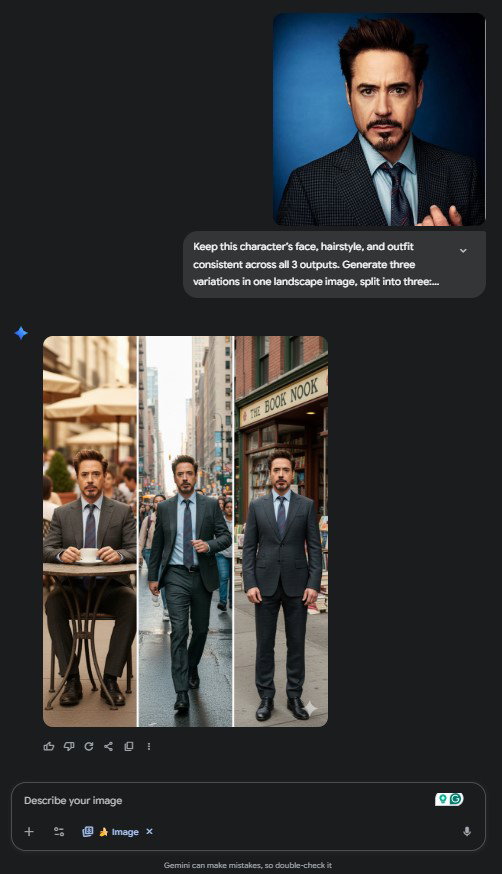
According to IPA’s 2024 study, campaigns from the most consistent brands generate 27% more Very Large Brand Effects, that is significant positive business outcomes, including enhanced awareness, stronger differentiation, and greater resonance with audiences.
Further, Lucidpress found that brand consistency across visuals and messaging can boost revenue by 10‑20%, and that inconsistent brands often spend significantly more on media just to achieve the same level of growth.
Nano Banana’s strength here is that it can preserve the “identity” of a subject across multiple edited images. Want your mascot or spokesperson to appear in a campaign with different backdrops and outfits, but still look recognizable? Nano Banana can do that. This makes it especially powerful for serialized branding, comic strips, visual storytelling on social media, or any scenario where continuity enhances trust and emotional connection.
When your audience sees the same character through multiple frames, with familiar visual cues—even as the scene or surroundings change—it builds recognition, and recognition turns into loyalty.
Bonus Nano Banana Use Cases
Beyond the big five, Nano Banana has a few niche, but high-impact applications:
-
Product Carousels For Online Stores
Online retailers can now create dynamic carousels where the same product is shown in multiple contexts without setting up extra shoots.
Prompt Used Above: ” Take this product photo of a handbag and generate three carousel variations in a single landscape image split into 3: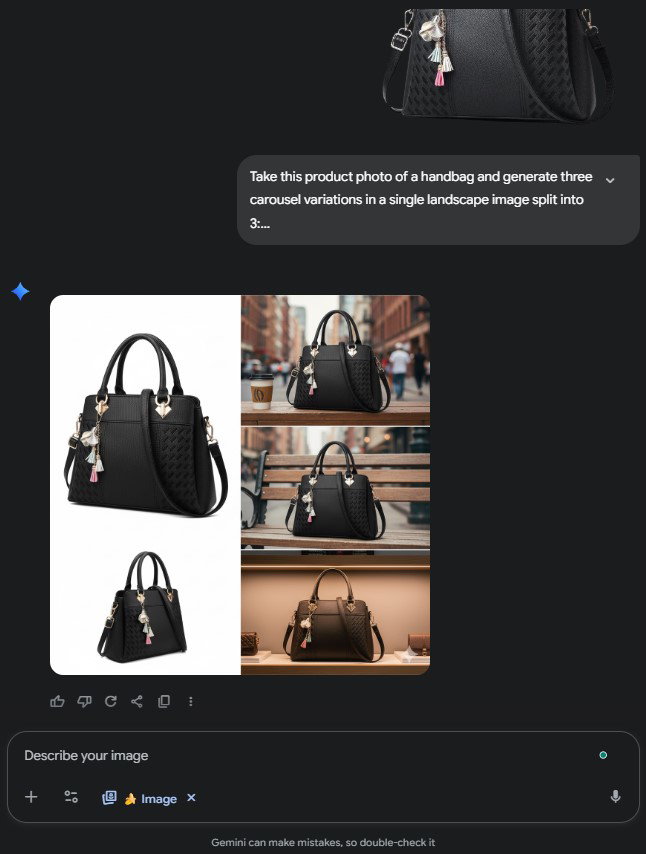
- On a clean white studio background,
- Styled in a lifestyle setting (urban street),
- Displayed in a modern retail shelf environment.
Maintain consistent product dimensions and details across all edits. Ensure lighting and shadows are natural to each setting and preserve brand logo clarity.”
With E-commerce conversion rates rising when product visuals are diversified, this is a cost-saver and sales booster.
-
Headshots And Profile Photos
Professional portraits are often expensive or time-consuming to arrange. Nano Banana can adjust lighting, backgrounds, and attire while keeping facial features intact, making it ideal for LinkedIn, resumes, and corporate branding.
Prompt Used Above: ”Take this portrait photo and edit it into a professional headshot suitable for LinkedIn. Keep the subject’s face, hairstyle, and expression unchanged. Replace the background with a clean gradient (light grey or soft blue), adjust lighting for even tone, and enhance sharpness for a polished look. Ensure the attire appears formal (dark blazer over a light shirt), while maintaining natural proportions and realism.”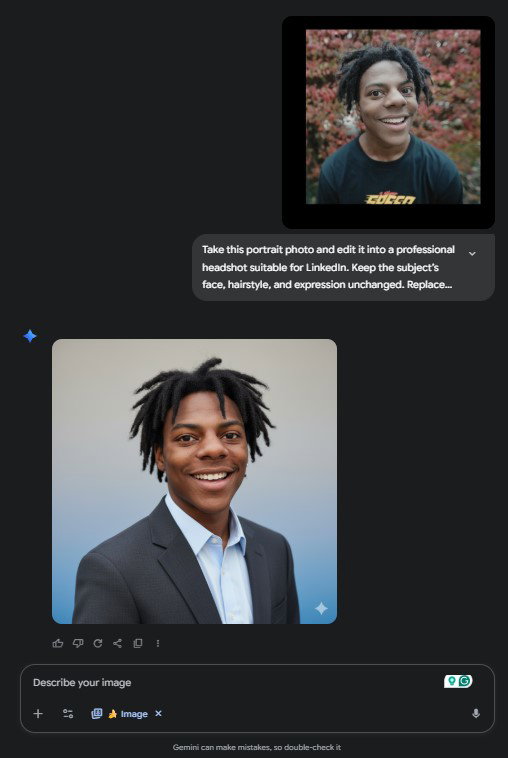
A LinkedIn study shows that profiles with professional headshots receive 14x more views than those without.
Limitations Of Nano Banana
As promising as Nano Banana is, it comes with certain limitations like:
-
Editing Failures
Complex edits sometimes distort backgrounds or erase subtle details, especially with overlapping elements.
-
Ethical Concerns
From privacy violations to potential misuse in deepfakes, AI editing tools face scrutiny. Google is addressing this with SynthID watermarking, but vigilance is key.
-
Device Constraints
Latency and resolution limits may hinder complex edits on lower-end devices, keeping the best results tied to higher-spec hardware.
Conclusion
Google’s Nano Banana is still evolving, but its direction is clear. With upcoming support for video-based editing, fine-tuned object control, and prompt chaining, the model could soon enable full-blown storytelling in motion, not just in stills.
It isn’t just another horse in the AI race—it’s redefining how we think about editing visuals. From powering e-commerce with virtual try-ons to transforming interior design and amplifying social media creativity, its potential is vast.
We bet you want to try it yourself? So, navigate to the Gemini app, upload an image, and experiment with simple edits to see how naturally it integrates into your workflow.
The question now is: how will you use it to tell your story?
Frequently Asked Questions
How Do I Access Nano Banana—And Is It Free?
You can use Nano Banana in the Gemini app, Google AI Studio/Gemini API, and Vertex AI. AI Studio is free for testing; the paid Gemini API tier offers higher limits and different data handling. Availability generally follows Gemini’s country rollout and local AI regulations.
Are Nano Banana Edits Watermarked And Safe To Use?
Yes. Images created/edited in Gemini’s Nano Banana include a visible watermark and an invisible SynthID watermark for provenance. Google documents additional safety measures (filtering, red-teaming), but press and experts still advise caution with personal photos—as watermark verification isn’t broadly available to the public yet.
Can Nano Banana Keep My Subject Consistent Or Combine Multiple Images?
Yes. Gemini 2.5 Flash Image (Nano Banana) supports multi-image fusion, style application across images, and identity-preserving edits—useful for brand assets and sequential storytelling. Google’s docs and model page highlight placing the same character in new scenes and fusing products into photorealistic settings with one prompt.
Thu, Sep 25, 2025

Enjoyed what you read? Great news – there’s a lot more to explore!
Dive into our content repository of the latest tech news, a diverse range of articles spanning introductory guides, product reviews, trends and more, along with engaging interviews, up-to-date AI blogs and hilarious tech memes!
Also explore our collection of branded insights via informative white papers, enlightening case studies, in-depth reports, educational videos and exciting events and webinars from leading global brands.
Head to the TechDogs homepage to Know Your World of technology today!
Disclaimer - Reference to any specific product, software or entity does not constitute an endorsement or recommendation by TechDogs nor should any data or content published be relied upon. The views expressed by TechDogs' members and guests are their own and their appearance on our site does not imply an endorsement of them or any entity they represent. Views and opinions expressed by TechDogs' Authors are those of the Authors and do not necessarily reflect the view of TechDogs or any of its officials. While we aim to provide valuable and helpful information, some content on TechDogs' site may not have been thoroughly reviewed for every detail or aspect. We encourage users to verify any information independently where necessary.
Loading comments...