

Business Intelligence
Top 5 Business Intelligence Software Of 2026
Share
Overview
Business Intelligence tools empower organizations to transform complex data into actionable insights for smarter, faster, and more competitive decision-making.
-
Microsoft Power BI: Offers exceptional value through its deep integration with the Microsoft 365 ecosystem and Al-powered Copilot features.
-
Qlik Sense: Uses an associative data engine to let users explore complex relationships across datasets without being restricted by predefined hierarchies.
-
Tableau rovides an industry-leading user experience with intuitive drag-and-drop visualization tools that turn data into compelling, narrative-driven stories.
-
Amazon QuickSight delivers a serverless, highly scalable platform with a unique pay-per-session pricing model designed specifically for cloud-first organizations.
-
Zoho Analytics focuses on customization and affordability, featuring the Zia Al assistant to help small and mid-sized businesses generate automated insights.

Introduction
Have you ever seen the 2015 drama-comedy The Intern? It features Robert De Niro as Ben Whittaker, a seasoned professional who becomes the unlikely backbone for a stressed CEO played by Anne Hathaway. Just as Ben used his years of experience to help Jules navigate the complex hurdles of her rapidly growing e-commerce empire, every modern business leader needs a reliable guide.
While Anne Hathaway seems to be aging in reverse, your business data doesn’t have that luxury and requires immediate, expert attention to stay relevant. Business Intelligence software acts as your digital "Ben," working magic with raw numbers to provide the perspective you need to grow. A successful company requires more than just talent; it needs a team capable of making the right calls at the exact right moment. By gathering and visualizing data, these tools identify hidden trends and optimize processes to keep you ahead of the competition. Here are the Top Five Business Intelligence Software Solutions for 2026 to help you make smarter data-driven choices.
What Is Business Intelligence Software?
Business Intelligence (BI) Software solutions help organizations gather, analyze, and visualize data to make more informed decisions. The software integrates components such as data mining, business analytics, and data visualization to audit and present a company's performance comprehensively. This helps businesses identify trends, optimize processes, identify areas of improvement, and respond effectively to market shifts.
Fun Fact: The term 'Business Intelligence' was coined in 1989, but its roots trace back to the 1960s!
This blog lists an updated lineup of leading BI software for 2026. While a few familiar names still hold their ground, some exciting new players have joined the mix.
Ready to level up your business? Let's see some of the best Business Intelligence Software for 2026 that will supercharge your insights and help you make smarter, data-driven decisions for your business.
Let's get started!
Top 5 Business Intelligence Software Of 2026
Here are some of the best BI software tools of 2026, each offering unique benefits. We've listed them in (no particular order!) to help you explore the best fit for your needs.
 |
 |
 |
 |
 |
Microsoft Power BI: Best Value
The Microsoft Power BI platform continues to retain its place among the top business intelligence solutions in 2026, helping businesses transform raw data into actionable insights at a scale. Recognized as a Leader by Gartner Inc. in the Magic Quadrant for Analytics & BI Platforms in 2025 for its execution and vision, the broader Power Platform and Fabric ecosystem supports thousands of organizations across 200+ countries.
Why We Choose Microsoft Power BI In 2026
Power BI stands out in 2026 for its seamless integration with the Microsoft 365 and Azure ecosystems, its rapid innovation cadence (including AI-powered features such as Copilot), and its cost-effective licensing. The platform also offers strong semantic modelling, extensive visualization options, and a huge partner community, making it accessible for both self-service and enterprise-grade deployments. This gives Power BI a strong advantage over many competitors.
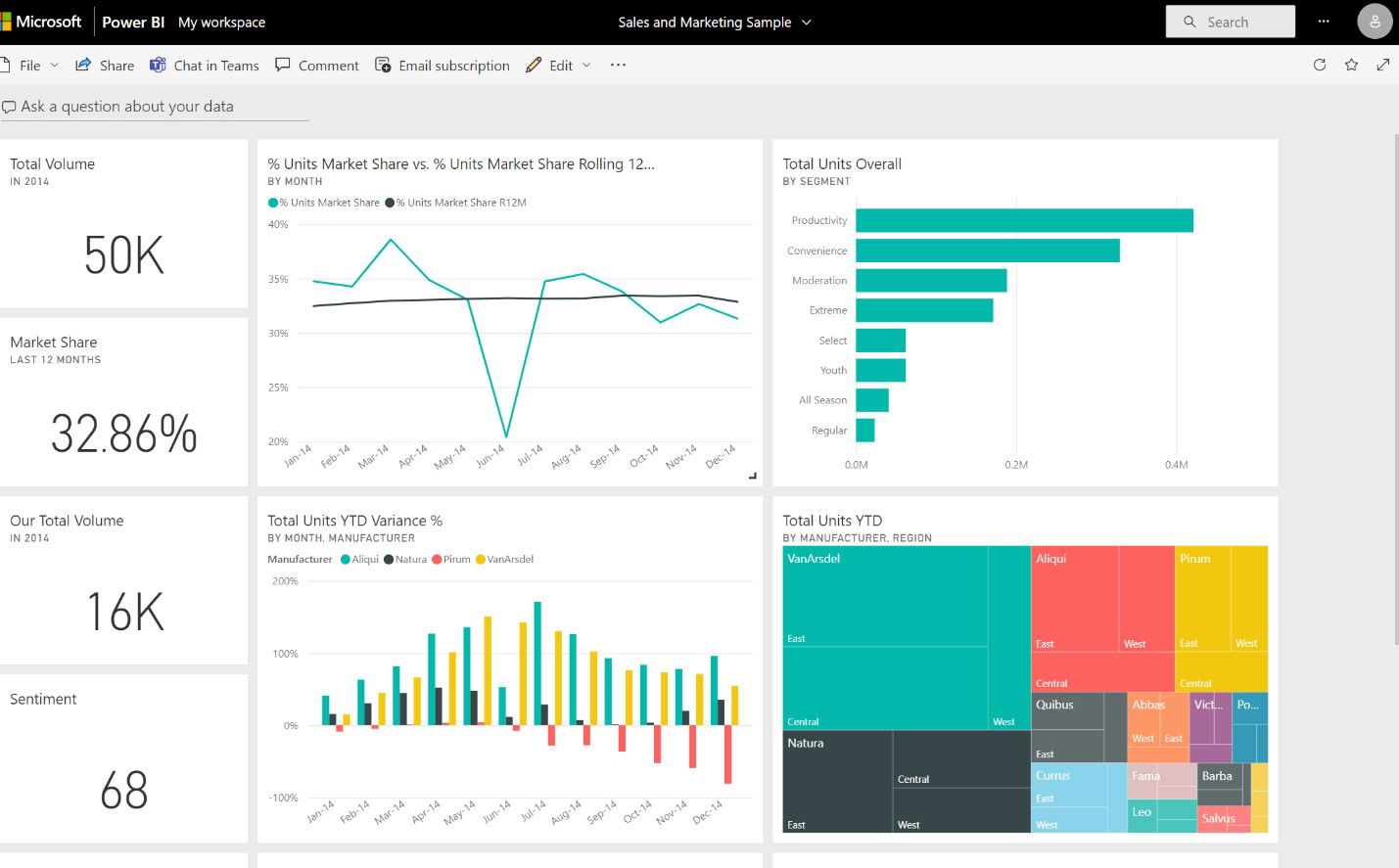
In practical terms, Power BI offers features such as live data connectivity, composite models, Direct Lake architecture, and embedded analytics via the Fabric platform. From a security and compliance viewpoint, it supports SOC 2 and ISO/IEC 27001 certifications. It offers encryption at rest and in transit, along with GDPR and HIPAA compliance options for eligible plans. This means organizations scaling up across departments and geographies can rely on Power BI’s governance, scalability and integration capabilities for 2026 and beyond.
Pricing
Power BI pricing starts with a free tier, with Power BI Pro at approximately $14/user/month and Premium at roughly $24/user/month. Free trials are also available.
What Works And What Doesn’t
| Pros | Cons |
| Excellent value relative to features and strong enterprise capabilities | Comes with a steep learning curve for non-technical users. |
| Deep integration with Microsoft 365 and Azure partner ecosystems | Cross-platform or non-Microsoft environments may see less synergy |
| Robust governance, security, and data-sharing capabilities for wide-scale deployment | May require careful tuning and architectural oversight for complex enterprise setups |
Our Final Take
Microsoft Power BI is best suited for organizations already invested in the Microsoft ecosystem that are seeking a scalable, secure, well-integrated BI solution with a strong roadmap for AI-infused analytics. It may be less ideal for firms whose data stack is predominantly non-Microsoft or who need ultra-lightweight tools with very minimal setup. For companies seeking enterprise-grade features at a reasonable cost and continuous analytics innovation, Power BI remains a compelling choice in 2026.
Qlik Sense: Best For Integration
Qlik Sense, developed by Qlik, joins our 2026 list as a standout new entrant, unifying data integration and analytics on a single cloud-native platform. It was named a Leader in the Gartner Magic Quadrant for Analytics and Business Intelligence Platforms and also recognized as a 2025 Data Quadrant Champion by InfoTech Research Group. Qlik serves over 40,000 customers across 100+ countries, powering decision-making in industries from healthcare to finance.
Why We Chose Qlik Sense In 2026
Qlik Sense excels through its associative data engine, which allows users to explore relationships across datasets without predefined queries. Its AI-driven insight suggestions and data integration fabric combine analytics with real-time data pipelines, setting it apart from traditional BI tools that separate ETL from visualization. Its open API architecture and robust partner ecosystem reinforce scalability and adaptability across diverse enterprise landscapes.
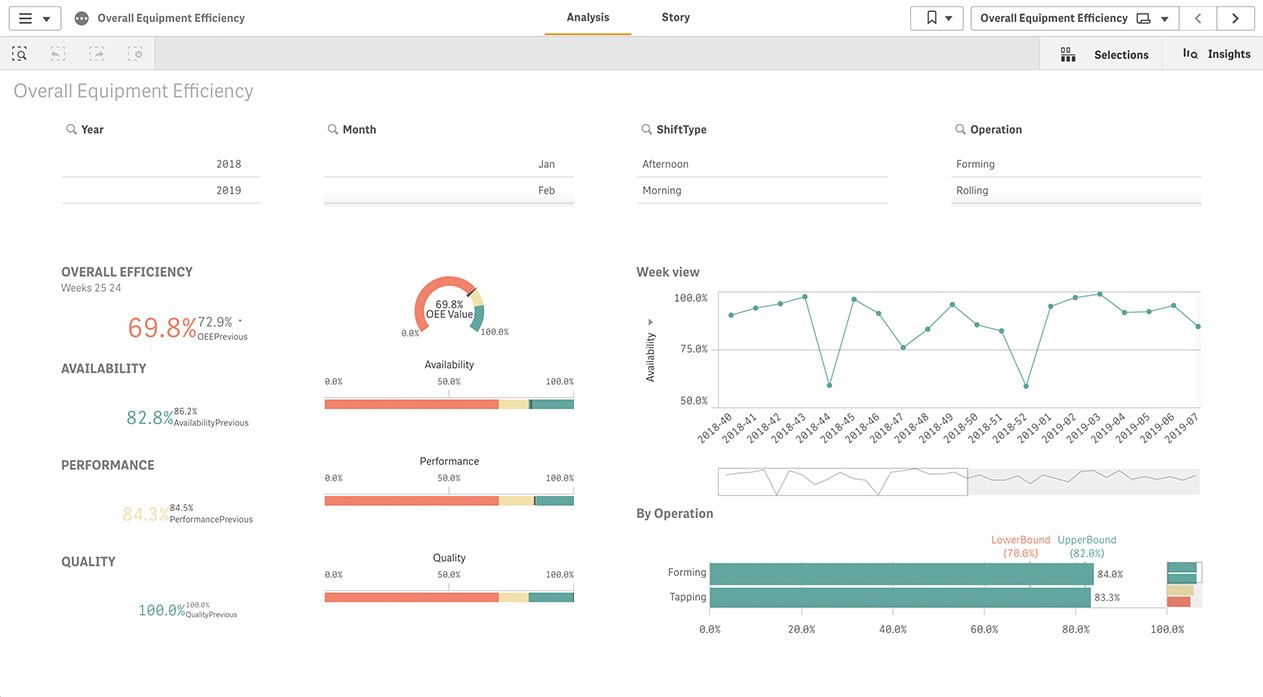
Qlik Sense supports governed self-service analytics, real-time data streaming via Qlik Data Integration, and embedded analytics for developers. From a security perspective, the platform provides role-based data access control, audit trails, and encryption both at rest and in transit, aligning with ISO 27001 and GDPR compliance principles. Its hybrid, multi-cloud deployment model makes it particularly attractive to organizations pursuing flexible analytics architectures.
Pricing
Qlik Sense offers four pricing tiers billed annually to suit different data and analytics needs. The Starter plan costs $200 per month for up to 10 users and includes 25 GB of data. The Standard plan is priced at $825 per month for 25 GB, with the option to expand storage in 25 GB increments. The Premium plan, at $2,750 per month, includes 50 GB of data along with predictive analytics and advanced AI capabilities. For large-scale deployments, the Enterprise plan is quote-based, starting at 250 GB and supporting multi-region environments. All plans include AI-powered analytics, access to 100+ data connectors, and flexible deployment through Qlik Cloud..
What Works And What Doesn’t
| Pros | Cons |
| Intuitive, context-rich data exploration without predefined hierarchies | Requires expert configuration and resource investment for implementation |
| Supports hybrid and multi-cloud environments with flexible deployment | Not so transparent pricing policies |
| Strong AI-powered insights and governed self-service capabilities | Smaller user communities in certain regions |
Our Final Take
Qlik Sense is best suited for enterprises seeking a unified data visualization tool with strong governance and AI-driven exploration. It may be less ideal for data teams seeking minimal setup or the simplest interface. For organizations emphasizing real-time insights and data flexibility, Qlik Sense delivers an intelligent, future-ready BI experience in 2026.Tableau: Best User Experience (UX)
Tableau (developed by Tableau Software, a subsidiary of Salesforce) continues to secure its place in our 2026 lineup, helping organizations turn data into vivid stories and actionable insights. In 2025, Tableau was named a Leader in the Gartner Magic Quadrant for Analytics & BI Platforms and a Leader in the Forrester Wave™: Business Intelligence Platforms Q2 2025. The platform boasts over 100,000 customer accounts worldwide and is used across 135+ countries, highlighting its global reach.
Why We Choose Tableau In 2026
Tableau’s standout strengths in 2026 lie in its best-in-class visualization capabilities, intuitive drag-and-drop interface, and strong community ecosystem. It allows users to explore data visually without extensive coding, and its Salesforce integration adds value for CRM-centric organizations. These features position it uniquely for teams prioritizing exploration and story-driven analytics in data pipelines.
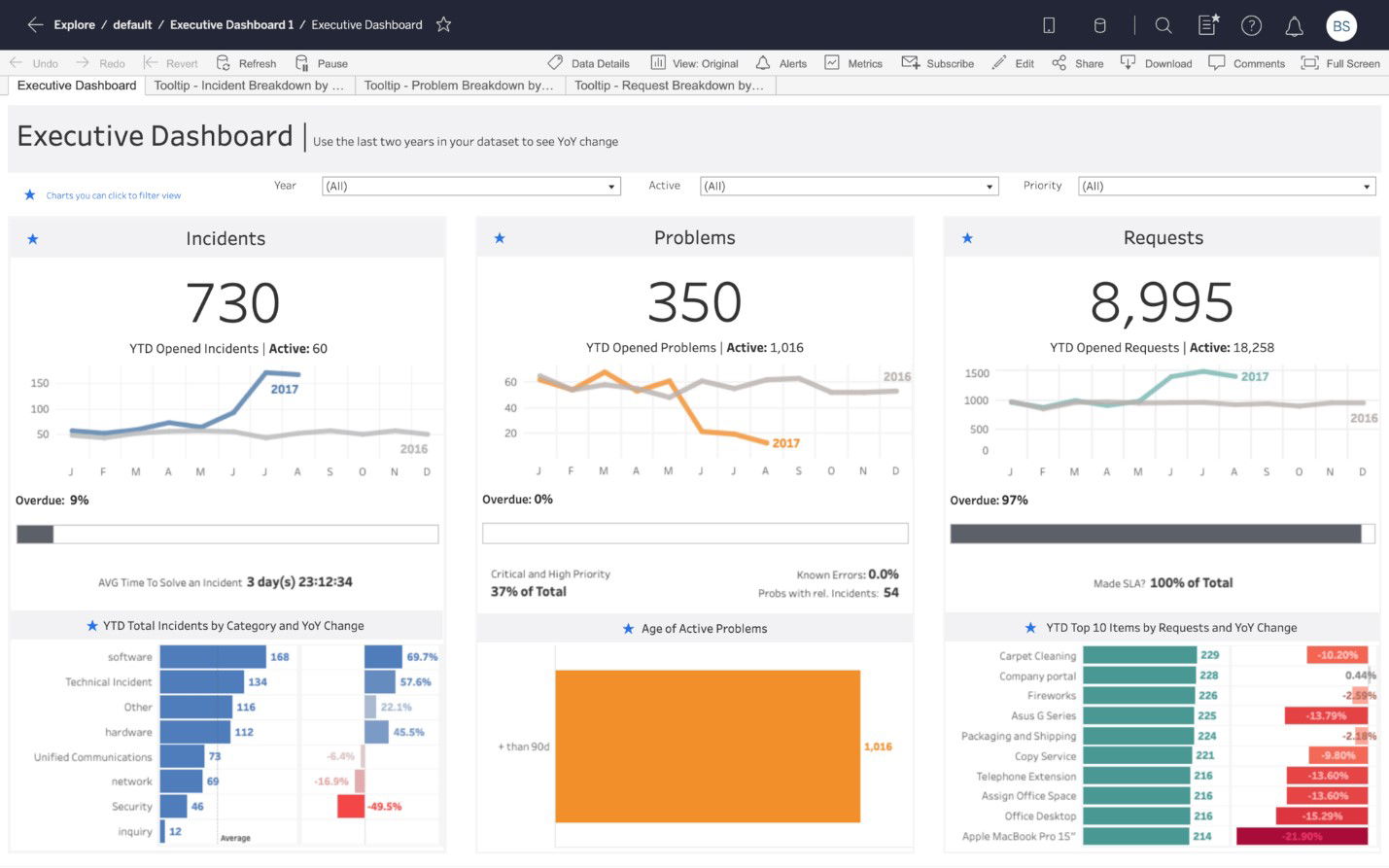
Tableau also supports self-service analytics, governed enterprise deployments, and embedded analytics within applications. Its security and compliance suite includes encryption in transit, role-based access control, and GDPR compliance for eligible clients. Scalability is proven through large-scale deployments across sectors, including finance, retail, and the public sector, making it suitable for both departmental and enterprise-wide rollouts.
Pricing
Tableau offers a flexible pricing structure across its subscription tiers. Pricing starts with the Viewer plan at $15 per user per month for view-only access, followed by the Explorer plan at $42 per user per month with interactive capabilities. The Creator plan, priced at approximately $75 per user per month, provides full data access and advanced analytics features. Additionally, a free Tableau Public version is available for non-commercial use.
What Works And What Doesn’t
| Pros | Cons |
| Industry-leading visualization and dashboarding capabilities for rich insights | High licensing costs |
| A large and supportive community | Requires significant setup and expertise for complex data modelling and large-scale governance |
| Flexible deployment options and strong embedding capabilities | Requires advanced performance tuning for large data sets |
Our Final Take
Tableau is best suited for organizations that prioritize data visualization, narrative-driven analytics, and user adoption through intuitive interfaces. It may not be ideal for teams with tight budgets. If your goal is to empower a broad set of users to explore data and tell compelling stories, Tableau remains a top-tier choice for 2026.
Amazon QuickSight: Best For Scalability
Amazon QuickSight, developed by Amazon Web Services (AWS), makes a strong entry on our 2026 list as a modern, serverless BI service that delivers fast, scalable, and AI-powered analytics. In the 2024 Gartner Magic Quadrant for Analytics and Business Intelligence Platforms, QuickSight was recognized as a Challenger for its rapid innovation and integration within the AWS ecosystem. Amazon QuickSight now supports tens of thousands of customers in 100+ countries, from startups to Fortune 500 enterprises.
Why We Chose Amazon QuickSight In 2026
Amazon QuickSight excels through serverless scalability, per-session pricing, and seamless AWS integration. Its ML Insights and Generative BI capabilities automate data narratives, forecasts, and anomaly detection. The platform’s simplicity, speed, and accessibility—combined with its deep native integration into AWS data sources—make it an efficient BI choice for cloud-first organizations.
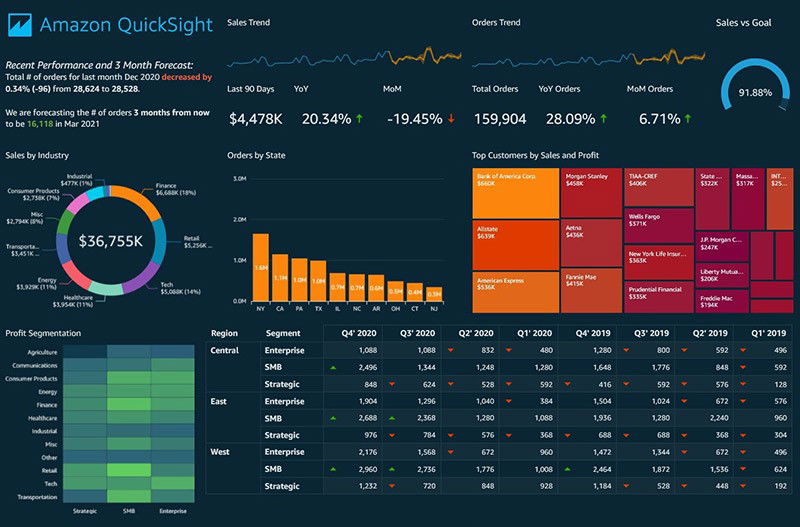
QuickSight offers auto-scaling analytics, the SPICE in-memory engine, and QuickSight Q, enabling natural-language querying powered by generative AI. Security and compliance align with SOC 2, ISO 27001, GDPR, and FedRAMP standards, and encryption at rest and in transit is enforced by default. It also integrates AWS IAM for fine-grained access control, while its pay-per-session model ensures cost efficiency for organizations scaling analytics to thousands of users.
Pricing
Amazon QuickSight offers flexible pricing: Readers from $3/month, Authors from $24/month, and Pro tiers from $20–$40/month with AI features. Capacity plans start at $250/month for 500 sessions. All include SPICE acceleration and AWS-native integration for scalable, cost-efficient BI.
What Works And What Doesn’t
| Pros | Cons |
| Fully serverless, highly scalable, and deeply integrated with AWS data sources | Limited flexibility for cloud ecosystems except AWS |
| Offers per-session pricing for cost-efficient deployments | Less extensive visualization customization |
| Built-in AI and natural language querying via QuickSight Q | Comes with a learning curve for optimizing SPICE capacity and IAM permissions |
Our Final Take
Amazon QuickSight is ideal for cloud-driven enterprises and AWS users seeking scalable, AI-enhanced analytics without infrastructural overhead. It’s less suitable for teams outside the AWS ecosystem or for those requiring extensive design customization. For businesses prioritizing efficiency, automation, and an AWS-native approach, QuickSight stands out as a smart, future-ready BI platform for 2026.
Zoho Analytics: Best Customization
Zoho Analytics, developed by Zoho Corporation, remains among the top BI tools of 2026, known for its affordability, AI-driven insights, and seamless integration across the Zoho ecosystem and beyond. It was named a Leader in the 2024 G2 Grid® for Business Intelligence Platforms and recognized as a Challenger in the 2025 Gartner® Magic Quadrant for Analytics and BI Platforms. The platform now serves over 20,000 customers across 120+ countries, reflecting its growing global reach and trust among mid-market and enterprise users.
Why We Chose Zoho Analytics In 2026
Zoho Analytics stands out for its AI assistant, “Zia,” which supports natural language queries and generates automated insights. Its drag-and-drop interface, data blending, and prebuilt connectors simplify data analysis. At the same time, native integration with Zoho apps and major third-party tools (Google Workspace, HubSpot, Salesforce) makes it a versatile choice for SMBs and enterprises alike.
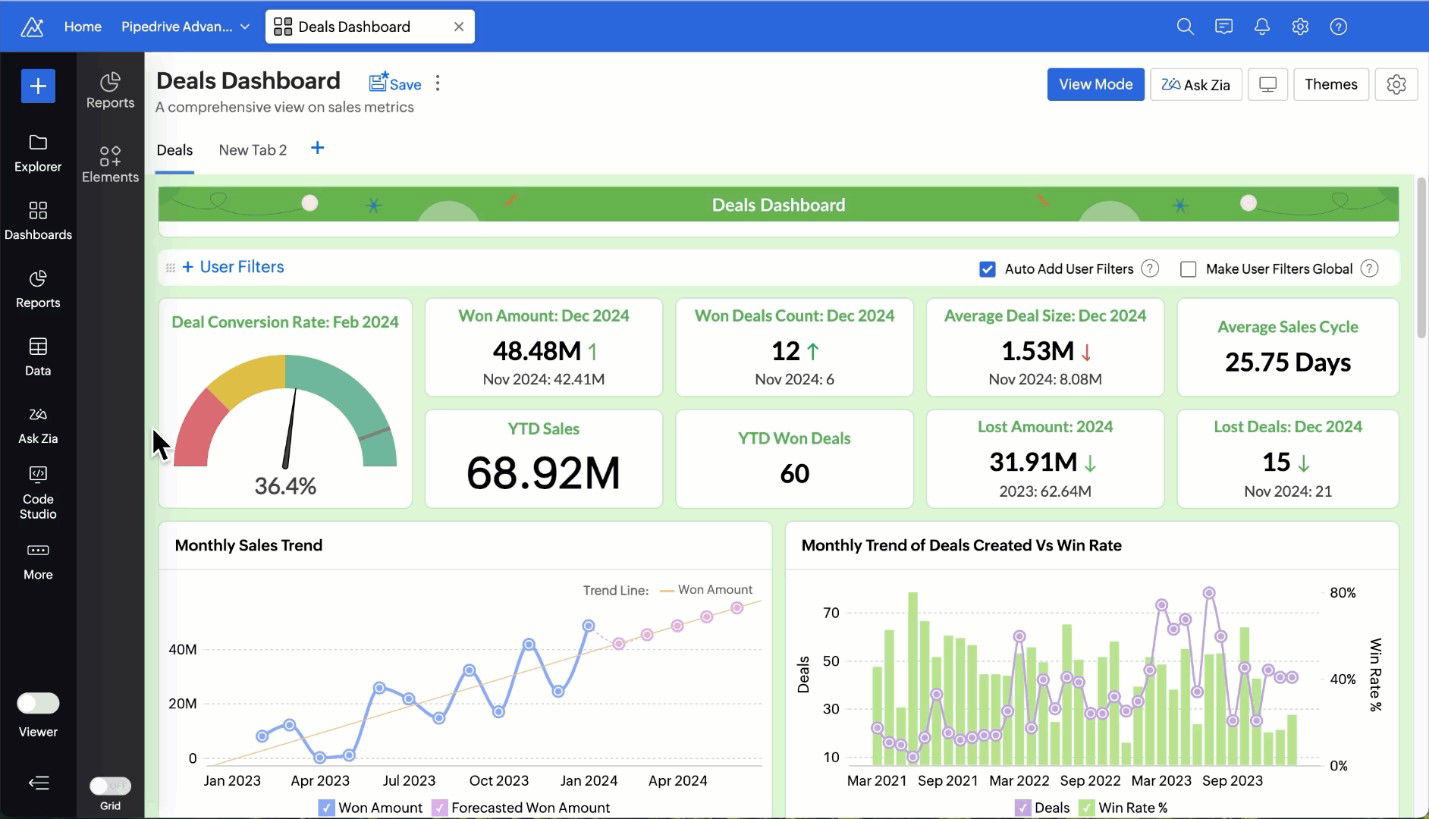
Zoho Analytics provides end-to-end data management, from ingestion and preparation to visualization and forecasting. It supports SOC 2 Type II, ISO 27001, GDPR, and CCPA compliance with AES-256 encryption for data at rest and in transit. Enhanced scalability and embedded BI capabilities help businesses deploy secure analytics both internally and for clients.
Pricing
Zoho Analytics offers a scalable pricing structure, starting with a Free plan and extending up to the Enterprise tier at $455 per month. Plans are designed to grow with business needs, supporting between 2 to 50 users and handling data volumes from 10,000 to 50 million rows. Higher-tier plans include advanced features such as AI-driven insights, white-labeling, and embedded analytics, along with flexible add-ons for additional users and expanded data capacity.
What Works And What Doesn’t
| Pros | Cons |
| Robust data modeling and ETL capabilities with advanced query performance optimization | May face performance limits with large-scale or volume deployments |
| Strong AI capabilities and automated insights via Zia. | Requires technical knowledge for advanced customization |
| Tight integration with the Zoho suite and 500+ third-party apps | Limited real-time streaming support |
Our Final Take
Zoho Analytics is best suited for small to mid-sized businesses seeking affordable, AI-powered BI features with strong integrations and governance. It’s less ideal for ultra-large enterprises that need real-time or big data analytics. For organizations wanting powerful yet accessible business intelligence, Zoho Analytics remains a standout option in 2026.
Top 5 Business Intelligence Software Comparison
P.S.: Always remember to visit the vendor’s site for the latest information!
| Criteria |  |
 |
 |
 |
 |
| Starting Price | $14/user/month | $200/month | $15/user/month | $3/user/month | $25/month |
| Avg. User Rating | 4.4 | 4.3 | 4.6 | 4.3 | 4.4 |
| Trial Period / Demo | 60-day free trial | 30-day free trial | 14-day free trial | 30-day free trial | 15-day free trial |
| Key Features | AI-assisted insights, semantic modeling, and deep Microsoft 365/Azure integration | Associative data engine, hybrid/multi-cloud, and AI-powered analytics | Advanced visualization, Salesforce integration, and storytelling dashboards | Serverless BI, pay-per-session pricing, and AI-driven insights | AI assistant Zia, data blending, and white labeling |
| Integrations | Microsoft 365, Azure, Dynamics 365, and more | Talend Cloud, Snowflake, SAP, and more | Salesforce, AWS, Google Ads, and more | AWS data sources, IAM, and more | Zoho Suite, Google Workspace, HubSpot, and more |
Conclusion
In 2026, BI (Business Intelligence) Software features a blend of innovation, scalability, and AI integration across all five platforms. Microsoft Power BI remains an enterprise favorite for Microsoft ecosystems, while Qlik Sense offers unmatched associative exploration. Tableau leads in visualization quality, Amazon QuickSight delivers cloud-native efficiency within AWS, and Zoho Analytics provides accessible, AI-driven analytics for growing businesses.
Each platform caters to distinct needs, ensuring that every organization can find a BI solution aligned with its data maturity and strategic goals.
So, go ahead and pick the one most suited to your business, and take your data analytics game up a notch in 2026!
Frequently Asked Questions
What Are The Top 5 Business Intelligence Software In 2026?
The top BI Software in 2026 includes Microsoft Power BI, Qlik Sense, Tableau, Amazon QuickSight, and Zoho Analytics, recognized for their AI-driven analytics, scalability, and strong integration capabilities across various cloud and enterprise ecosystems.What Are The Features Of Business Intelligence Software?
Business Intelligence Software typically includes data visualization, AI-powered insights, report automation, real-time dashboards, data integration, and governance tools that help organizations analyze data, track performance, and make strategic, data-driven decisions efficiently.What Is The Most Popular Business Intelligence Software?
Microsoft Power BI remains the most popular BI Software in 2026 due to its affordability, Microsoft 365 and Azure integration, robust AI features, and global user base, making it a preferred choice for organizations of all sizes.Thu, Dec 18, 2025

Liked what you read? That’s only the tip of the tech iceberg!
Explore our vast collection of tech articles including introductory guides, product reviews, trends and more, stay up to date with the latest news, relish thought-provoking interviews and the hottest AI blogs, and tickle your funny bone with hilarious tech memes!
Plus, get access to branded insights from industry-leading global brands through informative white papers, engaging case studies, in-depth reports, enlightening videos and exciting events and webinars.
Dive into TechDogs' treasure trove today and Know Your World of technology like never before!
Disclaimer - Reference to any specific product, software or entity does not constitute an endorsement or recommendation by TechDogs nor should any data or content published be relied upon. The views expressed by TechDogs' members and guests are their own and their appearance on our site does not imply an endorsement of them or any entity they represent. Views and opinions expressed by TechDogs' Authors are those of the Authors and do not necessarily reflect the view of TechDogs or any of its officials. While we aim to provide valuable and helpful information, some content on TechDogs' site may not have been thoroughly reviewed for every detail or aspect. We encourage users to verify any information independently where necessary.
Loading comments...