
Blockchain
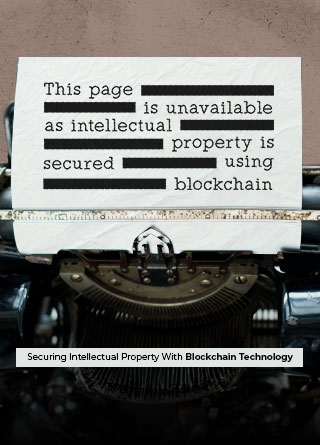
Securing Intellectual Property With Blockchain Technology
Share
Overview
The foundation of Facebook was riddled with innovation, but a messy trail of who is the rightful heir to the Intellectual Property. While watching the movie, we had this nagging thought that art, business ideas and other creations can be patented but business ideas cannot. In Facebook’s case, it was hard to prove if the idea originated from the Winklevoss twins or our very own Zuckerberg. (What do you think?)
The lack of legal protection and safeguards for Intellectual Property was one of the root of most problems - even more than the tech itself. In the modern age, an idea can make billions as technology has evolved to safeguard innovators and their ideas against plagiarism. With advancements in blockchain technology, the world is moving past traditional methods and exploring newer avenues in securing intellectual property. How, you ask?
Read on!
.jpg.aspx "TechDogs-\"Securing Intellectual Property With Blockchain Technology \"")
Applying for a patent isn’t all rainbows and butterflies. We bet many innovators can vouch for the pain behind this process! Those who have created original content, such as artists, writers, researchers, songwriters and photographers, are required to patent their work to avoid duplication and protect its authenticity.
However, consumers who are willing to legally consume these patented pieces of work also require to access Intellectual Property platforms so the creators can be paid royalties for their work. Copyright agencies too have a large role to play here, and thus it becomes cumbersome to access all the information in one place. With modern technology, legalities have taken a new outlook and processes are becoming digital – and as you know at TechDogs, we love tech!
So, are you ready to uncover it all?
What Is Intellectual Property And What’s The Need To Protect It?
With a mass generation of ideas, thanks to generative AI, there is a massive shift in focus for lawmakers and businesses to patent and protect IP. Fierce competition in businesses in this ever-evolving business landscape makes it the breeding ground for legal loopholes and idea duplication. By the end of 2024, over 3.4 million patent applications will be filed annually worldwide, with China and India leading the growth. Despite this, an estimated 35% of applications contain errors, creating substantial financial risks for businesses, as highlighted by the World Intellectual Property Organization and other reports.

Patents play a vital role in every significant industry, protecting and incentivizing innovation and providing legal protection for novel ideas, algorithms, processes and inventions. The basic idea is that data created by a party (could be a business or individuals) should not be copied and passed as own by someone else – as simple as that!
By granting exclusive rights to creators and innovators, IPs ensure the protection of intangible assets and encourage free-flowing innovation. Yet, you may be asking, how does blockchain help you patent or protect your intellectual property?
How Can Blockchain Help In Securing Intellectual Property?
In the pursuit of securing IP rights, blockchain technology is a game-changer. With its transparency and innovative solution along with decentralized control over ownership and transactions, this is definitely the newest way to an old-age system.
How does it work though? Blockchain operates on a time-stamped, immutable ledger, making it ideal for tracking and verifying intellectual property rights, as highlighted by a recent study from Deloitte on the impact of blockchain technology in intellectual property management. It provides transparent and immutable records of copyright ownership and transactions.

By registering copyright information on a blockchain, creators can establish tamper-proof evidence of their work's existence and prove authorship. As mentioned by the European Patent Office, blockchain-based smart contracts can automate royalty payments, ensuring transparent, real-time compensation for creators, thus minimizing disputes over intellectual property rights.
Since the IP process involves so many moving parts, having a decentralized, third-party blockchain network helps connect them. Yet, you may still be wondering:
How do blockchain patent platforms work?
-
Step 1
Creators sign up on the platform and update their basic information such as names, addresses, contacts, etc. Yet, the blockchain network can ensure no data is disclosed without the user’s consent.
-
Step 2
Creators upload their IP on the blockchain network once the sign-up is complete. The creator can add the details of the patent and its classification. Blockchain then ensures its traceability and accountability to prevent fraud and duplication.
-
Step 3
Consumers raise a request to use the work after they sign up on the same network. Consumers can then request creators to grant full or partial access to the patented content, post which a smart contract is created to safeguard both parties.
-
Step 4
Patent management entities enter the blockchain network to assist with disputes such as proof of ownership, transferring rights, sharing private information and much more.
That’s how simple it is!
What Are The Use Cases Of Blockchain In Securing IPs?
The applications of blockchain in IP protection are wide and many applications can be seen across patents, trademarks and so more. Let’s look at some key use cases:
-
Proof Of Ownership
Blockchain can identify asset credentials and be used to differentiate originals from counterfeits by creating IP ownership certificates and can be used to settle disputes by verifying timestamps.
-
IP Marketplaces
These provide a holistic platform to carry our IP registries, exchanges and payments for creators and consumers.
-
Evidence Of IP Rights
Blockchain can make it easier to track the usage of IP and notify the creator in real-time as evidence.
-
Version Control Of Assets
IPs and patents evolve from time to time and blockchain serves as a unified platform that can easily trace, update and store the changes.

We agree!
Our Parting Thoughts
With the advent of smart contracts and decentralized networks, we can see a paradigm shift in the way we approach the safeguarding of intellectual property rights using blockchain. Combining transparency, reliability and immutability with decentralization, the potential that blockchain holds to disrupt traditional IP protection is indisputable – and it’s fast approaching!
As businesses will always evolve with new requirements and demands, staying ahead of the curve is the need of the hour. With blockchain, you can at least ensure your intellectual property remains yours!
Frequently Asked Questions
What Is Intellectual Property (IP) And Why Is It Important To Protect It?
Intellectual Property refers to creations of the mind, such as inventions, literary and artistic works, designs, symbols, names and images used in commerce. Protecting IP is crucial because it incentivizes innovation by granting exclusive rights to creators and innovators. This legal protection ensures that original ideas, inventions and creative works are not copied or used without permission, thus safeguarding the rights and interests of creators and promoting a culture of innovation.
How Does Blockchain Technology Contribute To Securing Intellectual Property (IP)?
Blockchain technology revolutionizes the process of securing Intellectual Property by providing transparency, decentralization and immutability. By registering copyright information on a blockchain, creators can establish tamper-proof evidence of their work's existence and prove authorship. Blockchain-based smart contracts automate royalty payments and ensure fair compensation for content creators. Additionally, blockchain platforms for patent management offer a decentralized network where creators can securely upload and manage their IP, while consumers can request access to patented content through transparent and accountable processes facilitated by smart contracts.
What Are Some Use Cases Of Blockchain In Securing Intellectual Property (IP)?
Blockchain technology offers a myriad of use cases in securing Intellectual Property, including proof of ownership, IP marketplaces, evidence of IP rights, and version control of assets. Blockchain can create ownership certificates to differentiate originals from counterfeits, provide platforms for IP registries, exchanges, and payments, track the usage of IP in real time and maintain version control for evolving patents and assets. By leveraging blockchain, stakeholders in the IP ecosystem can enhance transparency, reliability and efficiency in managing and protecting intellectual property rights.
Wed, Mar 13, 2024

Liked what you read? That’s only the tip of the tech iceberg!
Explore our vast collection of tech articles including introductory guides, product reviews, trends and more, stay up to date with the latest news, relish thought-provoking interviews and the hottest AI blogs, and tickle your funny bone with hilarious tech memes!
Plus, get access to branded insights from industry-leading global brands through informative white papers, engaging case studies, in-depth reports, enlightening videos and exciting events and webinars.
Dive into TechDogs' treasure trove today and Know Your World of technology like never before!
Disclaimer - Reference to any specific product, software or entity does not constitute an endorsement or recommendation by TechDogs nor should any data or content published be relied upon. The views expressed by TechDogs' members and guests are their own and their appearance on our site does not imply an endorsement of them or any entity they represent. Views and opinions expressed by TechDogs' Authors are those of the Authors and do not necessarily reflect the view of TechDogs or any of its officials. While we aim to provide valuable and helpful information, some content on TechDogs' site may not have been thoroughly reviewed for every detail or aspect. We encourage users to verify any information independently where necessary.
Loading comments...