
Human Resource Technology
Manage It Right With Talent Management Tools
Share
Overview
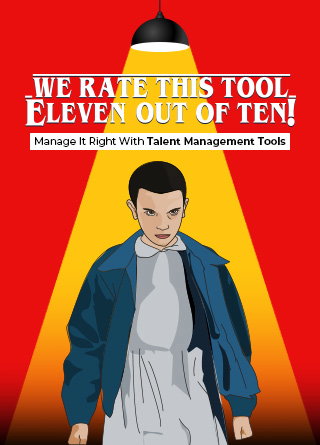
You see, a talented workforce at any organization is much like Eleven from Stranger Things. Talented employees bring something more to the table through their specialized skills and knowledge. They come up with innovative ideas, keep the business up to date and create value to secure their businesses (like Eleven saved the town from Demogorgons!). These employees are so rare and valuable that companies will go the extra mile to find and keep them.
An organization’s ability to find and retain talented employees is a key indicator of its future success. Talent Management Tools helps organizations with that! It makes it easier for them to identify opportunities and improve the areas of recruitment, employee performance management, learning development and compensation processes. It helps businesses identify and develop their best employees and ensure they are equipped with the right tools to participate in your organization’s growth. Want to read about Talent Management Tools in detail?
Keep scrolling through.
.jpg.aspx "TechDogs-\"Manage It Right With Talent Management Tools\" We Rate This Tool Eleven Out Of Ten!")
Stranger Things!
Now that we have grabbed your attention with the Netflix series that took the world by storm; let's talk about Mike Wheeler – the best friend of the main protagonist Eleven AKA El. From being probably the smartest one in his squad to being supportive of Eleven in almost every situation, Mike surely does redefine intelligence and compassion. The way he pushed Eleven to harness her psychic abilities to find Will (his best buddy who was missing) has undoubtedly been the highlight of the show.
Ever noticed that just like Eleven had telekinetic and psychic abilities, organizations also want their skilled and talented workforce to have superpowers? Well, we don’t mean abilities such as telepathy! A talented workforce will help an organization improve revenue and operational efficiency, survive in the competitive environment and reach new heights of success.
We all know that right from Season 1, Mike motivated Eleven and helped her harness her superpower in the best possible manner. Just like Eleven, organizations also need a helper to harness the talent of their employees, utilize it efficiently and maintain the balance between various aspects of the talented workforce. Talent Management Tools is like Mike to your organization’s Eleven; a tool that helps HR teams manage employees as a competitive advantage, harness and manage their talent efficiently. Now that we have begun this article with Stranger Things, why not sprinkle it with some strange, spooky puns? Sounds exciting, right? Let's binge-read on!
What Is A Talent Management Tool?

A Talent Management Tool is a tool that supports core talent management processes, including recruitment, employee onboarding, performance management, learning and professional development, succession planning and much more. Just like imagining The DND Party without Mike is impossible, the HR department is incomplete without Talent Management Tools as it helps them meet an organization's required human capital needs. This software simplifies and streamlines planning, attracting, selecting, developing and retaining talented employees. With the help of Talent Management Software (TMS), talent managers can save time and effort in managing talent and tracking employee data at different points of the employee lifecycle.
With that, we are done revealing the 'fangtastic what' of Talent Management Software; let's sneak-peek into its evolution.
Evolution Of Talent Management Tools
Who thought of coming up with a tool like this? Well, the evolution of Talent Management Tools shares its roots with personnel development tools. So, without further ado, pumpkin spice and everything nice; here we are rolling the timeline's dice:
-
Phase 1: Personnel Development
It was an era between the 1970s and the 1980s when talent management spread its roots in the form of personnel development. It referred to hiring people, paying them well and ensuring employees had the necessary benefits. Payroll management software supported the whole process of personnel development.
-
Phase 2: Strategic HR
It was a golden period from the 1980s to the 1990s when the concept of strategic HR emerged. During this phase, organizations realized that recruiting the right people, training them, developing compensation packages and designing jobs were crucial. Recruiting and application tracking systems (ATS), portals, total compensation software, compensation management systems and learning management systems were the tools that played a crucial role during this phase.
-
Phase 3: Rise Of Talent Management
Here comes the protagonist of our article – talent management! Finally, phase three i.e., the 2000s were here. This period was the dawn of learning and development strategies, that played a vital role in talent management. Slowly with the evolution of social media, the cloud and a more significant amount of data from HRIS, talent management gained an all-new dimension. Like every other phase, there was a need for a system or software to simplify the talent management process and streamline its various functions. Ta-da! Talent Management Tools were the answer.
Quite awesome history there, right? Let's get back to the present and figure out how does Talent Management Tools exactly works.
Working Of Talent Management Tools
Keep calm and curry a wand; the working of TMS will leave you in awe!

-
Step 1: Planning
Talent Management Tools helps organizations plan, execute and monitor measures related to recruitment, training and retention of talent. Thus, it effectively utilizes company resources to achieve business objectives. With the help of suitable Talent Management Tools, you can plan effectively and optimize cost and time, while managing employees at different stages of their careers.
-
Step 2: Designing
The HR department is often burdened with administrative tasks, which leads to them not being able to spend as much time on planning as they'd like to. Keeping track of employee records, performance appraisals and even personal details amounts to a lot of work for an HR manager. However, with the help of a good Talent Management Tools, it becomes much easier for HR professionals to manage their employees and create strategies for increasing employee retention.
-
Step 3: Recruiting
Great talent is the heartbeat of every organization. If you have great talent, you can build and launch new products faster, innovate more quickly and stay ahead of your competition. However, hiring top talent is a challenge for organizations of all sizes. To source and recruit great talent, using Talent Management Tools streamlines your entire recruiting process from candidate sourcing to onboarding new employees.
-
Step 4: Managing
Today's workforce is digitally savvy and wants to feel connected to the company they work for. Many people value job satisfaction and flexibility along with career growth. To attract and retain top talent, businesses have implemented several methods, from providing catered benefits to hiring consultants. One strategy that has proven especially beneficial is implementing Talent Management Tools to streamline processes, reduce redundancies and manage employee information more efficiently.
Now it's time to delve into the benefits of Talent Management Tools. We know you’ve been waiting!
Benefits Of Talent Management Tools
No clowning around here; this is how Talent Management Tools will help your HR teams!
- In today's fast-paced world, staying ahead of the curve is an ongoing challenge for businesses in any sector. One area that needs constant attention to avoid falling behind is talent management. Talent Management Tools benefit you with strategic management and planning of human resources. It's particularly essential in today's fast-paced world, where organizations must stay agile, fund their growth and achieve measurable results.
- Today, companies are focusing on hiring the right talent. There is increasing pressure to fill new positions quickly and efficiently. Talent Management Tools helps you find the best and most relevant candidates for your job openings by identifying potential employees based on their skill sets, experience and interests.
- Talent Management Tools enable you and your team to make better decisions by providing the functions needed to analyze employee data, restructure processes and manage employee performance. It makes it easier to analyze how your organization is performing now and how it can make progress going forward.
Going forward reminds us of exploring the future of Talent Management Tools. Delve right in!
Future Of Talent Management Tools
Woah! Woah! Woah! The spooktacular future of Talent Management Tools is all set to surprise you.

Today, the world of work is being rapidly transformed by artificial intelligence (AI), machine learning and Natural Language Processing. These technologies will enable organizations to automate many HR processes and tasks so they can focus on their most important asset – employees.
The future will need organizations to be hybrid work-culture friendly. They will need to develop permanent models for hybrid work and make it an integral part of the organization to attract talented individuals. Besides, the focus will shift to the concept of total talent management; these platforms will include health and wellness programs, better training opportunities through immersive technologies and giving personalized career advice. Such initiatives will work like magnets to attract and retain talented employees. Talent Management Tools will continue to be the backbone of recruitment, performance management, learning and development and compensation processes to help companies to keep pace with competitors.
Summing It Up!
Friends don’t lie!
So, here we’re spilling the truth that talent management has now become one of the most important functions in organizations. This is because organizations now know the importance of investing in people along with investing in technology. Imagining an organization without talent management is just like watching Stranger Things without Eleven. Exactly, it’s bland!
In Stranger Things, whenever Eleven doubted herself, Mike was there to help her; in the same way, Talent Management Tools reorganizes your whole talent management processes, tracks hiring needs and identifies high-potential employees. It also helps organizations to measure employee engagement, performance and retention so that they can take corrective measures in case of unplanned attrition. We give it Eleven out of ten!
Frequently Asked Questions
What Is A Talent Management Tool?
A Talent Management Tool is a comprehensive software solution designed to support essential talent management processes within organizations. It encompasses various functions such as recruitment, employee onboarding, performance management, learning and development, succession planning, and more. Just as Mike is an indispensable part of Eleven's journey in Stranger Things, Talent Management Tools serve as vital components for HR departments, assisting them in meeting the human capital needs of an organization. By simplifying and streamlining tasks related to planning, attracting, selecting, developing, and retaining talented employees, these tools help talent managers optimize their efforts and efficiently manage employee data throughout the employee lifecycle.
How Did Talent Management Tools Evolve?
The evolution of Talent Management Tools traces back to the early phases of personnel development in the 1970s and 1980s, focusing on hiring, compensation, and benefits. It progressed into the era of strategic HR in the 1980s and 1990s, emphasizing the importance of recruiting, training, compensation management, and job design. Finally, in the 2000s, Talent Management emerged as a distinct phase, integrating learning and development strategies with advancements in technology such as social media and cloud computing. Talent Management Tools evolved alongside these developments, providing organizations with solutions to simplify and streamline talent management processes.
What Is The Working Of Talent Management Tools?
The working of Talent Management Tools involves several key steps aimed at effectively managing human resources within an organization. These steps include planning, designing, recruiting, and managing talent. Talent Management Tools assist organizations in planning and executing measures related to recruitment, training, and retention, optimizing company resources to achieve business objectives. They also help HR departments streamline administrative tasks, track employee records, and create strategies for increasing employee retention. Additionally, these tools facilitate the recruitment process by sourcing and onboarding top talent, enabling organizations to build and maintain a skilled workforce that drives business growth and innovation.
Mon, Nov 14, 2022

Liked what you read? That’s only the tip of the tech iceberg!
Explore our vast collection of tech articles including introductory guides, product reviews, trends and more, stay up to date with the latest news, relish thought-provoking interviews and the hottest AI blogs, and tickle your funny bone with hilarious tech memes!
Plus, get access to branded insights from industry-leading global brands through informative white papers, engaging case studies, in-depth reports, enlightening videos and exciting events and webinars.
Dive into TechDogs' treasure trove today and Know Your World of technology like never before!
Disclaimer - Reference to any specific product, software or entity does not constitute an endorsement or recommendation by TechDogs nor should any data or content published be relied upon. The views expressed by TechDogs' members and guests are their own and their appearance on our site does not imply an endorsement of them or any entity they represent. Views and opinions expressed by TechDogs' Authors are those of the Authors and do not necessarily reflect the view of TechDogs or any of its officials. While we aim to provide valuable and helpful information, some content on TechDogs' site may not have been thoroughly reviewed for every detail or aspect. We encourage users to verify any information independently where necessary.
Loading comments...