
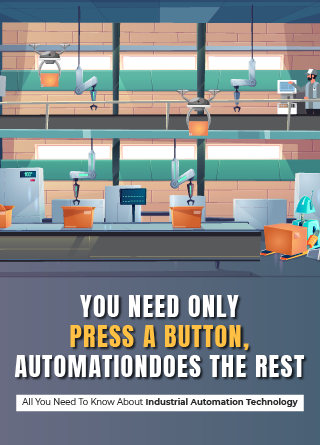
Automation
All You Need To Know About Industrial Automation Technology
Share
Overview
Be it Cobots (Collaborative Robots), advanced gripping sensors or technologies such as build-your-own-robots that allow you to build your own fully functional industrial robots (yes, it's true!). Every invention is a milestone in automation. We believe that Industrial Automation Technology is key in revamping the face of industrialization - and there's a lot to learn about it.
This article explains Industrial Automation Technology; its working, evolution, types, benefits and future. So, what are you waiting for? Let's begin this exciting ride!
-01-(9).png.aspx "TechDogs-\"All You Need To Know About Industrial Automation Technology\" You Need Only Press A Button, Automation Dose The Rest")
If we asked you what's the one thing common between J.A.R.V.I.S, repulse blasts and the arc reactor, what would that be?
Yeah, they are related to Iron Man but there's one more similarity; these extraordinary inventions took place at Stark Industries. Stark Industries has been an unsung hero in Marvel Cinematic Universe (MCU). Well, Stark Industries not only introduced some exceptional inventions but was driven by the seamless combination of automation and industrialization.
From the arc reactor (the glowing circle positioned in the center of Iron Man's chest) to badassium (the new element discovered and named by none other than Tony Stark) to J.A.R.V.I.S (a super-intelligent AI who took care of Tony Stark's every need and whim)! Every invention by Tony Stark not only added entertainment but also took Marvel movies to another level. However, it shows that every industry is looking for ways to automate and streamline existing processes using the latest technology.
Simply put, in this real world, Industrial Automation Technology is creating wonders that are no less extraordinary than the inventions of Stark Industries. This article is all about that! To begin with, let's understand the meaning of Industrial Automation Technology.
What Is Industrial Automation Technology?
Industrial automation is the replacement of human efforts with the intervention of computers and machines. The word automation means "self-dictating" or "a mechanism that moves independently." It derives from the Greek words - Auto and Matos, where “auto” means self while “matos” means moving. The technology used in automated devices allows for superior performance over manual control by automating industrial processes without significant human intervention.

Industrial Automation Technology is the use of automated machinery to control industrial processes. The process of automating a production system typically begins with an analytical study of the production system. This includes mapping, modeling and optimizing the process so that it can be completed more reliably and efficiently by an automated system. Industrial automation is the use of control systems and information technology systems to increase the efficiency, accuracy and quality of manufacturing processes.
Let's head to the next section that decodes the evolution of Industrial Automation Technology.
Evolution Of Industrial Automation Technology
The roots of industrial automation trace back to the 1800s when automated tools and processes were started to be used to increase productivity and efficiency in factories. Yeah, it was an era when automated tools just sprouted! Then, in the 1920s, electricity boosted the process of industrialization, which led to faster production and changed the factory floor dynamics.
The 1930s and 1940s brought significant changes toward modern automation in industries. During this phase, manufacturing and production processes geared up and introduced time-efficient methods that relied on lower human effort. In the past three decades, there has been exponential growth in the area of industrialization.
2012 brought the exciting era of robots in industrial automation. Robots and Artificial Intelligence (AI) were game-changers in the area of Industrial Automation Technology. Just like Stark Industries evolved into Stark International, Stark Solutions, Stark Industrialization and so on, Industrial Automation Technology also evolved after the introduction of Robots and AI. As a result, in 2016, the global shipment of robots was around 294,000, almost double the growth from what it was in 2012.
2020 saw the introduction and convergence of information technology and operations technology as manufacturers realized it was key to glorious digital transformation. 2021 strengthened the roots of Augmented Reality (AR) in Industrial Automation Technology. Employees working from home were reaping the benefits of AR by seeing the plants and assets with the help of digitally overlaid information. This transformation continued in the upcoming years.
Let's take a look at the types of Industrial Automation Technology.
Types Of Industrial Automation Technology
Here are some of the types of Industrial Automation Technology you need to know about:
-
Fixed (Hard) Automation
Fixed (Hard) Automation refers to the incorporation of special-purpose equipment to automate a fixed sequence of processing or assembly operations. Fixed Automation includes technologies like mechanized assemblies and machining transfer lines.
-
Programmable Automation
Programmable Automation is automation under which the production equipment is designed with the capability to change the sequence of operations to accommodate different product configurations. Industrial robots, Computer Numerical Controlled (CNC) machines are examples of this type of Industrial Automation Technology.

-
Flexible (Soft) Automation
Industrial automation involves several machine tools that are linked together by a material handling system which is often used to offer rapid and smooth changes to processes. You must have seen those specialized robotic arms that are often used to handle tasks such as inserting screws, drilling holes and painting items. This kind of Industrial Automation Technology belongs to the category of flexible automation.
-
Integrated Automation
The automotive industry, plastic processing factories, packaging industries, food and beverages industries and tobacco industries often use Integrated Automation solutions to reduce complexity, ensure higher productivity and reduce life-cycle costs.
The next section explains the benefits of Industrial Automation Technology, so let's wait no more and head-on!
Benefits Of Industrial Automation Technology
Sometimes you have to run before you walk, so let’s understand the benefits of running our industries with Industrial Automation Technology!


-
Highly Productive
With the help of Industrial Automation Technology, companies can run a manufacturing unit 24 hours a day, 7 days a week and 365 days a year. This eventually leads to constant improvement in the productivity of the company. In a nutshell, it ensures that your production facility never sleeps and can scale to the demands.
-
Qualitative Results
To err is human, to forgive is automation (pun intended!). On a serious note, this quote fits in here because automation eliminates human errors and leaves no room for any risks. Besides this, robots, which are an essential element of Industrial Automation Technology, do not feel any fatigue which results in the constant production of qualitative products.
-
Flexible And Safe
Adding new tasks in your industrialization process requires you to train human operators and involves costs. It's no hidden fact that robots can be programmed to do any task which makes the whole process flexible. Moreover, deploying robots and automated technologies to handle hazardous processes prevents accidents and errors. So, it's time for robots to take over your industrial hustle!
Let's #sneakpeek into the future of Industrial Automation Technology.
Future Trends To Expect In Industrial Automation Technology
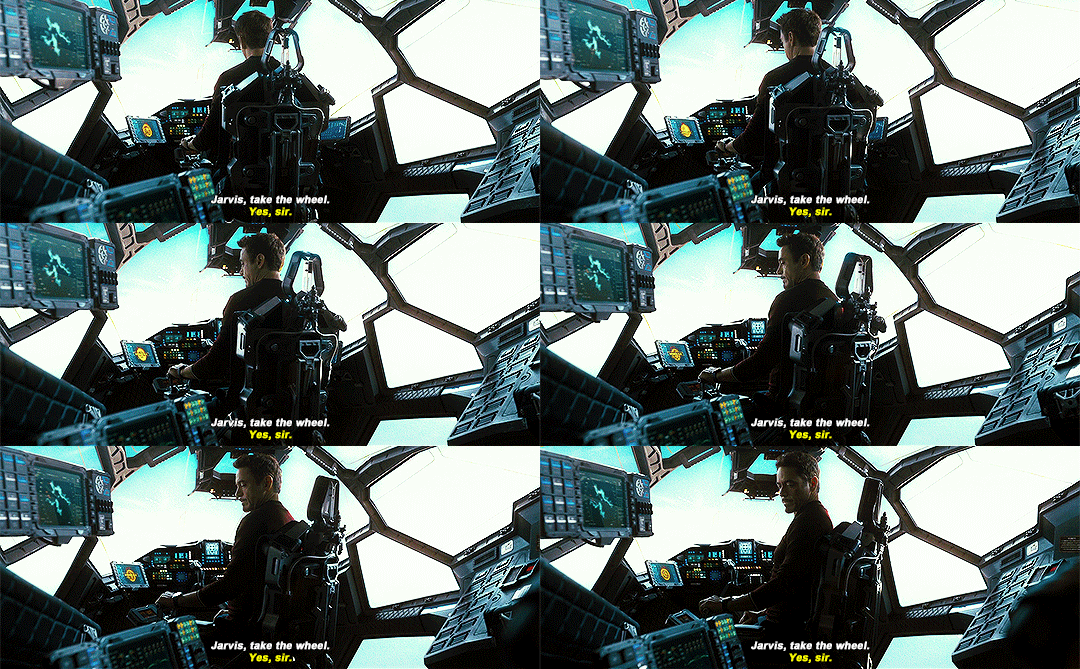
Let’s take the wheel and fly into the future!

Developments in Artificial Intelligence, Augmented Reality, robotics and cloud computing will transform the manufacturing industry. Industrial companies will need to remain at the forefront of this revolution. The convergence of technologies has paved the path for industrialists to leap to the next revolution in industrial automation.
To stead ahead of the curve, industrialists will have to capitalize on technologies that are already out there. They have to accelerate technology implementation and unlock new sources that will bring value and productivity to their processes. No wonder the current trends in Artificial Intelligence-based robotics and cloud computing for real-time analytics will evolve and make industrialization quicker, more productive and safer. The future looks bright, right?
Conclusion
Industrial Automation Technology not only reduces variability in industrial processes but also eases the unpredictability within these production processes. It helps increase efficiency and productivity, which leads to a decrease in wasted effort, resources and energy. In order to create greater customer value and achieve operational excellence, companies need to understand what Industrial Automation Technology can offer them and use them in their industries.
Frequently Asked Questions
What Is Industrial Automation Technology?
Industrial Automation Technology involves the integration of computers and machines to replace human efforts in industrial processes. This technology aims to streamline and enhance performance by automating various tasks without significant human intervention. By leveraging control systems and information technology, industrial automation improves efficiency, accuracy, and quality in manufacturing processes, ultimately leading to enhanced productivity.
How Has Industrial Automation Technology Evolved Over Time?
The evolution of Industrial Automation Technology can be traced back to the 1800s, with the initial use of automated tools to boost productivity in factories. The advent of electricity in the 1920s accelerated industrialization, leading to faster production rates. Significant advancements occurred in the 1930s and 1940s, introducing modern automation methods that relied less on human labor. The introduction of robots and Artificial Intelligence (AI) in 2012 marked a significant milestone, revolutionizing industrial automation. Subsequent years saw the convergence of information technology and operations technology, along with the rise of Augmented Reality (AR), further enhancing industrial automation capabilities.
What Are the Different Types of Industrial Automation Technology?
Industrial Automation Technology encompasses various types, including Fixed (Hard) Automation, Programmable Automation, Flexible (Soft) Automation, and Integrated Automation. Fixed Automation involves specialized equipment to automate specific processing or assembly operations. Programmable Automation allows for the flexibility to change operation sequences to accommodate different product configurations. Flexible Automation utilizes machine tools linked by a material handling system to facilitate rapid process changes. Integrated Automation solutions are prevalent in industries such as automotive, plastics, packaging, food and beverages, and tobacco, aiming to reduce complexity, enhance productivity, and minimize life-cycle costs. Each type of automation technology offers unique benefits and applications tailored to different industrial needs.
Wed, Dec 28, 2022

Enjoyed what you read? Great news – there’s a lot more to explore!
Dive into our content repository of the latest tech news, a diverse range of articles spanning introductory guides, product reviews, trends and more, along with engaging interviews, up-to-date AI blogs and hilarious tech memes!
Also explore our collection of branded insights via informative white papers, enlightening case studies, in-depth reports, educational videos and exciting events and webinars from leading global brands.
Head to the TechDogs homepage to Know Your World of technology today!
Disclaimer - Reference to any specific product, software or entity does not constitute an endorsement or recommendation by TechDogs nor should any data or content published be relied upon. The views expressed by TechDogs' members and guests are their own and their appearance on our site does not imply an endorsement of them or any entity they represent. Views and opinions expressed by TechDogs' Authors are those of the Authors and do not necessarily reflect the view of TechDogs or any of its officials. While we aim to provide valuable and helpful information, some content on TechDogs' site may not have been thoroughly reviewed for every detail or aspect. We encourage users to verify any information independently where necessary.
Loading comments...