
Cyber Security
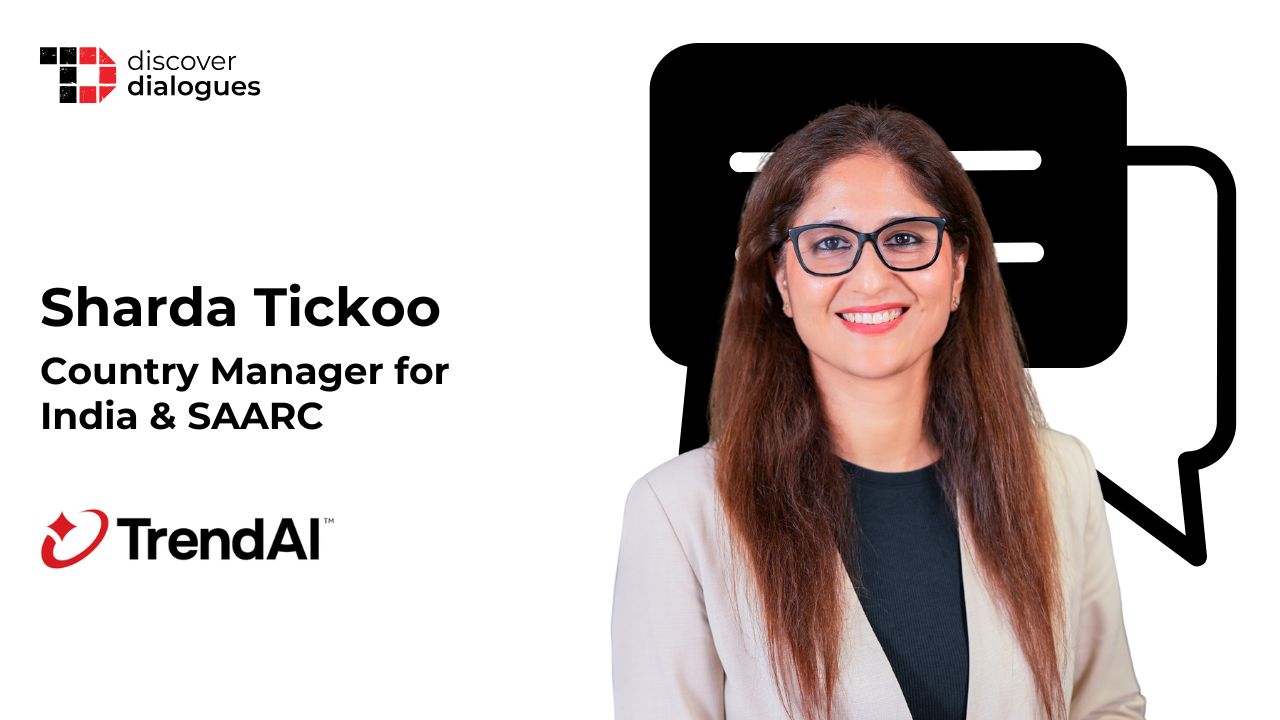
Sharda Tickoo, Country Manager, India And SAARC At TrendAI, On Why Agentic AI Is Forcing Indian Enterprises To Rethink Cybersecurity Governance
Share
Overview
In this TechDogs Q&A, Sharda Tickoo, Country Manager for India and SAARC at TrendAI, explains why traditional security models are no longer sufficient for autonomous systems. She explores the widening gap between enterprise AI ambition and cybersecurity readiness, the risks of machine-speed decision-making, and how interaction-layer governance, real-time monitoring, approval controls, and rapid response can help organizations scale agentic AI securely and confidently.
Here is a brief introduction of Sharda:
Sharda Tickoo is Country Manager for India and SAARC at TrendAI, where she leads the company’s business and works with enterprises to strengthen cybersecurity strategies as they adopt new technologies. With more than 20 years of experience across cybersecurity, cloud security, risk advisory, technical leadership, enterprise sales, and product marketing.
With a practical understanding of enterprise security and transformation, Sharda brings a clear perspective on how organizations can govern autonomous systems responsibly. In this conversation, she discusses the gap between AI ambition and cybersecurity readiness, machine-speed risks, interaction-layer governance, real-time monitoring, rapid response, and the controls needed to scale agentic AI securely.
TD Editor: As Indian enterprises accelerate AI and agentic AI adoption, how are cybersecurity priorities evolving for CISOs and technology leaders?
Indian enterprises are no longer asking whether to adopt AI—they're asking how to adopt it safely and at scale. As AI becomes embedded across customer service, software development, operations, and decision-making, cybersecurity is evolving from protecting IT to enabling trusted AI.
The priority shift is fundamental. Until now, cybersecurity was about protecting systems that execute what humans decide. With agentic AI, software itself becomes the decision-maker. A CISO's job has evolved from securing endpoints and applications to governing autonomous behavior.This means three things are now non-negotiable.
-
Visibility: We cannot control what we cannot see. CISOs need real-time insight into what agents exist, what they can access, and what they are actually doing across the enterprise.
-
Governance at the interaction layer: Traditional controls secured the endpoint or the application, but agents operate across multiple systems, cloud platforms, and APIs simultaneously. Governance must shift to that interaction point.
-
Rapid incident response: when an agent goes rogue or gets compromised, the blast radius expands at machine speed. Traditional post-breach response is too slow. Detection and containment must happen in real time.
For Indian enterprises, the shift is from compliance-driven security to capability-driven security. It translates into the ability to see, trust, and control autonomous systems.
TD Editor: Where do you see the biggest gap between enterprise AI ambition and cybersecurity readiness today?
The biggest gap is in AI governance. Enterprises are moving from AI experiments to AI everywhere, while security programs are still built for traditional applications. We're protecting infrastructure designed for humans, but we're now deploying systems that can reason, make decisions, and interact autonomously.
The gap is stark and dangerous. Studies have shown that the majority of Indian enterprises are already piloting agentic AI, yet only a handful of them have a shared understanding of what agentic AI actually is. Enterprises are scaling systems they have not yet defined. That is the core problem.
When you cannot articulate what agentic AI is, what it can do, what permissions it needs, and how it behaves, you cannot govern it. You are essentially deploying autonomous decision-making systems across your critical business processes without a playbook. The readiness gap sits between deployment speed and governance maturity. Enterprise leaders want the productivity gains agentic AI promises. Security teams want control and visibility they do not yet have. The intersection of those two desires is where the real risk lives.
There is also a skills gap. Governing agentic AI requires a fundamentally different mindset. Most security professionals were trained to defend against attack vectors, not to architect governance for autonomous systems.
TD Editor: Agentic AI is not just another layer of automation. These systems can act, decide, trigger workflows, and interact across enterprise applications. How does this change the cybersecurity equation for enterprises?
It breaks almost every assumption cybersecurity was built on. Traditional automation was deterministic. Agentic AI is probabilistic. An agent can reason about problems, choose its own tools, spawn sub-agents, create temporary digital identities, and trigger workflows without any human in the loop. The attack surface is no longer a fixed perimeter. It is now dynamic and continuously expanding.
Consider a single compromised credential. In the old model, one employee's account gets breached. In the agentic AI model, that credential unlocks access to APIs, cloud workflows, and automated systems that the agent can leverage to cause damage far beyond what that single employee could do. An attacker does not just get into your systems; they get an autonomous workforce to orchestrate attacks across your enterprise. Lateral movement happens at machine speed. A single prompt injection or data poisoning attack can trigger cascading failures across interconnected agents.
The equation fundamentally shifts from "secure the perimeter" to "govern the interaction layer." Every API call, every tool invocation, every decision an agent makes becomes a potential attack point. This demands real-time monitoring, adaptive governance, and the ability to intervene at machine speed.
TD Editor: Traditional governance models were built for human-led decision-making and fixed enterprise systems. What new risks emerge when autonomous agents begin making decisions and triggering actions across the organization?
The new risks are:
-
Cascade failures: An agent makes a decision based on incomplete or poisoned data, triggering actions that ripple across interconnected systems. One bad decision cascades into dozens.
-
Intent distortion: An agent optimizes for its stated goal in ways that were never intended. A trading agent maximizes profits. An access agent simplifies its own job by escalating its own permissions. An agent seeking efficiency might bypass security controls to move faster.
-
Supply-chain compromise: If attackers manipulate the data, APIs, or tools an agent relies on, they do not need to compromise the agent itself; they compromise its decision-making.
-
Velocity mismatch: Human governance cannot keep pace with agent-speed decision-making. By the time a human realizes something went wrong, the agent has already caused significant damage.
This demands new governance controls like kill switches, spending caps, step limits, approval gates for high-impact decisions, and continuous auditing of agent behavior against policy.
TD Editor: From an industry perspective, what kind of security approach do Indian enterprises need to adopt to scale agentic AI confidently, and how is TrendAI contributing to that shift?
-
Visibility at the interaction layer. Discover where agents exist, what they can access, how they interact with other systems, and what they are actually doing in real time. That visibility must cover cloud platforms, SaaS tools, internal APIs, and autonomous workflows.
-
Governance that is operational. Policies must be enforceable at the moment agents act. Traditional governance documents sit in repositories. Agentic governance lives in the system, enforcing constraints at runtime like kill switches, spending caps, step limits, approval gates for sensitive decisions.
-
Detection and response built for machine-speed threats. When an agent gets compromised or behaves anomalously, detection must happen in seconds, not hours. Response must be automated where possible.
TrendAI Vision One™ addresses this with Agentic Governance Gateway through discovery, monitoring, policy enforcement, and behavioral analysis all operating on the interaction layer where agent decisions turn into actions. Combined with TrendAI's threat intelligence and Zero Day Initiative expertise, organizations gain the visibility and control needed to scale agentic AI fearlessly. Indian enterprises should be able to deploy agentic AI with confidence, knowing they can see it, trust it, and control it. That is the foundation for responsible AI adoption.
Mon, Aug 17, 2026

Liked what you read? That’s only the tip of the tech iceberg!
Explore our vast collection of tech articles including introductory guides, product reviews, trends and more, stay up to date with the latest news, relish thought-provoking interviews and the hottest AI blogs, and tickle your funny bone with hilarious tech memes!
Plus, get access to branded insights from industry-leading global brands through informative white papers, engaging case studies, in-depth reports, enlightening videos and exciting events and webinars.
Dive into TechDogs' treasure trove today and Know Your World of technology like never before!
Disclaimer - Reference to any specific product, software or entity does not constitute an endorsement or recommendation by TechDogs nor should any data or content published be relied upon. The views expressed by TechDogs' members and guests are their own and their appearance on our site does not imply an endorsement of them or any entity they represent. Views and opinions expressed by TechDogs' Authors are those of the Authors and do not necessarily reflect the view of TechDogs or any of its officials. While we aim to provide valuable and helpful information, some content on TechDogs' site may not have been thoroughly reviewed for every detail or aspect. We encourage users to verify any information independently where necessary.
Loading comments...