
Cyber Security
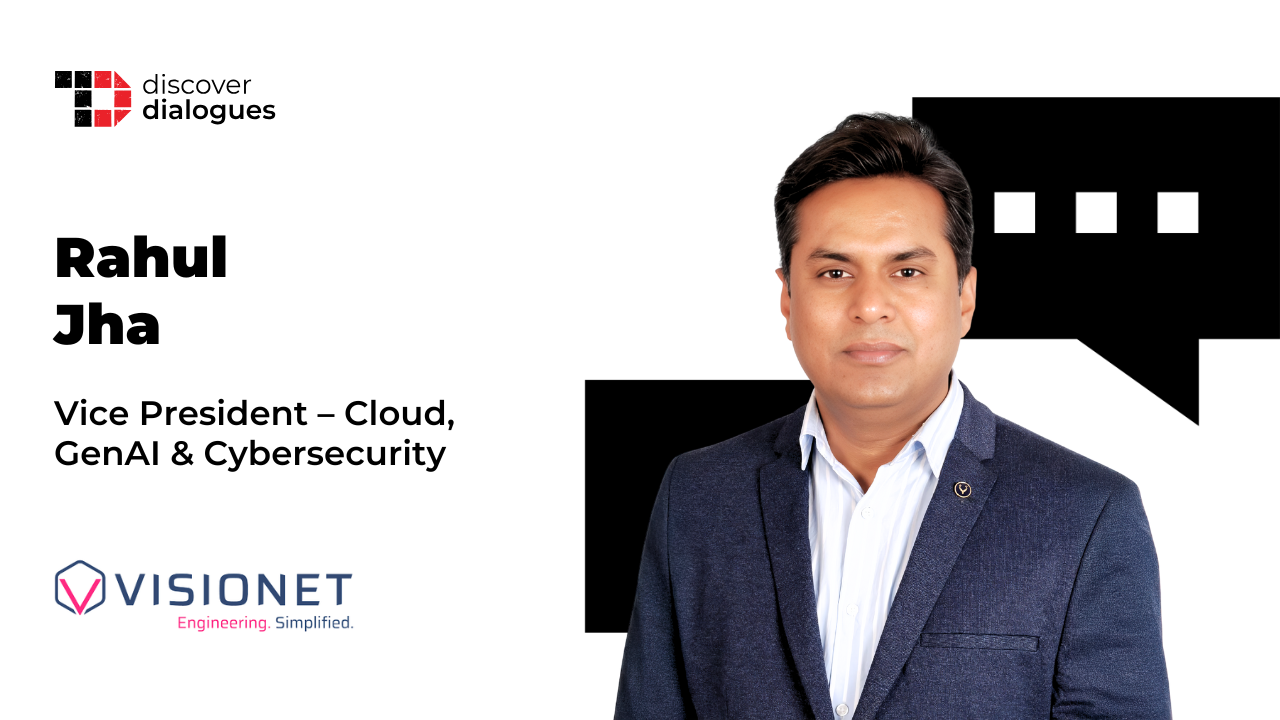
Rahul Jha, Vice President At Visionet On Balancing Speed And Governance In GenAI Adoption
Share
Overview
Here is a small introduction to Rahul Jha :
Rahul Jha is Vice President – Cloud, GenAI & Cybersecurity at Visionet Systems Inc. With nearly two decades of experience across cloud, DevOps, AI, and cybersecurity, he has led large-scale transformations and enterprise solutioning for global clients. At Visionet, he is at the forefront of scaling multi-cloud and AI-driven strategies, aligning them with business outcomes. His work spans technology innovation, governance frameworks, and building cross-functional teams that deliver enterprise-grade impact.
TD Editor: Cloud migration today isn’t just about modernization — it’s about continuous value delivery. How do you ensure that transformation roadmaps are outcome-driven rather than infrastructure-driven?
Rahul Jha: At Visionet, we have moved beyond “cloud-first” to embrace an “AI-first” paradigm, recognizing that modernization is just the foundation and not the destination. Our transformation roadmaps are platform-led, powered by Visionet CloudStudio and GenAI Studio, and engineered to deliver continuous business value and not just infrastructure uplift.
We start by aligning every transformation with clearly defined business KPIs, whether it’s boosting operational efficiency, improving customer experience, accelerating innovation, or unlocking new revenue streams.
Our methodology is anchored in modern architecture principles, cloud-native engineering and AI-enabled automation, integrated FinOps, DevSecOps, and observability frameworks, industry-specific cloud accelerators, and GenAI solution jumpstarts.
Here are some concrete examples of value delivery:
-
Luxury Retail Giant: Achieved measurable improvement in knowledge accessibility and service efficiency across HR, IT, and Legal by integrating 18K+ employees into a unified cloud-GenAI assistant platform, thereby reducing response time and boosting productivity.
-
Industrial Supplier Company: Automated dozens of processes, integrating FinOps and DevSecOps frameworks for end-to-end visibility, control, and operational excellence.
-
Insurance Provider: Adopted verticalized industry cloud solutions, streamlining operations and enhancing compliance in the highly regulated insurance sector.
-
Lifesciences Organization: Deployed a Microsoft Azure-based cloud foundation and integrated LLMOps to rapidly build and scale AI-driven solutions for Research scientists, thereby accelerating time-to-market and innovation agility.
These aren’t just tech upgrades; they’re business reinventions, enabled through platform-driven transformation that combines CloudStudio’s architecture and automation with GenAI Studio’s intelligence and adaptability.
TD Editor: CISOs and CTOs often face a conflict: speed vs. control. How do you balance the business push for fast GenAI adoption with the security discipline required at the enterprise level?
Rahul Jha: At Visionet, we believe that speed and control are not opposing forces. They are design parameters. Fast, secure GenAI adoption is only possible when governance is built into the foundation, not bolted on later.
Our approach is rooted in a three-tiered governance model, embedded directly into our GenAI Studio and delivery lifecycle:
-
Structured Oversight Across the Lifecycle
We start with a comprehensive design and security review. During Ideation & Screening, we evaluate data sensitivity, misuse potential, and ethical flags using a lightweight intake process. This is followed by closed-loop testing of a Minimal Viable Agent (MVA) by our CoE. Finally, before going live, we conduct a full pre-production audit and present findings to our internal Governance Council. This ensures responsible innovation from concept to launch. -
LLMOps and Continuous Observability
Governance doesn’t stop at deployment. We maintain real-time observability dashboards tracking token usage, latency, hallucination rates, and user satisfaction. Alerts are automated; for instance, if hallucination or accuracy crosses set thresholds, it triggers an intervention and possible retraining. Every interaction, feedback loop, and model iteration is versioned and auditable. -
Scalable Governance via Policy Engine
We’ve embedded a context-aware policy engine into GenAI Studio that adapts governance dynamically to the risk profile of each use case. It automates enforcement through LLMOps pipelines and scales oversight to GenAI Solutions & workflows without becoming a bottleneck to innovation.
This model empowers CISOs and CTOs to move at speed without compromising trust, compliance, or control. Our experience shows that when we design with governance in mind, we don’t have to slow down innovation, but scale it responsibly.
TD Editor: In enterprise cloud modernization, how do you define 'value delivered'? What metrics or tangible outcomes do you push clients to align on from day zero?
Rahul Jha: At Visionet, we define "value delivered" not by the number of workloads migrated but by the measurable business impact cloud modernization creates. From day zero, our goal is to shift the conversation from infrastructure to outcomes aligned with business priorities.
Our CloudStudio framework helps clients establish a Value Realization Map early in the transformation journey. We guide them to baseline and measure across four core dimensions:
-
Time-to-Value
-
Cost Efficiency
-
Operational Agility
-
Innovation & Experience Uplift
We measure value as a compound outcome: reduced cost + increased speed + better experience. That’s the North Star we align on from day zero.
TD Editor: As tech leaders race to adopt GenAI, what are some unspoken risks or long-term implications you believe organizations are underestimating — particularly when it comes to IP, data leakage, or ethics?
Rahul Jha: The speed at which enterprises are adopting GenAI is impressive. But in that urgency, some of the most critical risks are being underestimated or ignored entirely. Some of the common risks we consistently see organizations overlooking are,
-
IP Contamination and Data Leakage
Enterprises are rapidly integrating GenAI into customer service, engineering, and product workflows, often without understanding where model boundaries end and data risk begins. Improper prompts, ungoverned integrations, or shadow AI usage can lead to IP exposure, sensitive data exfiltration, and non-compliant outputs. -
Model Drift and Silent Hallucinations
GenAI systems are not static. Over time, they drift semantically and behaviorally, potentially generating incorrect or biased outputs without obvious warning signs. This becomes especially dangerous in regulated or public-facing use cases. -
Ethics, Bias, and AI Amplification
Many organizations are deploying models without bias testing, audit trails, or clear accountability, thereby creating ethical blind spots that can result in reputational or regulatory damage.
At Visionet, we address these with a Responsible AI framework. We believe GenAI isn’t just a technological shift; instead, it’s a governance evolution. This needs to be addressed from the beginning.
TD Editor: You’ve led major cloud and GenAI rollouts across verticals — which industries do you think are currently the most unprepared for AI-led disruption, and why?
Rahul Jha: Cloud and GenAI adoption is steadily gaining ground across all sectors, but in some industries, the pace is more cautious and complex due to structural, regulatory, or data-related challenges. For example,
-
Insurance
While there's growing interest in AI for underwriting, claims automation, and customer engagement, many insurers are still navigating legacy platforms and fragmented data ecosystems, which can slow enterprise-scale adoption. -
Manufacturing & Supply Chain
These sectors are exploring GenAI for predictive maintenance and intelligent planning, but real-time integration between operational technology (OT) and cloud-based AI systems remains a key hurdle. -
Public Sector
Government and public institutions recognize the potential of GenAI in citizen services and policy operations. Yet, adoption tends to follow longer cycles due to procurement complexity, risk sensitivity, and compliance constraints.
In these industries, it’s not a question of lack of interest, but rather the need to bridge the gap between readiness and ambition. At Visionet, we focus on platform-led strategies that deliver quick wins while laying the foundation for scale, thereby enabling organizations to move forward confidently, even in complex environments.
TD Editor: Many organizations chase the latest GenAI tools without a solid data foundation. How do you evaluate data maturity before recommending AI adoption strategies?
Rahul Jha: At Visionet, we believe GenAI can’t create sustainable value without a mature, trustworthy data foundation. That’s why every AI engagement begins with a structured Data Readiness Assessment, focused on five key pillars:
-
Data Availability & Accessibility
-
Data Quality & Integrity
-
Metadata & Governance
-
Modern Data Architecture
-
Security & Compliance
Once this foundation is in place, we extend value by building AI-powered products and custom Data Agents using our GenAIStudio & AgentVerse platform. These agents enable intelligent querying, summarization, anomaly detection, and domain-specific decision support directly on enterprise datasets.
TD Editor: How do you balance the urgency to scale GenAI with the foundational gaps many enterprises still face in data readiness and architecture maturity?
Rahul Jha: At Visionet, we recognize that the demand to scale GenAI is real, but so are the risks of rushing in without foundational readiness. The key isn’t choosing between speed and structure, it's designing for both.
We address this through a three-phase model backed by our enterprise-ready GenAI Studio platform:
1. Crawl – Strengthen the Foundation
We begin by assessing the enterprise’s data architecture, governance, and security layers. This includes evaluating data pipelines, availability, and governance maturity, modernizing fragmented data estates using Microsoft Fabric, etc. This ensures that before GenAI scales, it’s sitting on a secure, performant, and compliant architecture.
2. Walk – Deliver Tangible Impact with Pre-Built Solutions
Rather than waiting for perfection, we deploy targeted, pre-built solutions from our GenAI Solution Catalogue, such as GTM CoPilot for marketing content, customer research, and SOW generation, Cloud CoPilot for architecture recommendations, cost optimization, and GenAI-powered automation, etc. These accelerators generate early wins, build internal confidence, and validate ROI.
3.Run – Scale Through Custom AI Agents & Products
With the foundation and initial value in place, we move to enterprise-scale adoption by building custom AI Agents and Products leveraging our GenAIStudio & AgentVerse platform, managing experimentation and deployment through our GenAI Lifecycle Workbench, etc. All of this happens within our Responsible AI framework, ensuring that governance and innovation scale together, not in conflict.
TD Editor: In multi-cloud strategies, where do most organizations get stuck — is it tooling, talent, or governance — and how do you help them course-correct?
Rahul Jha: In our experience, most organizations don't struggle with choosing cloud platforms; instead, they struggle with orchestrating value across them. The real challenges lie in multiple intertwined areas:
-
Fragmented Tooling
Teams end up managing multiple silos of DevOps, security, and monitoring tools across clouds, leading to inefficiencies, duplication, and a lack of visibility. -
Talent Gaps
While cloud engineers are abundant, multi-cloud fluency (the ability to architect and operate across environments with unified practices) is rare and often underestimated. -
Governance Breakdown
Policies, access controls, and cost governance don’t scale uniformly, creating compliance risks and financial inefficiencies as environments grow.
At Visionet, we help organizations course-correct by implementing standardized foundations and integrated operating models:
-
We provide cloud-agnostic automation and governance templates, ensuring consistent security, identity, and cost controls across AWS, Azure, and GCP
-
Through our integrated policy engine and FinOps framework, we bring visibility and control to cloud usage, spend, and compliance
-
We support clients with cross-platform enablement, helping upskill teams and deploy best-practice blueprints via our Multi Cloud management platform, CloudStudio
Ultimately, success in multi-cloud isn’t about tools; it’s about building a unified, intelligent operating model. With our platform-led, CCoE-driven, governance-first, and AI-embedded approach, we enable enterprises to confidently scale across clouds with consistent control, agility, and measurable business value at every layer.
Tue, Sep 16, 2025

Enjoyed what you've read so far? Great news - there's more to explore!
Stay up to date with the latest news, a vast collection of tech articles including introductory guides, product reviews, trends and more, thought-provoking interviews, hottest AI blogs and entertaining tech memes.
Plus, get access to branded insights such as informative white papers, intriguing case studies, in-depth reports, enlightening videos and exciting events and webinars from industry-leading global brands.
Dive into TechDogs' treasure trove today and Know Your World of technology!
Disclaimer - Reference to any specific product, software or entity does not constitute an endorsement or recommendation by TechDogs nor should any data or content published be relied upon. The views expressed by TechDogs' members and guests are their own and their appearance on our site does not imply an endorsement of them or any entity they represent. Views and opinions expressed by TechDogs' Authors are those of the Authors and do not necessarily reflect the view of TechDogs or any of its officials. While we aim to provide valuable and helpful information, some content on TechDogs' site may not have been thoroughly reviewed for every detail or aspect. We encourage users to verify any information independently where necessary.
Loading comments...