
Featured
Artificial Intelligence
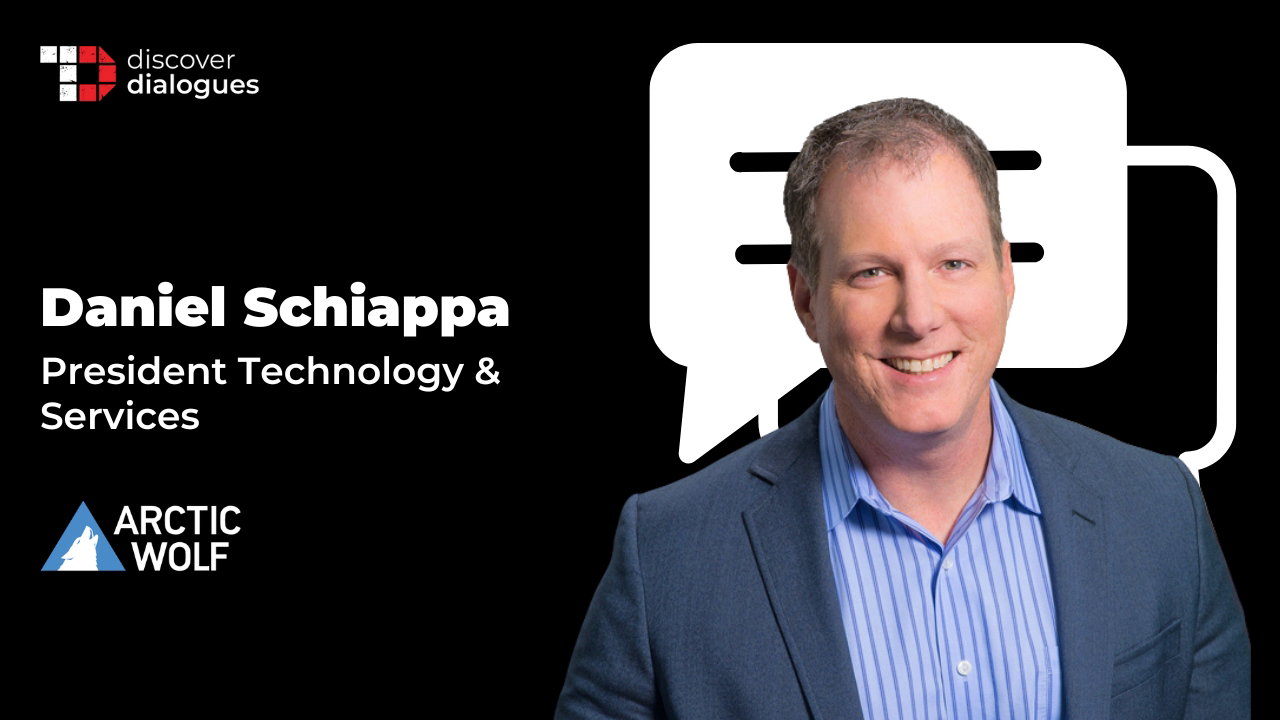
Daniel Schiappa, President Of Technology And Services At Arctic Wolf, On Why Cyber Resilience Requires AI, Human Expertise And Unified Security Operations
Share
Overview
In this TechDogs Q&A, Daniel Schiappa, President of Technology and Services at Arctic Wolf, discusses how AI, unified data, continuous monitoring, and human expertise can strengthen cyber resilience. He explains where AI can improve threat detection, investigation, and response, why human judgment remains essential, and how identity security, cloud complexity, agentic AI, and proactive risk management will shape the future of cybersecurity.
Here is a brief introduction of Daniel:
Daniel Schiappa is President of Technology and Services at Arctic Wolf, where he leads the company’s AI, product and technology strategy, global security operations, service delivery, incident response, and strategic development efforts. He previously served as Arctic Wolf’s Chief Product and Services Officer.
With extensive technology and cybersecurity leadership experience across Microsoft, RSA Security, Sophos, and Arctic Wolf, Daniel brings deep expertise in identity security, cloud computing, managed detection and response, product innovation, and global security operations. Throughout his career, he has led large technology teams and helped organizations strengthen security across increasingly complex digital environments. In this conversation, he discusses applying AI responsibly, reducing operational fragmentation, improving threat response, and building long-term cyber resilience.
TD Editor: You have led cybersecurity and product strategy across companies such as Microsoft, RSA, Sophos, and now Arctic Wolf. How has your perspective on enterprise security evolved as organizations have moved from platform and identity security to cloud, MDR, and AI-led operations?
Over the course of my career, the focus of enterprise security has steadily expanded from protecting defined boundaries to managing dynamic, continuously changing environments. Early on, a strong perimeter and identity controls could meaningfully reduce risk. As organizations moved to cloud and hybrid infrastructure, those boundaries dissolved, and security became less about individual controls and more about how effectively teams could operate across a distributed attack surface. That shift exposed a gap between the number of tools organizations deploy and their ability to translate those tools into consistent, effective outcomes.
What has become clear is that security is now an operations problem at its core. The pace and scale of modern attacks, especially with AI in play, require organizations to move faster and make decisions with greater precision across the entire environment. That is why the industry is moving toward platforms and managed operations models like MDR and the Aurora® Superintelligence Platform, where AI, data, and human expertise are integrated into a single system designed to deliver outcomes that teams can trust.
TD Editor: Cybersecurity has moved far beyond traditional perimeter defense, with enterprises now dealing with cloud complexity, identity risks, AI-driven threats, and expanding attack surfaces. How should security leaders rethink their strategy to build stronger cyber resilience in this new environment?
Security leaders need to shift away from a tools-centric mindset and focus on building an operational strategy that improves resilience over time. Many organizations have invested heavily in point solutions, yet still struggle with fragmentation, alert fatigue, and limited visibility into actual risk. A more effective approach is to center the strategy on an AI-native platform that can integrate existing investments, unify data across the environment, and continuously improve detection and response. With adversarial AI becoming the norm, operating with broad visibility, at scale, and at machine speeds has become critical.
Resilience also depends on combining technology with expertise and accountability. That means adopting models that incorporate continuous monitoring, real-world threat intelligence, and human oversight to ensure that decisions are grounded in context. When organizations align their security program to measurable outcomes such as faster response, better prioritization, and reduced exposure, they move beyond reacting to threats and begin to systematically reduce risk across the business.
TD Editor: AI is becoming an important part of security operations, from detecting threats to supporting investigation and response. Where do you believe AI can create the most meaningful impact, and where does human expertise remain irreplaceable?
AI has the greatest impact in areas where speed, scale, and pattern recognition are critical. This includes triaging large volumes of alerts, correlating signals across the attack surface, accelerating investigations, and responding with protective actions. This would otherwise take analysts significant time to complete but must now operate at machine speeds. With the right data and validation in place, AI can help organizations detect threats earlier and respond more quickly, which is essential as attackers increasingly operate at machine speed.
At the same time, human expertise remains essential for judgment, context, and accountability. Complex investigations, novel attack patterns, and high-impact decisions require an understanding of business context that AI alone cannot fully replicate. That is why effective models keep humans in the loop, using AI to extend their capabilities rather than replace them. This combination of agent-led operations and expert validation is what enables both speed and trust in modern security operations.
TD Editor: Many organizations have invested in multiple cybersecurity tools, yet still struggle with alert fatigue, fragmented visibility, and slow response times. What separates a well-equipped security team from a truly effective one?
A well-equipped team has access to many tools and data sources, but an effective team can turn that input into clear, actionable outcomes. The difference comes down to integration, prioritization, and execution. Teams that struggle are often overwhelmed by disconnected alerts and workflows, which slows response and increases the risk of missing critical threats.
Effective teams operate within a cohesive system where data is normalized, signals are enriched, and workflows are coordinated end to end. They are able to focus on what matters most because much of the routine analysis and correlation is handled at scale. This allows analysts to spend more time on higher-value work such as threat hunting, investigation, and strategic risk reduction, which ultimately improves both speed and quality of response.
TD Editor: Security operations have become a major challenge for enterprises as threats grow faster, environments become more distributed, and internal teams face increasing pressure. How can organizations bring together technology, human expertise, and continuous monitoring to improve detection, response, and overall cyber resilience?
Organizations need an operating model that unifies technology, human expertise, and continuous monitoring into a single system rather than managing them separately. That starts with a platform that can ingest and analyze telemetry across the entire attack surface, creating a consistent view of activity and risk. From there, agent-led workflows can help accelerate detection and response while maintaining consistency at scale.
Equally important is the role of human expertise in guiding and validating outcomes. Continuous monitoring is most effective when it is paired with analysts who understand the environment and can apply context to every decision. Models like the Aurora Agentic SOC™ demonstrate how this can work in practice by combining AI-driven operations with a Concierge Experience that keeps experts engaged in the process, ensuring that security improves over time rather than remaining static.
TD Editor: Looking ahead, what major cybersecurity shifts do you expect over the next few years, especially around AI, identity, cloud security, and proactive risk management?
We will continue to see AI reshape both sides of the cybersecurity equation. Attackers are already using AI to scale their operations, automate campaigns, and adapt faster than traditional defenses can keep up. On the defensive side, organizations will accelerate adoption of agentic AI to improve detection, investigation, and response, but success will depend on trust, validation, and integration into real security operations.
Identity and cloud security will remain central as environments grow more distributed, and proactive risk management will become a bigger priority. Rather than focusing only on detection and response, organizations will invest more in continuously reducing risk and demonstrating measurable improvements in their security posture. The shift will be toward platforms and partners that can deliver both protection and long-term resilience, helping organizations manage cyber risk as a core business issue rather than a purely technical challenge.
Tue, Aug 11, 2026

Enjoyed what you've read so far? Great news - there's more to explore!
Stay up to date with the latest news, a vast collection of tech articles including introductory guides, product reviews, trends and more, thought-provoking interviews, hottest AI blogs and entertaining tech memes.
Plus, get access to branded insights such as informative white papers, intriguing case studies, in-depth reports, enlightening videos and exciting events and webinars from industry-leading global brands.
Dive into TechDogs' treasure trove today and Know Your World of technology!
Disclaimer - Reference to any specific product, software or entity does not constitute an endorsement or recommendation by TechDogs nor should any data or content published be relied upon. The views expressed by TechDogs' members and guests are their own and their appearance on our site does not imply an endorsement of them or any entity they represent. Views and opinions expressed by TechDogs' Authors are those of the Authors and do not necessarily reflect the view of TechDogs or any of its officials. While we aim to provide valuable and helpful information, some content on TechDogs' site may not have been thoroughly reviewed for every detail or aspect. We encourage users to verify any information independently where necessary.
Loading comments...