
Storage
AI Vision For Enterprise Storage From Systems You Manage To Experiences That Manage Themselves
Share
The future of storage will be characterized by ultra-simple, zero-click, self-service experiences where systems consistently meet performance, capacity, availability, and cyber-resilience goals with little manual effort. At the center of this change is Agentic AI, which is intelligence that can perceive, reason, plan, and act based on policies set by the organization. When paired with conversational interfaces, it changes how people interact with storage- from using a tool to working with an intelligent partner.
It's important to have a practical perspective here: generative AI will first change storage operations by speeding up human decision-making- resulting in faster diagnoses, clearer choices, and safer change plans. Fully autonomous fixes will come more slowly and only in controlled, validated, and governed situations. In enterprise storage, trust is not just a slogan; it’s a necessary part of operations.
The Shift: From Managing Infrastructure To Expressing Intent
Traditional storage management is reactive and operational. Administrators monitor dashboards, interpret alerts, correlate logs, and manually execute corrective actions. Even with automation, humans remain deeply engaged in the control loop, approving workflows, stitching tools together, and carrying the cognitive load of understanding what matters and what doesn’t.
AI-driven storage flips the model. Instead of telling systems how to operate, users express what they want:
-
Ensure my databases always stay under 2 ms latency.
-
Reduce storage costs for cold data without affecting compliance.
-
Migrate this workload to the best system with zero downtime.
Agentic AI can translate these intents into specific actions, i.e., provisioning, tuning, migration, protection, and optimization, executed across the environment. The result is an experience where outcomes are consistently achieved without manual configuration or intervention.
But for CIOs and CTOs, the key is not the elegance of the interface, but it is the architecture of control.
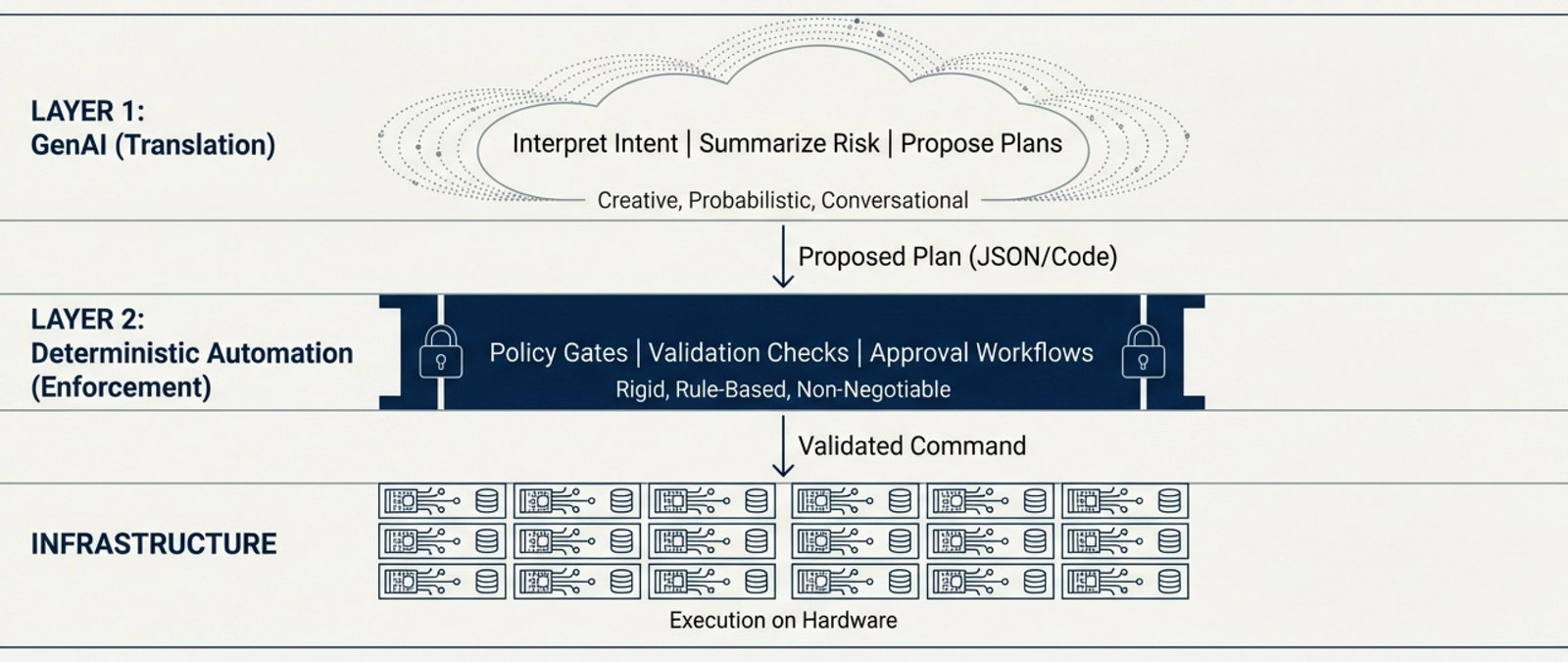
The most credible approach separates responsibilities:
-
GenAI as the translation layer: interpret intent, generate queries, propose plans, summarize risk, and present options.
-
Deterministic automation as the enforcement layer: apply changes only when they pass policy gates, validation checks, and approval workflows.
That’s how intent-based operations scale in the enterprise: convenience without sacrificing discipline.
Agentic AI: The Brain Behind Autonomous Storage
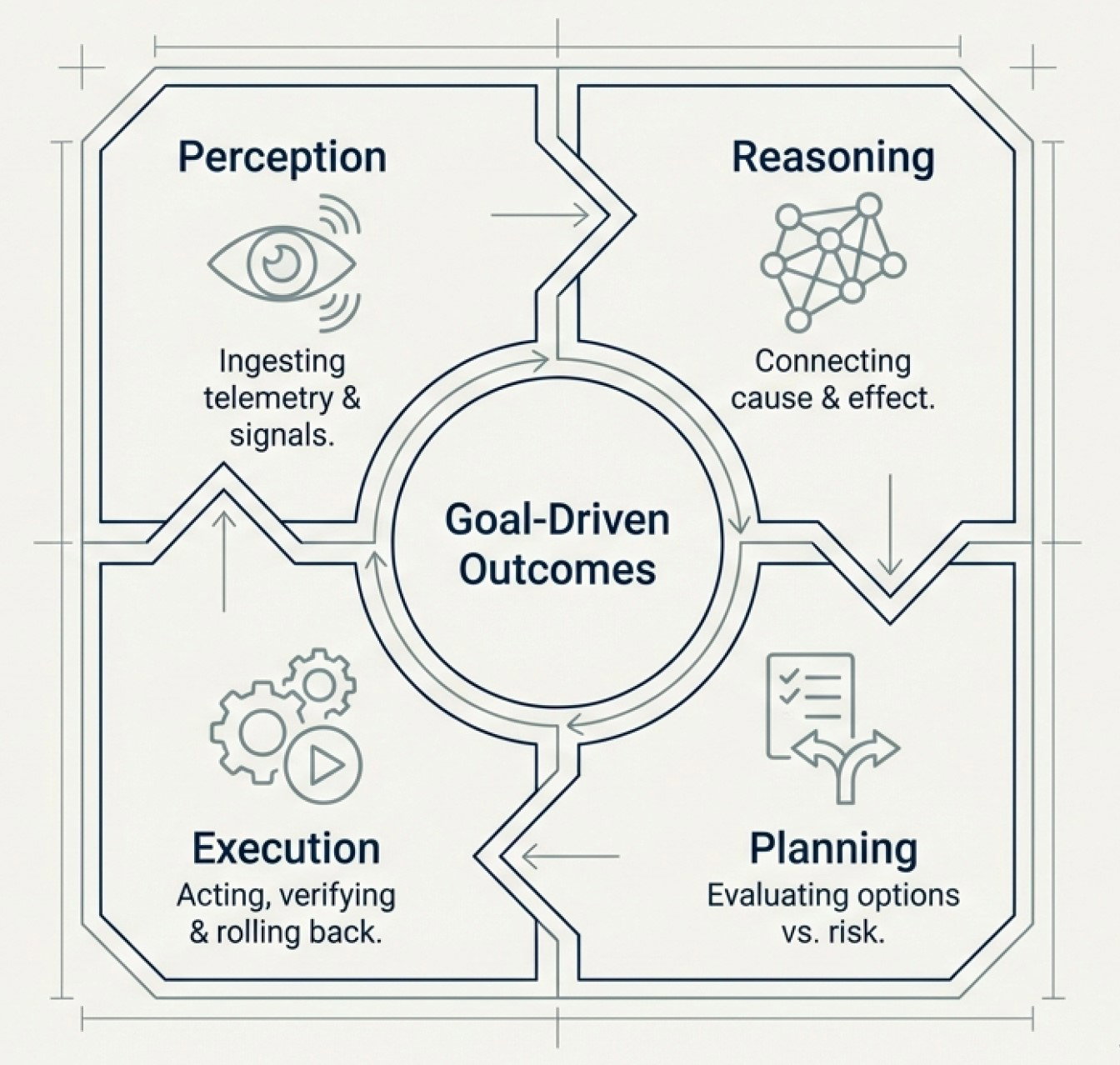
Unlike AI, which only recommends, Agentic AI is designed to act. It brings four essential capabilities:
-
Perception
continuously ingesting telemetry, workload patterns, and environmental signals.
-
Reasoning
connecting cause and effect across performance, capacity, availability, and cyber-threat signals.
-
Planning
evaluating options based on policy, risk tolerance, and business objectives.
-
Execution
carrying out changes safely, verifying outcomes, and rolling back when needed.
-
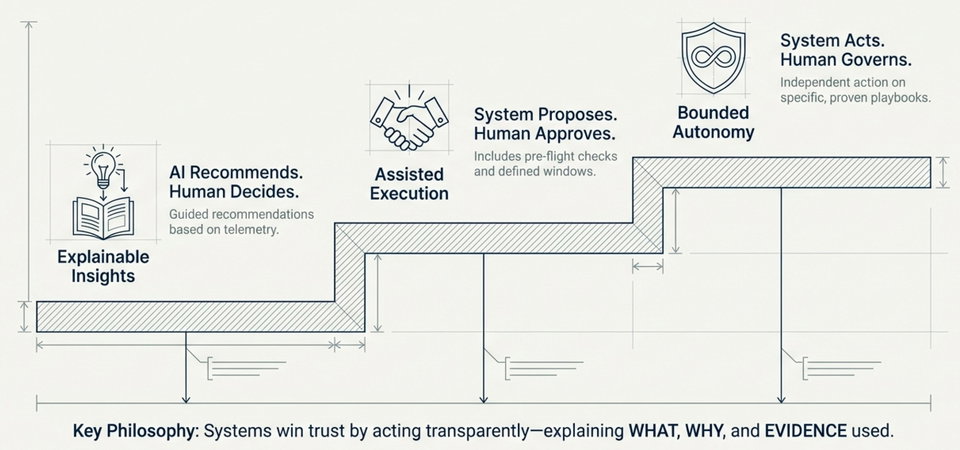
Start with explainable insights and guided recommendations.
-
Move to assisted execution (human approval, pre-flight checks, change windows).
-
Earn the right to bounded autonomy for specific, proven playbooks where validation and rollback are deterministic.
Systems that act transparently, explaining what they did, why they did it, the evidence they used, and how success was confirmed, will be the ones that gain people's trust. For a concrete view of how IBM is advancing autonomous, policy-guided storage operations, see [Link].
Conversational Interfaces: A New User Experience For Storage
As storage becomes more autonomous, the interface must evolve. Metric-rich dashboards are useful, but they are designed for experts and presume that the operator already knows what questions to ask.
Conversational interfaces, which reduce friction and expedite decision-making, are the way of the future.
-
Why did latency spike last night?
-
What’s the fastest path to add 200 TB without downtime?
-
Am I protected against ransomware right now?
The defining requirement for conversational storage is credibility. An enterprise storage assistant can’t be a guessing machine. Every response has to be grounded in authoritative telemetry, configuration state, and policy context- with clear time windows and traceability.
When implemented correctly, conversational management becomes the quickest route from question to evidence to plan to validated action.
Executive teams should demand a high standard in this situation because the quality of the conversational experience depends on the observability, data quality, and governance that support it.
Automated Diagnosis And Self-Healing Systems
Few areas consume more time than diagnosis. Storage problems typically affect hosts, fabrics, arrays, and applications rather than just one layer. Today, triage often requires expert input from various systems and teams.
Agentic AI enhances this by swiftly connecting signals:
-
Find irregularities before people do.
-
Connect symptoms to historical occurrences and recognized patterns.
-
Determine probable underlying causes and possible outcomes.
-
Make recommendations and implement safe solutions
However, a precise definition of "self-healing" is crucial. Self-healing in enterprise block storage should entail:
-
Closed-loop solutions for a small number of proven safe practices
-
Policy reviews according to the significance of the workload
-
Pre-flight inspections and confirmations following changes
-
One important design principle is rollback.
-
Accurate documentation for each action
Instead of saying "AI fixes everything," this is the operationally sound strategy: "AI reliably handles repeatable tasks and escalates unclear issues with context."
Autonomous Data Migration Without Fear
Data migration is one of the most disruptive and error-prone activities in storage. It has historically demanded careful planning, downtime coordination, and a deep bench of expertise. Risk is often driven not by the concept of migration, but by the complexity of execution and the possibility of human error.
Agentic AI changes the economics of migration by turning it into a controlled workflow. When the system understands workload behavior and dependencies, it can:
-
Identify optimal migration windows
-
Choose the right target tier or platform based on objectives
-
Execute live, non-disruptive migrations
-
Validate application performance and policy compliance after the move
This is a strong candidate for early autonomy because it can be structured end-to-end. The operator states the goal; the platform proposes a plan with clear risk boundaries; execution is validated; and rollback is built in. Migration becomes a background capability rather than a major event.
Trust, Governance, And Human Oversight
Autonomy is only valuable if it’s governable.
The most effective AI-powered storage systems will strike a balance between control, transparency, and independence. Agentic AI must adhere to human-defined risk thresholds, policies, and compliance guidelines. Every action needs to be reversible, auditable, and explicable.
Cyber resilience is where this philosophy becomes concrete. In order to detect anomalous patterns in a matter of seconds and initiate response workflows like alerting, immutable snapshots, and recovery readiness, storage platforms are increasingly integrating intelligence near the data path.
However, detection is not resilient on its own. Resilience is detection plus disciplined operational response: guardrails, rehearsed recovery, and end-to-end visibility.
Over time, as confidence builds, human oversight gradually moves from micromanagement to strategic intent setting, which involves establishing cyber policies, automation boundaries, and service goals while the system consistently manages daily tasks.
Conclusion: Storage As An Intelligent Partner
The goal of the AI storage vision is to free people rather than replace them.
Compressing time-to-clarity will have the greatest immediate effects, including quicker diagnosis, safer change planning, and automation of repeated operations under governance. Storage will eventually feel less like infrastructure and more like an intelligent partner that listens to intent, acts upon it, and keeps becoming better.
The call to action for CIOs and CTOs is simple:
1. Consider storage as a control plane rather than a box. Prioritize platforms with strong telemetry, policy enforcement, and auditability across hybrid environments.
2. Start using GenAI where it is most effective. Utilize it to create safe change plans, expedite diagnosis, and summarize incidents before expanding into bounded autonomy.
3. Engineer trust explicitly. Explainability, validation, rollback, and change governance should be considered product features rather than after-the-fact procedures.
4. Make cyber resilience a requirement for storage-native systems. Align detection with operational preparedness, clean restore procedures, and immutable recovery.
5. Make an investment in skill development because the nature of work changes but doesn't go away. The future operator controls autonomy, establishes intent and policy, and concentrates on results.
This is how we achieve "zero-click" in a way that the business can truly function: disciplined autonomy, based on the principles storage has always required, rather than hype.
Tue, Feb 17, 2026

Enjoyed what you read? Great news – there’s a lot more to explore!
Dive into our content repository of the latest tech news, a diverse range of articles spanning introductory guides, product reviews, trends and more, along with engaging interviews, up-to-date AI blogs and hilarious tech memes!
Also explore our collection of branded insights via informative white papers, enlightening case studies, in-depth reports, educational videos and exciting events and webinars from leading global brands.
Head to the TechDogs homepage to Know Your World of technology today!
Disclaimer - Reference to any specific product, software or entity does not constitute an endorsement or recommendation by TechDogs nor should any data or content published be relied upon. The views expressed by TechDogs' members and guests are their own and their appearance on our site does not imply an endorsement of them or any entity they represent. Views and opinions expressed by TechDogs' Authors are those of the Authors and do not necessarily reflect the view of TechDogs or any of its officials. While we aim to provide valuable and helpful information, some content on TechDogs' site may not have been thoroughly reviewed for every detail or aspect. We encourage users to verify any information independently where necessary.
Loading comments...