
Manufacturing Technology
XPENG’s Physical AI Reveal: New Humanoid Robot, Robotaxi, Flying Car And More
Updated on Thu, Nov 6, 2025
Share
This spans beyond just humanoid robots or those being used to assist in factories, extending to robotaxis, flying vehicles, and the systems that enable such practical uses. Such applications fall under the umbrella of “Physical AI,” which is a branch of AI that enables machines to interact with the physical world.
On November 5, Chinese electric vehicle (EV) maker XPENG took a major leap in the physical AI sector with a series of product reveals and announcements made during its 2025 XPENG AI Day—the seventh iteration—held at XPENG Science Park in Guangzhou.
The event began with XPENG’s Chairman and CEO, He Xiaopeng, talking about how the company is set to evolve from an AI-driven mobility company to “a mobility explorer in the physical AI world and a global embodied intelligence company,” and outlined its vision for the coming years.
XPENG is now the only company in China to achieve a full-stack self-developed physical AI system—meaning that it has designed and produced the chips, intelligent hardware, AI models, and software used in its AI system.
This system will serve as the base for products such as AI-enabled vehicles, robotaxis, humanoid robots, and flying cars.
XPENG’s New AI System
Powering this innovation is the XPENG VLA 2.0, the company’s AI model.
He Xiaopeng believes that large models will become the “operating system of the physical AI world” and the foundation for all physical AI applications.
XPENG’s VLA 2.0 large model uses a brand-new “Vision-Implicit Token-Action” that cuts out the need for language translation and instead delivers end-to-end direct generation from visual signals to action commands.
As per the company, it serves as an action generative model and a physical world model for understanding and prediction, which can also learn and evolve on its own. It’s a cross-domain model that can be applied to AI cars, humanoid robots, and flying cars simultaneously.
The model is backed by XPENG’s cloud computing cluster of 30,000 cards and a previously deployed base model with 72 billion ultra-large-scale parameters. As such, the model can achieve a full-cycle iteration once every five days.
When it comes to its capabilities in self-driving cars, XPENG VLA 2.0 has been trained on nearly 100 million clips, representing the sum of extreme driving scenarios a human would encounter over 65,000 years. The model can use a vast number of real driving videos for training without any Data Annotation.
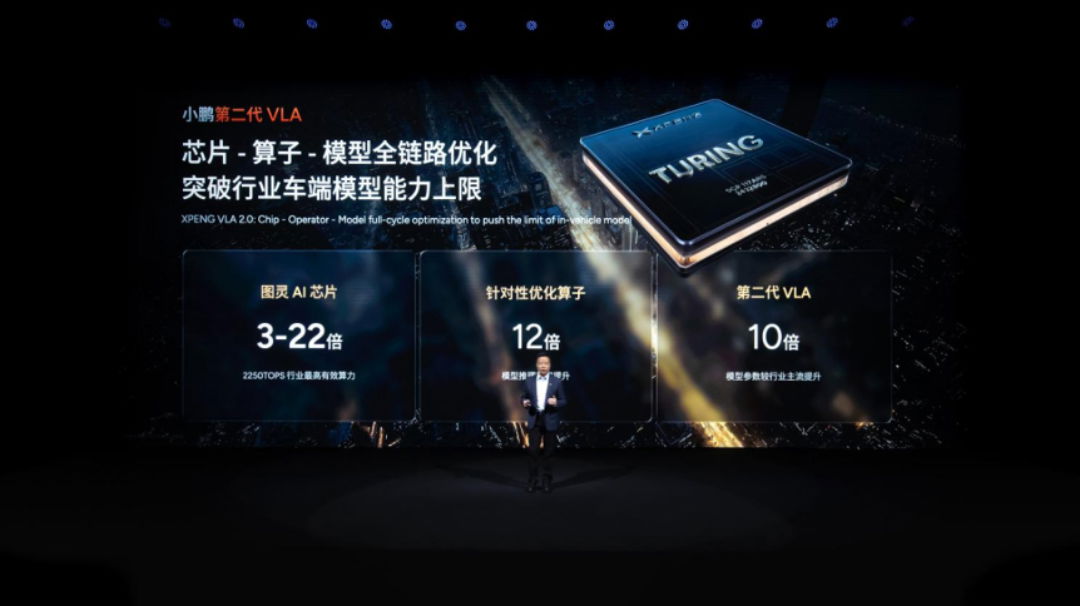
To bring the VLA 2.0 to mass production to be used in vehicles, the company redeveloped a targeted compiler and software stack for its self-developed Turing AI chip. This enabled a parameter scale of billions on the Ultra version model with 2250 TOPS. In comparison, current common models span parameters of only tens of millions.
XPENG also launched the “Narrow Road NGP” function to improve driving performance on complex, narrow roads and mixed-traffic environments. Meanwhile, “Navigation-Free Automated Driving Assistance" Super LCC + Human-Machine Co-Driving, which accentuates steering wheel movements to reduce effort and can be used globally without navigation.
By 2025 end, pioneer users will be invited to co-create and experience the new model, with full roll-out expected in Q1 2026 to XPENG Ultra models.
“To accelerate the global application of physical AI and the co-construction of its ecosystem, XPENG VLA 2.0 large model will be open-sourced to global business partners,” said XPENG, adding that Volkswagen will become the launch customer of XPENG VLA 2.0.
XPENG’s New Robotaxi
As per XPENG, the robotaxi sector has not yet hit large-scale popularization. As a result, it plans to launch three Robotaxi models in 2026 with the aim of addressing current challenges such as “high retrofit costs, small fleet size, limited operating scope, and numerous ride-hailing restrictions.”
Its robotaxi will come with 4 of its Turing AI chips that deliver 3000 TOPS of computing power, will rely on vision-based automation, and will be China's first full-stack self-developed and mass-produced Robotaxi.
Powered by the XPENG VLA 2.0 and VLM (Vision-Language Model), the driverless robotaxis will support generalization learning to enable higher versatility and global rapid deployment efficiency, while its dual-redundancy hardware architecture will allow two sets of hardware to serve as backups for each other.
The company spoke about privately owned driver-present L4 models and plans to open its SDK to jointly build its Robotaxi ecosystem with global partners—the first partner in this endeavor will be the Alibaba-backed Amap.
XPENG’s New Humanoid Robot
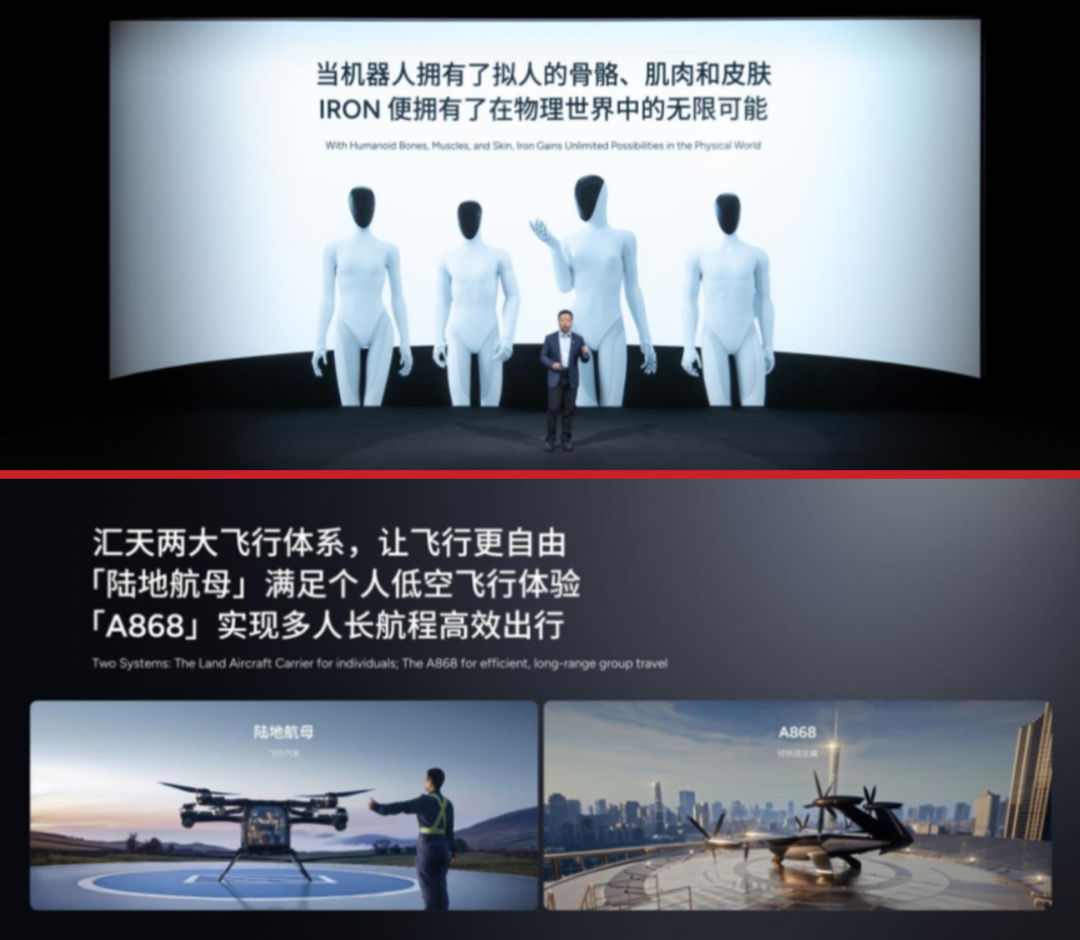
XPENG’s new Next-Gen IRON comes with a highly human-like appearance that makes it stand out when compared to other humanoid robots.
Featuring a humanoid spine, bionic muscles, 82 degrees of freedom, and fully covered flexible skin—which can be customized in different body shapes—the company’s new humanoid robot exhibits natural, smooth, and flexible movements, including high-difficulty human-like actions.
At the event, the robots catwalked!
Meow!
The Next-Gen IRON is powered by 3 Turing AI chips that deliver an effective computing power of 3000 TOPS and is equipped with XPENG's first-generation physical world large model.
In addition to the famous “Three Laws of Robotics,” the robot adheres to a new fourth law: Privacy data does not leave the robot.
“By the end of 2026, XPENG aims to achieve large-scale mass production of high-level humanoid robots,” said He Xiaopeng.
The company plans to monetize its robots by enabling them to perform commercial services such as guided tours, shopping guides, and traffic diversion, while also opening its SDK to “jointly build a humanoid robot application ecosystem with global developers.”
XPENG’s New Flying Car
XPENG introduced two flight systems for low-altitude travel—Land Aircraft Carrier for individual short-haul flight experiences and the full tiltrotor hybrid flying car A868 for multi-passenger long-haul travel.
The 6-seater A868 leverages a self-developed hybrid-electric core to provide continuous and sufficient energy supply, supporting a range of 500 km and a maximum cruising speed of 360 km/h. This flying car is in its flight verification stage.
Meanwhile, the Land Aircraft Carrier has officially entered the mass production stage, sitting with global orders exceeding 7,000 units—a new industry record, as per XPENG. Mass production is expected to begin by 2026.
The company comes in with a planned annual production capacity of 10,000 units—with an initial capacity of 5,000 units—where one aircraft can roll off the production line every 30 minutes.
Do you think XPENG’s full-stack style of product development will influence how automotive companies design their operations?
Let us know in the comments below!
First published on Thu, Nov 6, 2025

Enjoyed what you read? Great news – there’s a lot more to explore!
Dive into our content repository of the latest tech news, a diverse range of articles spanning introductory guides, product reviews, trends and more, along with engaging interviews, up-to-date AI blogs and hilarious tech memes!
Also explore our collection of branded insights via informative white papers, enlightening case studies, in-depth reports, educational videos and exciting events and webinars from leading global brands.
Head to the TechDogs homepage to Know Your World of technology today!
Disclaimer - Reference to any specific product, software or entity does not constitute an endorsement or recommendation by TechDogs nor should any data or content published be relied upon. The views expressed by TechDogs' members and guests are their own and their appearance on our site does not imply an endorsement of them or any entity they represent. Views and opinions expressed by TechDogs' Authors are those of the Authors and do not necessarily reflect the view of TechDogs or any of its officials. While we aim to provide valuable and helpful information, some content on TechDogs' site may not have been thoroughly reviewed for every detail or aspect. We encourage users to verify any information independently where necessary.
Loading comments...