
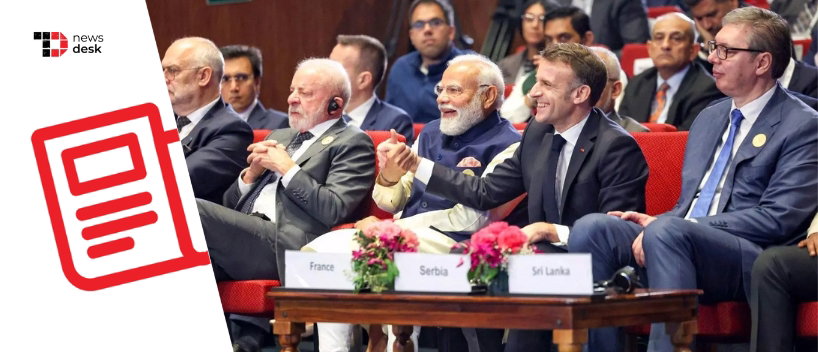
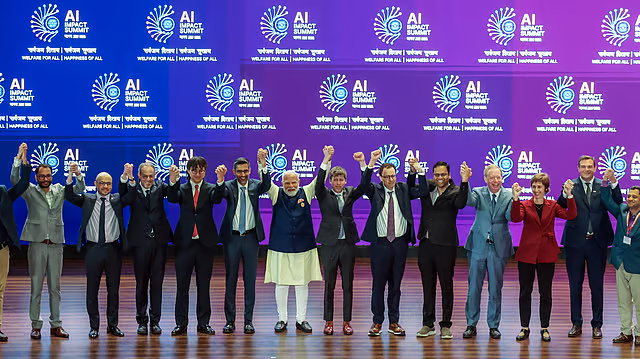
India’s AI Impact Summit 2026 brought together global political leaders and technology executives to discuss artificial intelligence governance, digital sovereignty, infrastructure, and inclusion. The event highlighted both the transformative potential of AI and the responsibility required to deploy it safely.
TL;DR
- Narendra Modi called for democratised, human-centric AI.
- Emmanuel Macron warned against digital dependency.
- Sundar Pichai cautioned against an AI divide.
- Mukesh Ambani spoke about intelligence self-reliance.
- Dario Amodei outlined AI benefits and risks.
Narendra Modi
Prime Minister Narendra Modi emphasized inclusive AI development and warned against reducing individuals to mere data inputs.
“For AI, humans are just data points. To ensure that humans are not reduced to mere raw material, AI must be democratised. It must be made a medium for inclusion and empowerment, especially in the Global South. We must give AI an open sky and also keep the command in our hands. The direction in which we take AI today will determine our future.”
His remarks framed artificial intelligence as both a technological and societal responsibility, particularly for emerging economies.
Emmanuel Macron
French President Emmanuel Macron focused on digital sovereignty and equitable access to AI systems.
“At a time when tensions are rising, there is an increased sense of urgency to direct all our digital tools towards this inclusive approach and in order, indeed, to be strong here in India but to be strong as well on the African continent. No country is bound to serve only as a market where foreign companies sell the models and download the citizens’ data.”
Macron’s comments underscored concerns about nations becoming passive consumers of foreign-developed AI technologies.
Sundar Pichai
Google and Alphabet CEO Sundar Pichai addressed the importance of preventing inequality in the AI era.
“We cannot allow the digital divide to become an AI divide. Responsibility also means navigating profound economic shifts. AI will undeniably reshape the workforce, automating some roles, evolving others, and creating entirely new careers. 20 years ago, the concept of a professional YouTube creator didn’t exist. Today, there are millions around the world.”
Pichai framed AI transformation as inevitable, while stressing the need for responsible navigation of economic transitions.
Brad Smith
Microsoft President Brad Smith emphasized infrastructure and applied AI solutions in developing regions.
“We need to leverage AI in the Global South to address the problems that matter most to them, such as improving agriculture. Microsoft is launching a new initiative this week to address food security across Africa. If we build infrastructure, invest in skills, and address real-world problems, we create a foundation for the future.”
His remarks centered on practical deployment rather than theoretical capability discussions.
Topics For More Insights
Mukesh Ambani
Reliance Industries Chairman Mukesh Ambani focused on domestic AI capability and cost accessibility.
“Jio connected India to the internet era. Jio will now connect India to the intelligence era. India cannot afford to rent intelligence. Therefore, we will reduce the cost of intelligence as dramatically as we did with the cost of data.”
Ambani’s statement positioned AI infrastructure as a strategic national priority.
Dario Amodei
Anthropic CEO Dario Amodei highlighted both the promise and potential risks of increasingly capable AI systems.
“On the positive side, we have the potential to cure diseases that have been incurable for thousands of years, to radically improve human health, and to lift billions out of poverty, including the global south, and create a better world for everyone. On the side of risks, I'm concerned about the autonomous behaviour of AI models, their potential for misuse by individuals and governments, and their potential for economic displacement.”
His comments balanced optimism with caution, reflecting broader global debates around advanced AI systems.
Demis Hassabis
DeepMind CEO Demis Hassabis described the broader historical significance of artificial general intelligence.
“In 2026, we’re at the threshold moment where artificial general intelligence (AGI), is on the horizon. We’re seeing these general purpose systems, foundational model systems becoming increasingly capable week by week. AGI will be one of the most momentous periods in human history, like the advent of fire or electricity.”
Hassabis framed AGI as a transformative technological milestone without tying it to a fixed economic forecast.
