
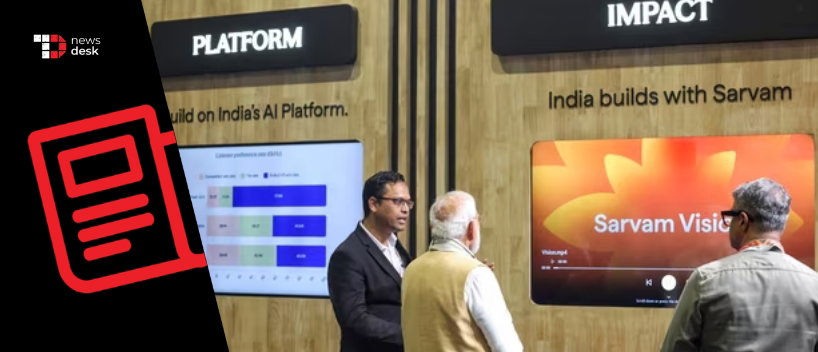
India’s artificial intelligence ecosystem added a new player as Bengaluru-based startup Sarvam unveiled a suite of large language models tailored for Indian languages and enterprise use cases. The company is positioning its systems as locally optimized alternatives in a market currently led by global platforms such as ChatGPT and Claude.
Rather than focusing purely on global benchmark rankings, Sarvam is emphasizing contextual depth and regional adaptation to address India’s linguistic and operational complexity.
TL;DR
- Sarvam launched AI models designed for India’s multilingual landscape.
- The models focus on Indic language understanding and enterprise workflows.
- Enterprise and public sector engagements are currently in pilot phases.
- The move aligns with India’s broader push toward domestic AI capability.
Sarvam’s newly introduced models are designed to address India’s diverse linguistic environment, which includes 22 officially recognized languages and hundreds of dialects. India presents challenges that differ from primarily English-centric AI markets, particularly in customer engagement, public services, and document-heavy enterprise workflows.
While global AI systems support multiple languages, Sarvam says its models are trained and fine-tuned with deeper emphasis on Indic datasets, cultural context, and localized enterprise requirements. The company has not made absolute claims about outperforming global competitors, instead highlighting performance in specific regional and task-based scenarios.
“Our mission is to build AI that truly understands India’s diversity, across language, regulation, and enterprise processes,” said Vivek Raghavan, Co-founder of Sarvam AI. “Localization goes beyond translation. It requires contextual adaptation and deep integration into real-world workflows.”
The startup is targeting sectors such as banking, healthcare, customer support, and government services, where multilingual communication and document-heavy processes are common. These industries often require contextual accuracy and workflow integration rather than only general conversational ability.
Topics For More Insights
However, large-scale enterprise and government rollouts remain in development. Sarvam indicated that partnerships and pilot deployments are underway, though it has not announced confirmed nationwide deployments or formal regulatory certifications.
India’s AI ecosystem has expanded significantly over the past two years, supported by startup growth and policy-level interest in strengthening domestic AI infrastructure. Policymakers have emphasized the importance of building local AI capabilities that align with India’s data governance and digital public infrastructure goals.
Industry observers note that region-specific optimization may become a competitive differentiator in emerging markets. While global leaders continue to dominate general-purpose AI benchmarks, localized models may offer advantages in contextual performance and enterprise adaptation.
Sarvam’s strategy reflects this belief. Instead of competing solely on model size or headline benchmark metrics, the company appears focused on customization depth, enterprise integration, and contextual alignment for Indian users.
As AI adoption accelerates across India’s digital economy, the competitive landscape may increasingly favor models that balance global capability with regional specificity.
.png?ext=.png)