
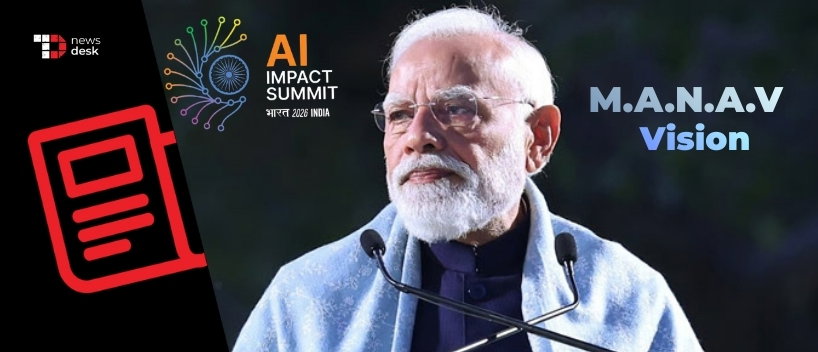
Prime Minister Narendra Modi unveiled India’s ‘MANAV’ vision for artificial intelligence at the Mega AI Impact Summit, outlining a human-centric and ethically governed framework for AI development while calling for stronger global cooperation and greater inclusion of developing nations in shaping AI’s future.
TL;DR
- PM Modi introduced ‘MANAV’, a human-first AI framework.
- Emphasized ethics, transparency, and accountability in AI systems.
- Advocated stronger inclusion of Global South nations in AI governance.
- Summit attended by global leaders, UN representatives, and technology executives.
What Is India’s ‘MANAV’ Vision?
At the summit, Modi described MANAV, meaning human in Hindi, as the guiding doctrine for India’s artificial intelligence journey. He stated that AI must remain centered on human values and democratic principles, and that innovation must be accompanied by responsibility.
According to Modi, artificial intelligence should enhance human capabilities rather than replace them. He stressed that AI systems must be safe, trustworthy, transparent, and accountable. Without ethical guardrails, he warned, rapid technological expansion could erode public trust and deepen inequality.
Modi positioned MANAV as India’s commitment to ensuring that artificial intelligence strengthens society while maintaining human oversight and dignity at its core.
A Clear Message On Global South Inclusion
A defining theme of Modi’s address was the need to prevent a widening technological divide between advanced and developing economies. He emphasized that AI governance cannot be shaped solely by advanced nations or a small group of global technology corporations.
Developing countries, he said, must have an equal voice in setting global standards and regulatory frameworks. He cautioned that concentration of computing power and AI capabilities in limited regions could marginalize emerging economies.
Modi urged the global community to ensure equitable access to AI tools, infrastructure, and knowledge so that the benefits of artificial intelligence are widely shared.
International Participation Highlights Global Stakes
The Mega AI Impact Summit brought together policymakers, multilateral representatives, and technology leaders from multiple countries. Reports noted participation from France and representatives linked to the United Nations, along with senior executives from global technology companies and research institutions.
Discussions focused on AI safety standards, ethical governance frameworks, regulatory coordination, and cross-border collaboration. The presence of international stakeholders underscored the summit’s role in shaping broader global conversations around responsible AI deployment.
Topics For More Insights
Skills, Trust, And Responsible Deployment
Modi also highlighted the importance of capacity building in the AI era. He called for investments in skilling, reskilling, and lifelong learning to prepare societies for AI-driven transformation.
He emphasized that workforce preparedness will determine whether artificial intelligence becomes a tool for empowerment or disruption. Public trust, he noted, will be central to AI adoption, and that trust depends on fairness, explainability, and accountability in AI systems.
Modi urged collaboration between governments, academia, industry, and civil society to design governance mechanisms that ensure responsible and inclusive AI deployment.
India’s Strategic Positioning In The AI Era
While the speech focused on governance principles rather than specific infrastructure commitments, it reinforced India’s intent to play a leading role in shaping the ethical and regulatory contours of the AI era.
By articulating the MANAV doctrine on a global stage, Modi positioned India as a proponent of value-driven technological progress. He concluded by reiterating that artificial intelligence must ultimately serve humanity, strengthen democratic systems, and promote shared prosperity across nations.
