

Artificial Intelligence
OpenAI Launches ChatGPT Atlas, An AI-Powered Browser, Taking On Google & More
Updated on Wed, Oct 22, 2025
Share
The announcement of its AI-powered browser, ChatGPT Atlas, came after a surprise livestream featuring OpenAI CEO Sam Altman (check out the highlights).
“We think AI represents a rare, once-a-decade opportunity to rethink what a browser can be,” said Altman. “In the same way that, for the previous way people used the internet, the URL bar and the search box were a great analogue, what we’re starting to see is that the chat experience and the web browser can be a quick analogue.”
All the notice people got was a mere two hours following a post on X saying there would be a livestream at 10 am PT. The next post came nine minutes before the scheduled livestream, which simply read, “Make room in your dock,” along with a link to the livestream redirecting to OpenAI’s website—which can also be viewed on YouTube.
Post the event, OpenAI also published a variety of posts highlighting the features and capabilities of ChatGPT Atlas.
ChatGPT Atlas
OpenAI’s ChatGPT Atlas is built with ChatGPT at its core.
Users can sign into ChatGPT to enable personalized conversations through the built-in ChatGPT memory.
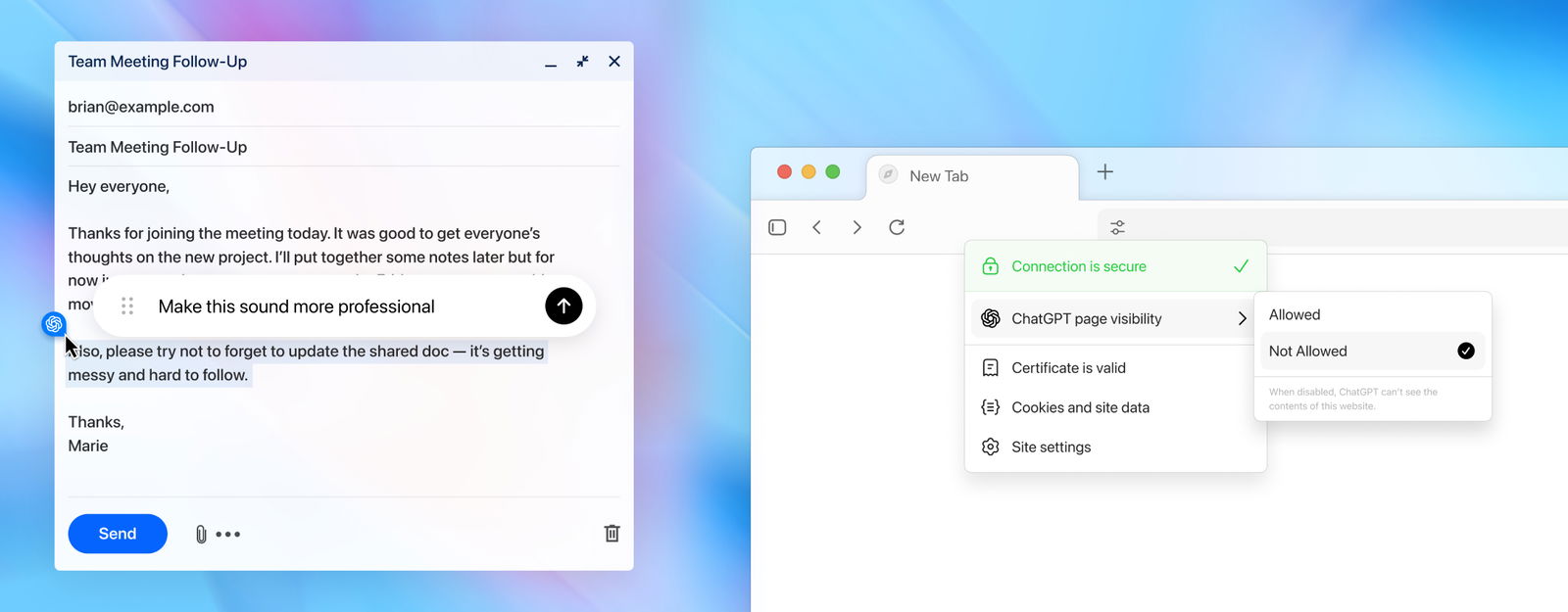
This allows conversations taking place through the browser to draw from previous chats, details, and browser history—if a user has turned on browser memories, which are kept private, and can be viewed, archived, or deleted in settings. Even if turned on, users can turn off visibility for websites using a toggle in the address bar.
Enabling browser memories improves chat responses and provides better suggestions, such as creating a to-do list from recent activity or resuming holiday gifts research based on viewed products.
Users can even import their bookmarks, saved passwords, and browsing history from other browsers.
Atlas’s starting point is a new tab, where users can ask questions or enter URLs, or explore more specific types of results (search links, images, videos, and news).
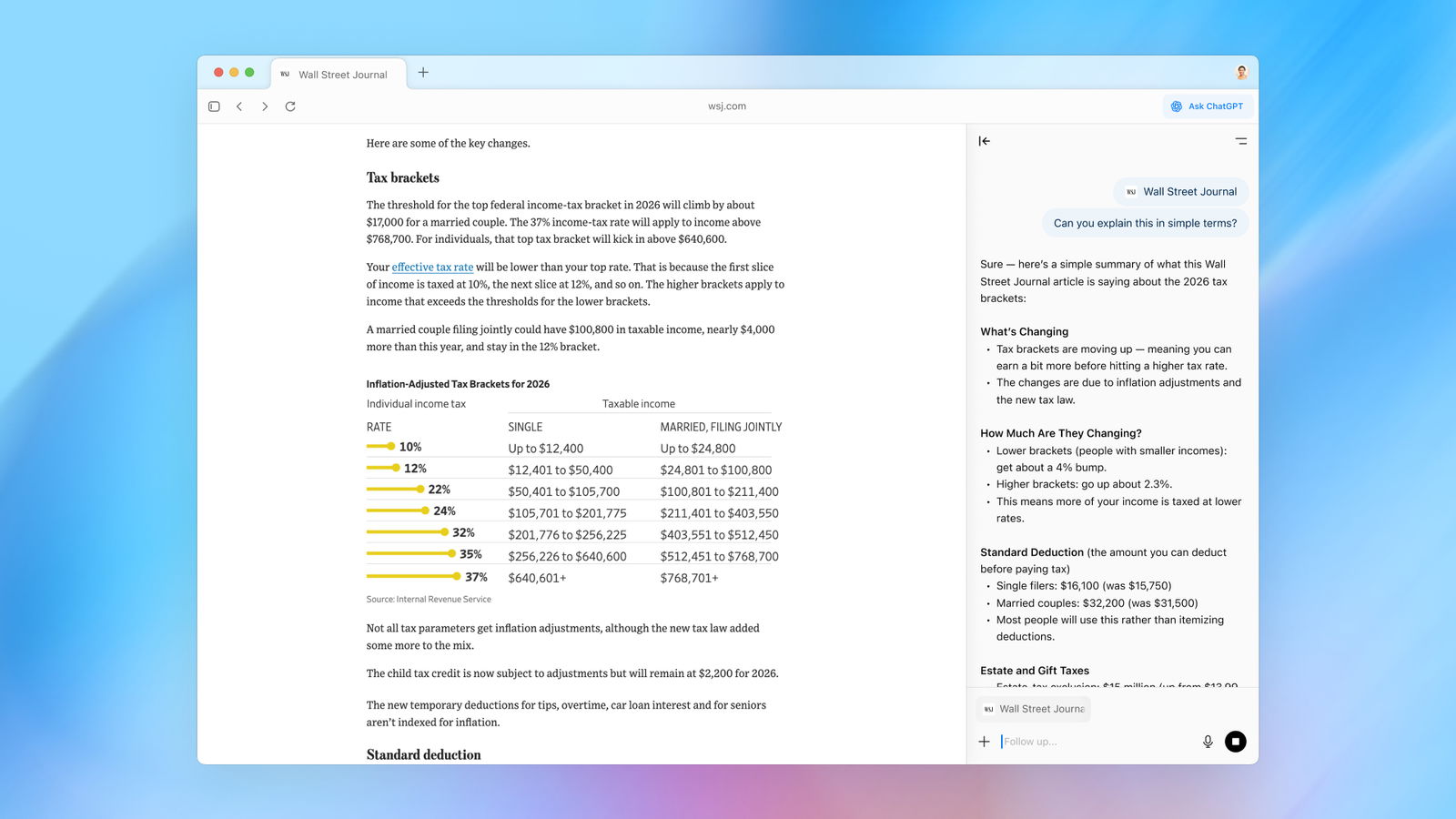
Once a search result is displayed, clicking on the “Ask ChatGPT” button opens a ChatGPT sidebar on any page to summarize, explain, or handle tasks within that window. The browser can access page details, enabling responses with more context.
It can also help users write in any open text field, offering in-line edits and personalized suggestions for highlighting text in emails, calendar invites, or documents.
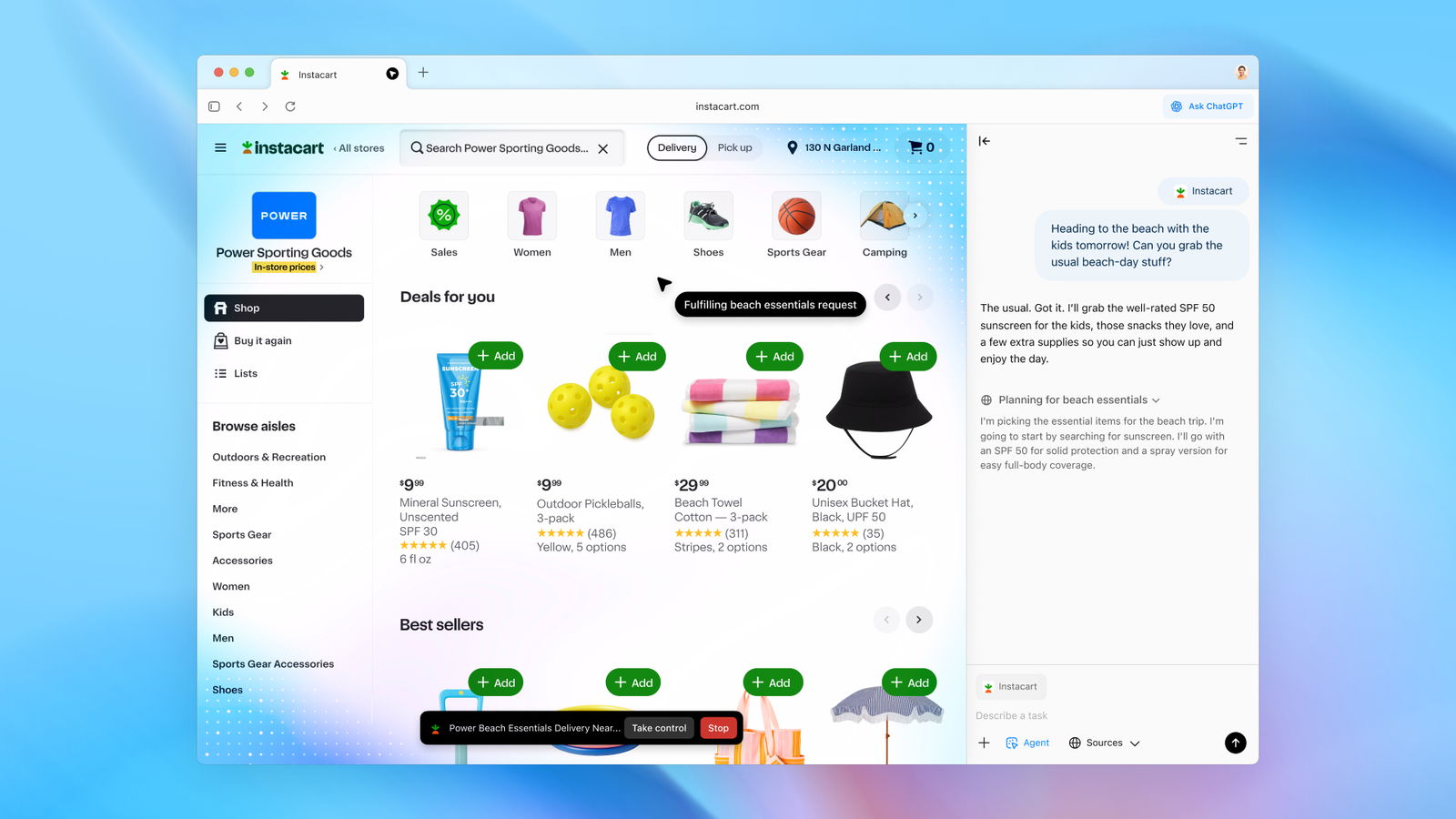
Users can ask ChatGPT to act and do things for them straight from the browser.
For example, if a user is cooking a meal, they can share the recipe with ChatGPT and ask it to find a grocery store, add all the ingredients to a cart, and order them to their house. At work, ChatGPT can be asked to open and read through past team documents, perform new competitive research, and compile insights into a team brief.
When asked a question, the browser can open tabs and click away to complete tasks—after asking a user.
“A browser built with ChatGPT takes us closer to a true super-assistant that understands your world and helps you achieve your goals,” reads ChatGPT Atlas’ announcement. “With Atlas, ChatGPT can come with you anywhere across the web—helping you in the window right where you are, understanding what you’re trying to do, and completing tasks for you, all without copying and pasting or leaving the page.”
ChatGPT Atlas comes to macOS first for Free, Plus, Pro, and Go users, as well as in beta for Business, and for Enterprise and Edu users (if enabled by their plan administrator)—availability for Windows, iOS, and Android is expected to follow soon.
The browser comes stacked with privacy features, including allowing users to clear specific pages, clear their entire browsing history, and incognito windows that temporarily log them out of ChatGPT. OpenAI promises it won’t use any content a user browses to train its models; however, users can choose to opt in to share this content.
OpenAI says it has prioritized safety while building ChatGPT’s agent capabilities in Atlas and safeguards to protect from “new risks that can come from access to logged-in sites and browsing history” when the browser’s agent takes actions on a user's behalf.
This includes prohibiting the browser from running code in the browser, downloading files, installing extensions; accessing other computer or file system apps; pausing to ensure users are watching it take actions on sensitive sites; and the ability to use the agent in logged-out mode to limit its access to sensitive data.
While OpenAI said it has “run thousands of hours of focused red-teaming," the company also warned users that its agent still carries risks other than when acting on a user's behalf—it’s susceptible to hidden malicious instructions embedded in a webpage or email.
“This launch marks a step toward a future where most web use happens through agentic systems—where you can delegate the routine and stay focused on what matters most,” concluded the release.
OpenAI’s announcement sent shockwaves through Alphabet’s stock market performance, causing a crash of nearly 5% (4.8% at $246.15), wiping out over $150 billion, until the Mountain View tech giant rallied and came back to a deficit of 2.4% ($250.46).
While OpenAI enjoys over 800 million weekly active users, it’s significantly smaller than Chrome’s 3.45 billion users.
So, whether OpenAI’s new browser will be able to create a dent in Google’s market share might seem like a long shot, but given the sway that AI has stirred across a wide range of industries—with ChatGPT at the forefront—it might just happen.
At the same time, other AI companies have attempted to integrate AI into their browsers, including Microsoft, Perplexity, and even Google, without largely affecting the market.
Do you think OpenAI’s new AI-centric browser will chip away at Google Chrome’s long-standing market share and outshine other browsers in the market?
Let us know in the comments below!
First published on Wed, Oct 22, 2025

Enjoyed what you read? Great news – there’s a lot more to explore!
Dive into our content repository of the latest tech news, a diverse range of articles spanning introductory guides, product reviews, trends and more, along with engaging interviews, up-to-date AI blogs and hilarious tech memes!
Also explore our collection of branded insights via informative white papers, enlightening case studies, in-depth reports, educational videos and exciting events and webinars from leading global brands.
Head to the TechDogs homepage to Know Your World of technology today!
Disclaimer - Reference to any specific product, software or entity does not constitute an endorsement or recommendation by TechDogs nor should any data or content published be relied upon. The views expressed by TechDogs' members and guests are their own and their appearance on our site does not imply an endorsement of them or any entity they represent. Views and opinions expressed by TechDogs' Authors are those of the Authors and do not necessarily reflect the view of TechDogs or any of its officials. While we aim to provide valuable and helpful information, some content on TechDogs' site may not have been thoroughly reviewed for every detail or aspect. We encourage users to verify any information independently where necessary.
Loading comments...