
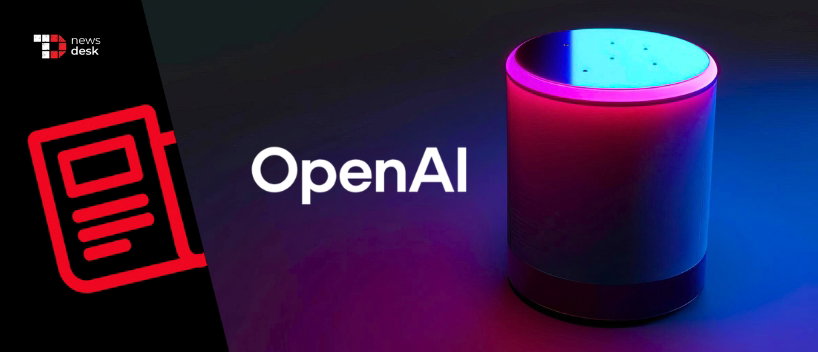
The move signals a broader ambition to embed ChatGPT into everyday physical environments, not just screens.
TL;DR
- OpenAI has assembled a 200-plus member hardware team to build AI-powered devices
- First product, a smart speaker with a built-in camera, may cost between $200 and $300 and launch in early 2027
- Smart glasses are reportedly targeted for 2028, while a smart lamp has been prototyped
- The effort follows OpenAI’s $6.5 billion acquisition of Jony Ive’s io Products
Smart Speaker With Camera To Anchor OpenAI’s First Consumer Launch
The first device expected to reach consumers is a ChatGPT-powered smart speaker that goes beyond traditional voice assistants. Priced between $200 and $300, it is unlikely to ship before February or March 2027 at the earliest.
Last month it was reported that OpenAI was set to launch its first hardware device in 2026, designed by Jony Ive’s LoveFrom.
Unlike existing smart speakers, OpenAI’s version is said to include a built-in camera capable of observing its surroundings. This would allow it to recognize items on a nearby table and detect conversations happening around it. By combining audio and visual inputs, the speaker could deliver more context-aware responses.
The device is also expected to feature a Face ID-like facial recognition system, enabling users to authenticate purchases securely. Such functionality would bring it closer to a home-based AI assistant capable of handling transactions and personalized interactions.
Ahead of the launch, OpenAI is reportedly upgrading its audio model architecture.
The updated system is designed to produce more natural and expressive speech, provide richer answers, and respond smoothly when interrupted. It may even support overlapping speech, allowing the AI to speak while a user is still talking, a feature not currently available in ChatGPT’s voice mode.
Topics For More Insights
- OpenAI Says Its First Jony Ive AI Device Isn’t A Wearable
- OpenAI To Launch Its First Hardware Device In 2026, Designed By Jony Ive’s LoveFrom
- OpenAI For India Launches With New Bengaluru & Mumbai Office, Partnership With Tata Group & More
- OpenAI's Frontier To Help Enterprises Build & Manage AI Agents
OpenAI Builds Dedicated Hardware Team To Develop AI-Powered Devices
OpenAI has formed a hardware division of more than 200 employees to develop a new category of AI-native devices. This marks a significant shift for the ChatGPT owner, which until now has focused primarily on software models and APIs.
The company’s hardware ambitions gained momentum after its nearly $6.5 billion acquisition of former Apple design chief Jony Ive’s startup, io Products, last May.
Since then, details have gradually emerged about a broader device roadmap that spans speakers, glasses, and possibly even ambient computing accessories like a smart lamp.
The collaboration with Ive has reportedly moved into the prototyping phase in 2025, positioning OpenAI to directly compete in the consumer electronics space for the first time.
However, interestingly, OpenAI will not use the name “io” for the upcoming line of AI hardware devices, as per a court filing filed a couple of weeks ago.

AI Smart Glasses And Lamp Remain Longer-Term Bets
Beyond the speaker, OpenAI is said to be developing AI-powered smart glasses, though mass production is not expected until 2028.
The company has also prototyped a smart lamp, but it remains unclear whether the device will reach commercial release.
The broader push comes as other technology giants intensify their own AI hardware efforts. Apple is reportedly exploring smart glasses, an AI-powered pendant, and camera-equipped AirPods.
Meanwhile, Meta has already found success with its Ray-Ban smart glasses, which enable photo capture, video recording, and live streaming through embedded cameras.
OpenAI’s hardware plans are still in early stages, and the company has not officially commented on the reports. However, if executed as described, the initiative could transform ChatGPT from a software assistant into a physically present, visually aware AI companion embedded in everyday life.
