
The event is part of NVIDIA GTC 2026, the company’s flagship global AI conference, taking place from March 16 to March 19, 2026, in San Jose, California.
At a packed SAP Center, Day 1 opened with NVIDIA founder and CEO Jensen Huang showcasing a video describing the token as the basic unit of modern AI, powering systems used for scientific discovery, virtual worlds, and machines operating in the physical world.
Huang also thanked the pregame hosts and participating partners, and highlighted the scale of the conference, which includes more than 450 sponsors, 1,000 sessions, and 2,000 speakers.
Coming to Day 2, the company’s latest announcements stretched from desk-based supercomputing and media production to sovereign AI, financial services, retail, and beauty science, painting a picture of AI infrastructure that is becoming more specialized, more distributed, and more deeply embedded in industry workflows.
TL;DR
- NVIDIA brings data center-grade AI to desktops with DGX Station GB300
- AI media tools enable real-time global content localization
- Cloud partners double AI factory footprint worldwide
- Retail shifts toward agent-driven commerce with OpenAI collaboration
- Oracle and NVIDIA boost vector search for enterprise AI
- Financial firms accelerate AI trading with new platforms
- AI factories improve trading efficiency and sustainability
- L’Oréal speeds up product discovery using AI simulations
- Financial giants adopt AI models to detect fraud and optimize commerce
NVIDIA DGX Station GB300 Brings Data Center Power To The Desktop
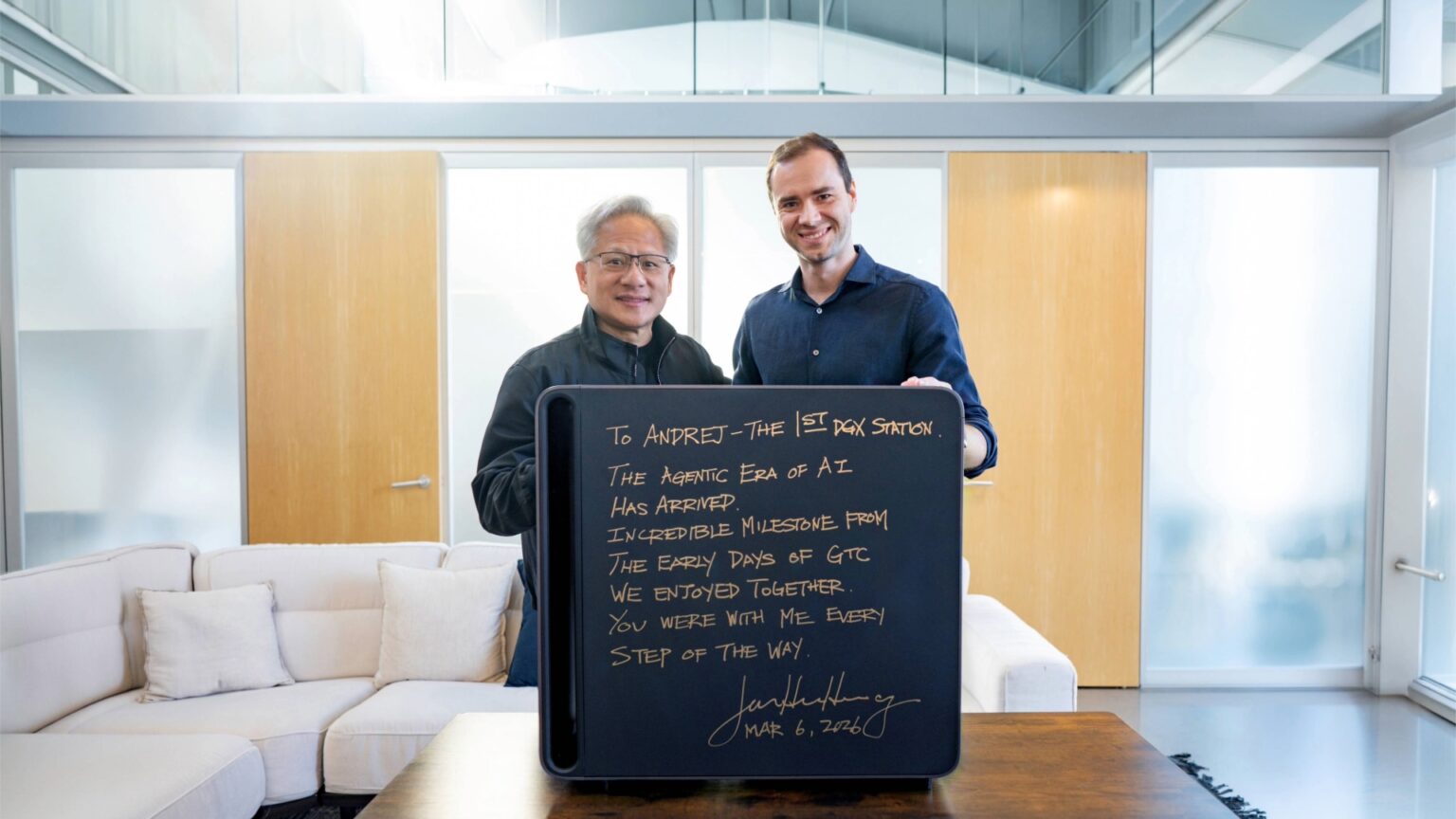
NVIDIA is pushing high-performance AI computing back to the desk with its DGX Station GB300, powered by GB300 superchips. Early systems are already in the hands of developers like Andrej Karpathy and Matt Berman, signaling a shift toward localized AI development.
With 748GB of coherent memory and up to 20 petaflops of FP4 performance, the system supports models with up to 1 trillion parameters. This effectively enables frontier-scale AI development without relying entirely on cloud infrastructure.
What makes this move significant is the rise of long-running autonomous agents. Tools like OpenClaw have shown how AI systems can independently execute complex workflows using local resources. NVIDIA is reinforcing this trend with NemoClaw, an open-source stack designed to run persistent AI agents securely.
The combination of hardware and software suggests a turning point where AI development becomes more decentralized, giving developers more control while maintaining scalability to cloud environments.
NVIDIA AI Media Tools Transform Content Localization And Production
NVIDIA is rethinking media workflows with AI-powered tools designed for real-time localization and production. Its Holoscan for Media platform now supports scalable translation of video, audio, and graphics, allowing global content distribution without traditional multi-production overhead.
This includes partnerships with companies like Camb.AI and Chyron to deliver features such as dubbing, captioning, and localized voice adaptation. Combined with video super resolution and lipsync capabilities, content can now be tailored to specific regions more efficiently.
The introduction of NVIDIA AI for Media expands this further with SDKs and microservices that integrate directly into production pipelines. Features like Studio Voice and Active Speaker Detection enhance both live and post-production workflows.
Additionally, a collaboration between Lenovo and NVIDIA aims to bring AI into sports, improving fan engagement and operational performance. Together, these developments point to a future where AI handles much of the heavy lifting in media creation and distribution.
NVIDIA Cloud Partners Expand AI Factories And Sovereign AI Globally
AI infrastructure is scaling rapidly, with NVIDIA Cloud Partners doubling their global AI factory footprint. Over 1 million GPUs are now deployed worldwide, delivering more than 1.7 gigawatts of compute capacity.
This surge enables complex simulations, from molecular research to autonomous driving scenarios, at unprecedented speeds. Countries including the U.S., Germany, India, and Indonesia are investing in sovereign AI capabilities, ensuring local control over data and models.
Key partnerships highlight this trend. TechQuartier and NayaOne are building sovereign AI platforms in Germany, while companies like Zadara and DDN are enabling secure multi-tenant AI infrastructure.
Meanwhile, initiatives like SOOFI are developing open-source foundation models to strengthen regional AI ecosystems. The expansion reflects a broader shift where nations and enterprises are building their own AI capabilities rather than relying solely on centralized providers.
NVIDIA And OpenAI Launch Agentic Commerce Blueprint For Retail
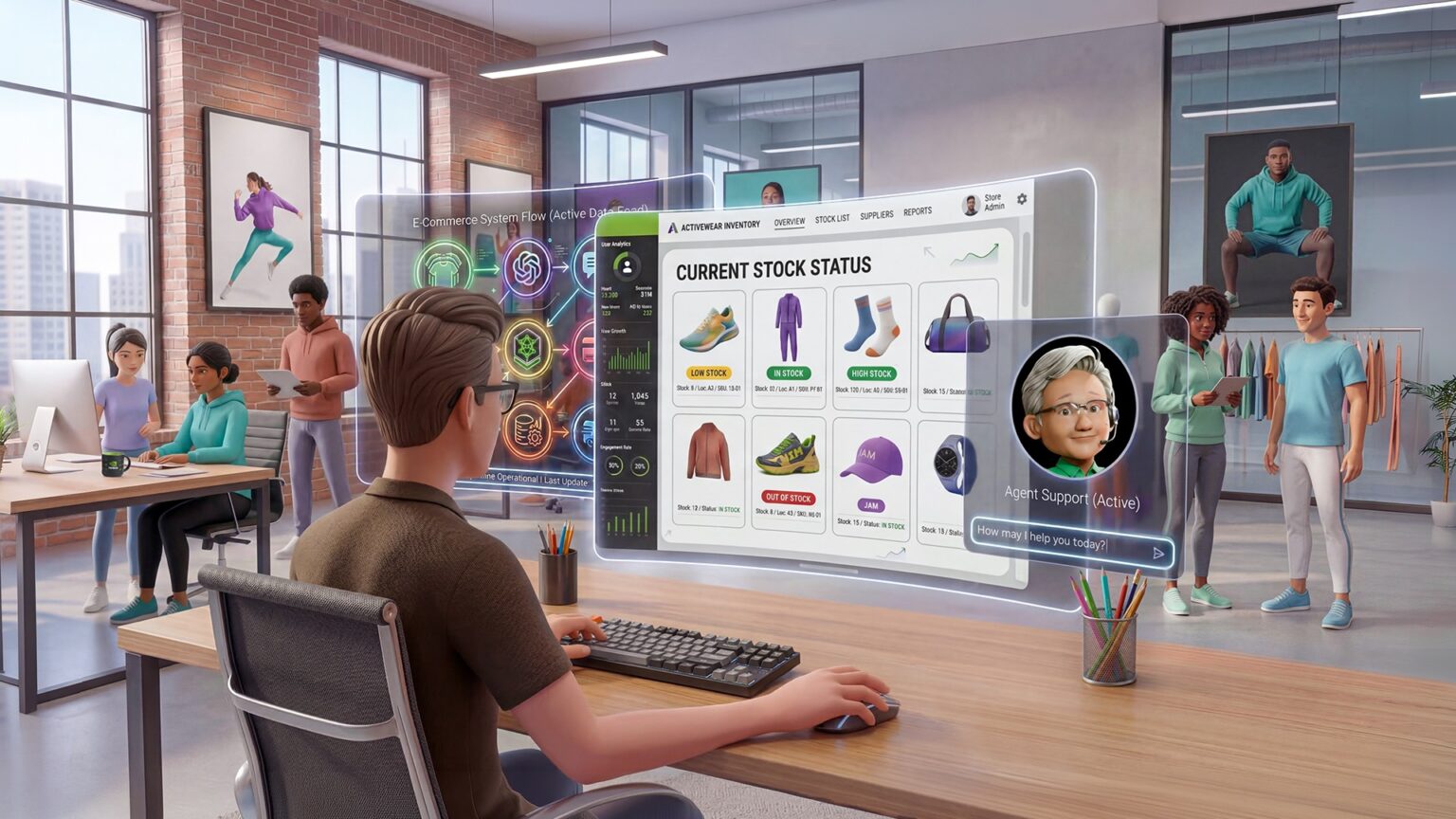
Retail is entering a new phase with NVIDIA’s agentic commerce blueprint, developed in collaboration with OpenAI. This framework allows AI agents to manage entire shopping journeys, from discovery to payment and post-purchase interactions.
The blueprint supports both OpenAI’s Agentic Commerce Protocol and Google’s Universal Commerce Protocol, enabling interoperability across platforms. This means users can complete purchases directly within AI interfaces like ChatGPT.
Built on NVIDIA’s NeMo Agent Toolkit and Nemotron models, the system includes agents for pricing, recommendations, search, and customer communication. A secure payment layer ensures transactions remain under merchant control.
This approach positions AI as an active participant in commerce rather than just a recommendation engine, potentially reshaping how consumers interact with online shopping platforms.
Oracle And NVIDIA Accelerate Vector Search For Enterprise AI Workloads
Oracle and NVIDIA are enhancing enterprise AI capabilities by integrating GPU-accelerated vector search through NVIDIA cuVS. This significantly reduces the time required to build vector indexes for large datasets.
Companies like Sofya and Biofy are already exploring these capabilities in healthcare. Sofya processes massive medical datasets, including 500 million vectors, while Biofy uses AI to identify infections and predict antibiotic resistance.
By offloading computational workloads to GPUs, these organizations can access faster insights and more accurate predictions. This is particularly important in fields where timely data processing can directly impact outcomes.
The collaboration highlights how infrastructure improvements are enabling real-world AI applications across industries.
Financial Firms Adopt NVIDIA Rubin Platform For Faster AI Trading Research
Jump Trading is among the first to adopt NVIDIA’s Rubin platform, aiming to accelerate AI-driven financial modeling. The platform delivers high compute density and improved efficiency, critical for handling massive market data streams.
Financial markets generate millions of messages daily, requiring systems that can process and adapt in real time. Rubin enables faster experimentation with deep learning models, improving research velocity.
This allows firms to respond quickly to market changes, refine strategies, and scale operations globally. The adoption underscores how AI is becoming central to modern financial systems.
Hudson River Trading Builds Energy-Efficient AI Factory In Norway
Hudson River Trading is leveraging NVIDIA’s Blackwell architecture to enhance algorithmic trading through an AI factory in Norway. The setup delivers a 1.6x improvement in research iteration time compared to previous systems.
The facility, located at Lefdal Mine Data Centers, uses renewable energy and advanced cooling systems to maintain efficiency. This allows high-performance computing with reduced environmental impact.
By integrating AI across data ingestion, model training, and deployment, HRT is improving decision-making and reducing costs. The use of digital twins and synthetic data further enhances strategy testing.
This reflects a growing focus on sustainable AI infrastructure without compromising performance.

L’Oréal Uses NVIDIA ALCHEMI To Speed Up Beauty Innovation
L’Oréal is applying NVIDIA’s ALCHEMI platform to accelerate product development in skincare. By simulating molecular combinations, the company can test formulations up to 100 times faster than traditional methods.
This reduces both time and cost while improving accuracy. With over 3,400 new formulas developed annually, the impact on R&D efficiency is significant.
The approach also extends beyond beauty, with applications in materials science and industrial chemistry. By exploring complex chemical spaces computationally, companies can unlock innovations that were previously difficult to achieve.
This demonstrates how AI is transforming even traditionally lab-driven industries.
Topics For More Insights
- NVIDIA GTC: DLSS 5 Delivers A Real-Time AI Graphics Breakthrough Since 2018's Ray Tracing
- Huang Predicts $1 Trillion In Blackwell And Vera Rubin Orders By 2027!
- NVIDIA Expands AI Partnerships With Oracle, OpenAI And AWS!
- Memories.ai Collaborates With NVIDIA To Build AI That Can See And Remember!
- Samsung Unveils HBM4E Memory At NVIDIA GTC 2026, Strengthens AI Partnership
Financial Giants Use NVIDIA AI Models To Decode Transactions And Combat Fraud
Companies like Mastercard, Revolut, and Adyen are adopting NVIDIA-powered transaction foundation models to better understand user behavior and improve financial systems.
Mastercard is developing a model trained on hundreds of millions of transactions, while Revolut has achieved a 20% increase in fraud detection precision. Adyen, processing $1 trillion in payments, reports a 195x speedup in model inferencing.
These models unify previously siloed data, enabling more accurate predictions and real-time decision-making. They also improve customer experience by optimizing transactions and reducing risk.
As financial systems grow more complex, AI is becoming essential for maintaining security, efficiency, and scalability.
