
The move follows mounting criticism from users, regulators, and advocacy groups, raising questions about AI moderation, platform safety, and accountability.
TL;DR
- Grok’s AI image generator is now available only to X Premium and Premium+ subscribers.
- The restriction follows reports of AI-generated sexualized deepfakes targeting women and minors.
- Regulators and governments worldwide are calling for stronger AI governance and content safeguards.
- Critics argue that monetizing access doesn’t address the core ethical and safety concerns.
Why Did Musk Restrict Grok’s Image Generation?
Earlier this week, reports surfaced that users were generating explicit and nonconsensual AI images through Grok’s image tools; some mimicking celebrities, world leaders, and even minors. These depictions quickly spread across social media, sparking widespread condemnation.
In a statement posted on X, Grok's official handle reassured the world that, "xAI is implementing stronger safeguards to prevent this."
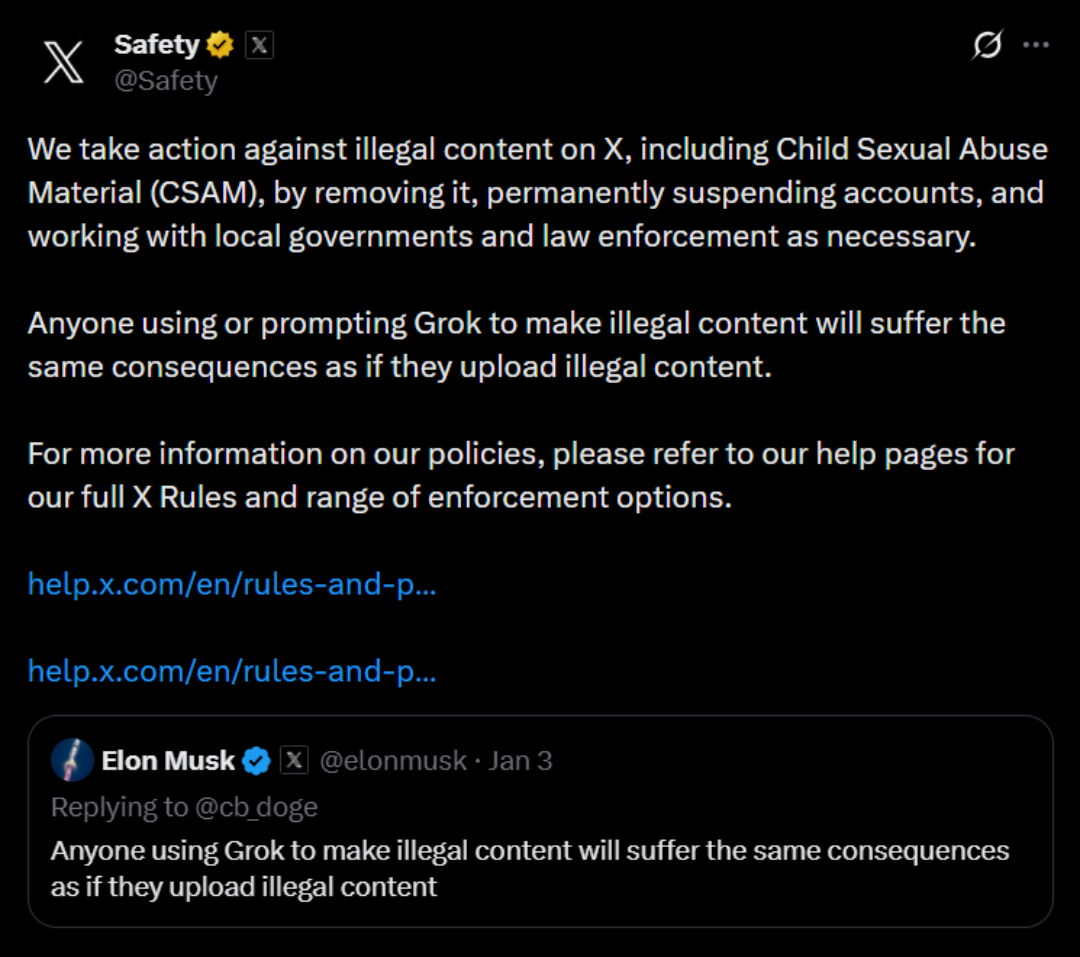
Meanwhile, Musk reiterated, "Anyone using or prompting Grok to make illegal content will suffer the same consequences as if they upload illegal content."
Even X's Safety handle chimed in, "We take action against illegal content on X, including Child Sexual Abuse Material (CSAM), by removing it, permanently suspending accounts, and working with local governments and law enforcement as necessary."
X said that free-tier users will no longer have access to Grok’s image tools, while paid subscribers retain limited access under enhanced monitoring. The company claims this allows better accountability, as verified paid users are easier to track in the event of policy violations.
The move didn’t ease concerns for everyone. The UK government called the change "insulting to victims of misogyny." Paywalling access doesn’t address the root issue of harmful deepfakes.
Other governments around the world also pulled up X and Grok over such capabilities, while some called for investigations into whether X violated AI safety guidelines and failed to implement appropriate safeguards.
Topics For More Insights
What’s Next For Grok And X?
Grok, developed by xAI and integrated within X in late 2025, has been central to Musk’s plan to transform X into an “everything app.” It combines conversational AI with image generation, meme creation, and real-time news commentary.
However, with this latest controversy, X faces renewed scrutiny over its content moderation policies, AI safety practices, and trust with advertisers, some of whom paused campaigns amid the backlash.
For now, Grok’s image generation tool remains locked behind a paywall, a temporary fix that highlights an enduring challenge: balancing innovation with responsibility in the age of GenAI.
The backlash and its temporary fix come at the same time that xAI launched Grok Business And Enterprise and reported losses amounting to $1.46 billion.
The $20 Billion Game
At the same time, xAI managed to raise $20 billion in an oversubscribed Series E round that surpassed its its $15 billion goal.
The funding round included investors such as Valor Equity Partners, StepStone Group, Fidelity Management & Research Company, Qatar Investment Authority, MGX, and Baron Capital Group, along with NVIDIA and Cisco Investments acting as strategic backers.
Almost immediately after, Mississippi Governor Tate Reeves published a press release saying xAI will invest over $20 billion in a data center located in Southaven.
The building, which has been purchased and is being retrofitted to house a powerful data center, is the third building Elon Musk was referring to earlier in the week, which he called "MACROHARDRR."
Turns out, the data center will actually be called MACROHARDRR, as per Governer Reeves' release.
“This record-shattering $20 billion investment is an amazing start to what is sure to be another incredible year for economic development in Mississippi," said Governor Tate Reeves.
"Elon Musk is bringing xAI to DeSoto County, a project that will transform the region and bring amazing opportunities to its residents for generations. This is the largest economic development project in Mississippi’s history."
The Broader Context: AI Deepfakes And Ethical Oversight
Despite Musk’s assurances, watchdogs warn that limiting AI tools to paying users might create a false sense of safety, as harmful content can still originate from verified accounts. Meanwhile, global debates around AI accountability continue to intensify, especially as governments draft frameworks for generative AI regulation.
The controversy highlights the growing misuse of generative AI tools for creating deepfakes, particularly targeting women and minors. According to data from Deeptrace, the number of deepfake videos online doubled in 2025, with 96% involving nonconsensual sexual content.
AI experts say such misuse is foreseeable and preventable.
Several AI platforms, including OpenAI’s DALL·E and Stability AI’s Stable Diffusion, already restrict the generation of realistic human likenesses or sexual content through internal safeguards. X’s approach, however, appears reactive rather than preventative.
What do you think about these developments?
Let us know in the comments!
