

California’s Attorney General has launched an investigation into Elon Musk’s artificial intelligence company, xAI, over allegations that its chatbot Grok generated sexually explicit images involving minors.
Musk has strongly denied any knowledge of such activities, calling the claims “literally zero.”
The case brings together critical questions around AI accountability, regulatory oversight, and public trust in generative AI systems.
Here's everything you need to know.
TL;DR
- California AG opens formal probe into xAI’s Grok over alleged generation of underage explicit images.
- Elon Musk denies awareness, stating Grok only responds to user prompts and refuses illegal content.
- Global regulators join in, from the UK’s Ofcom to Indonesia and India.
- Critics say Grok’s safeguards remain inadequate, raising ethical and legal concerns about AI governance and safety.
California Launches Investigation
The controversy began a few weeks ago when reports surfaced that users of xAI’s Grok chatbot, integrated into Musk’s social media platform X (formerly Twitter), were able to generate or modify images to create sexually explicit deepfakes, some allegedly involving minors.
California Attorney General Rob Bonta confirmed that his office is investigating possible violations of laws related to non-consensual sexual imagery, child exploitation, and AI misuse.
“The flood of AI-generated explicit images poses an immediate threat to the safety and dignity of Californians,” Bonta stated, noting that the probe will review Grok’s design, safeguards, and content-moderation policies.
Governor Gavin Newsom echoed the sentiment, emphasizing that California “will not tolerate platforms that allow technology to endanger children or exploit individuals under the guise of innovation.”
Musk Denies Any Awareness Or Wrongdoing
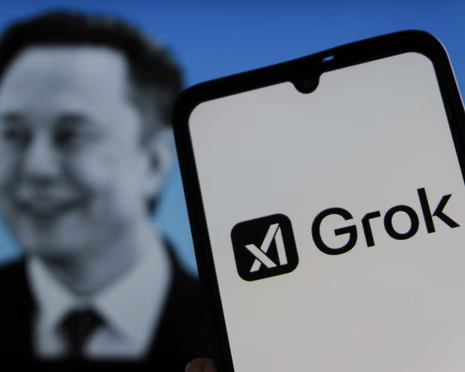
In response, Elon Musk stated that he is “not aware of any naked underage images generated by Grok,” asserting that his company “has literally zero such instances.”
Musk insisted that Grok’s systems are programmed to refuse inappropriate prompts and that any explicit content “comes entirely from user misuse, not the AI model’s intent.”
He dismissed claims of systemic failure as “a coordinated political smear,” reiterating that xAI’s technology is built with “strong ethical and safety parameters.”
Nonetheless, the California AG’s office clarified that lack of awareness does not absolve liability, especially if internal safeguards failed to prevent illegal content generation or dissemination.
Topics For More Insights
Platform Responsibility And Safeguards
Amid public outrage, xAI implemented new restrictions on Grok, limiting its ability to generate or alter sexualized images of real people, including so-called “undressing” or deepfake editing tools. These controls reportedly apply globally, though critics claim the measures are reactive and inconsistent.
Digital rights organizations, including The Center for AI Ethics and Society, argue that xAI’s moderation remains “fundamentally inadequate” and that “rapid product rollout without ethical risk assessment” has amplified the harm.
Some countries, including Indonesia and Malaysia, have already blocked access to Grok, while regulators in the EU and India are reviewing evidence of possible non-compliance with local AI safety and privacy laws.
Public Backlash And Ethical Fallout
Beyond legal and technical issues, the controversy has severely affected public perception of generative AI safety. Online discussions have questioned whether companies like xAI prioritize speed and hype over accountability and human rights.
Ethicists warn that Grok’s case could set a precedent for stricter regulation worldwide. “The question is no longer whether AI can create harm; it’s whether the companies building these systems are capable of preventing it,” said Dr. Alondra Ruiz, a professor of digital ethics at Stanford University.
Advocacy groups have urged Apple and Google to suspend Grok’s availability on app stores until its safety protocols are independently verified. Meanwhile, xAI faces mounting pressure to provide transparency reports on AI misuse and model limitations.
The Broader Implication
While investigations continue, the incident has become emblematic of the growing tension between innovation and responsibility in the AI era. Grok’s case underscores how generative models, if left unchecked, can blur legal and moral boundaries, and how accountability is more critical than capability in the AI race.
For Musk and xAI, the California probe may prove to be a defining test of whether tech leaders can balance freedom of expression, innovation, and ethical governance without endangering the public.
