Meta CEO Mark Zuckerberg has announced one of the company’s most ambitious undertakings yet: the launch of 'Meta Compute', a long-term Artificial Intelligence (AI) infrastructure initiative to build computing and energy capacity at a national scale.
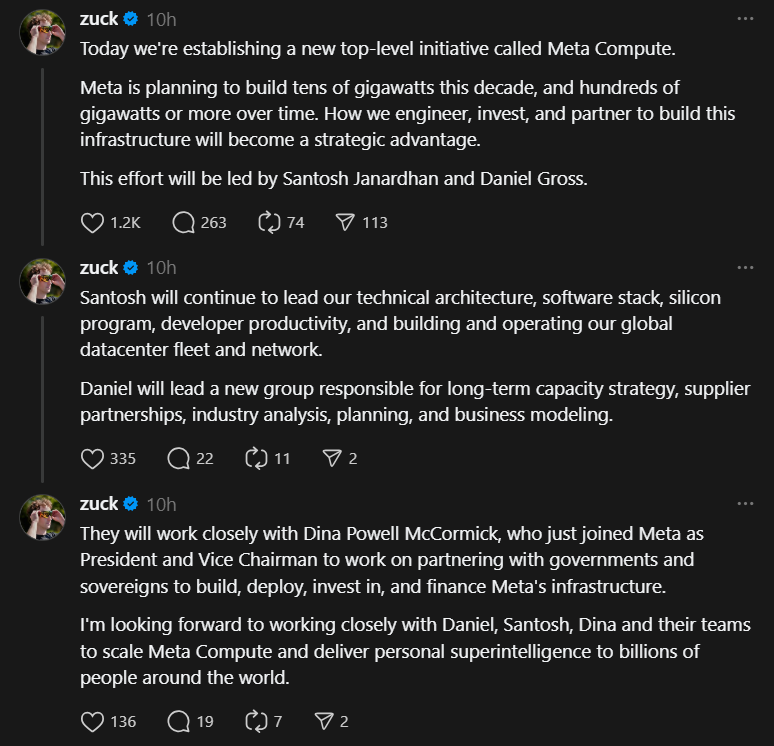
According to Zuckerberg, Meta will develop “tens of gigawatts this decade, and hundreds of gigawatts or more over time,” an effort that positions the company alongside major cloud providers like Microsoft, Amazon, and Google in the AI infrastructure arms race.
Here’s what the plan entails and what industry leaders are saying about it.
TL;DR
- Meta launches Meta Compute, a massive AI infrastructure effort to build its own computing and energy network.
- The company plans to develop hundreds of gigawatts of capacity to power AI systems globally.
- New leadership, including Dina Powell McCormick, will steer strategy and partnerships.
- Industry figures like Jeff Bezos and leading analysts express skepticism about efficiency and ROI.
Building An AI Empire
Meta Compute will focus on four major areas: advanced data center construction, long-term energy sourcing, compute capacity planning, and infrastructure governance.
The initiative will be led by Santosh Janardhan, Meta’s VP of Infrastructure, alongside Daniel Gross, who will handle long-term capacity forecasting and industry partnerships.

Former Goldman Sachs executive Dina Powell McCormick has also joined Meta as President and Vice Chair to oversee government and global strategy, a move signaling Meta’s intention to integrate industrial, financial, and political influence into its AI expansion.

Zuckerberg said the effort would help Meta “build the compute capacity necessary to make AI accessible to billions of people,” adding that it would “require deep, long-term infrastructure planning across technology, supply chains, and energy.”
Analysts note this marks a clear shift in Meta’s strategy, from building AI models to owning the compute layer itself.
However, not everyone in Silicon Valley believes this is the right approach.
Industry Voices React
Jeff Bezos, founder of Amazon, recently cautioned against tech giants constructing their own large-scale infrastructure, saying, “All these companies building their own datacenters are wrong, it’s like every factory in 1900 building its own power plant. Shared infrastructure is almost always more efficient.”
Bezos’ remarks highlight a key debate within the industry: should AI companies control their own energy and compute resources, or rely on shared, cloud-based systems to reduce redundancy and cost?
Meanwhile, investment analysts point out that Meta’s AI infrastructure spending outpaces its current AI monetization. A report comparing the AI strategies of Meta, Microsoft, Google, and Amazon noted that Meta’s approach is “investment-first with no clear near-term return, putting pressure on investor confidence.”
In other words, while Microsoft and Google are directly linking infrastructure expansion to profitable AI services, Meta remains in the “build-first, monetize-later” stage, a risky move in a market driven by rapid AI adoption cycles.
Topics For More Insights
The Bigger Picture
Despite concerns, most experts agree that Meta Compute cements Meta’s position as one of the few companies capable of scaling AI globally. The project’s size suggests that Meta wants to control its AI supply chain end-to-end, from chips to data centers to energy sourcing.
To put this scale in perspective, a single gigawatt equals one billion watts of electrical power. Analysts estimate that as AI infrastructure grows, the United States’ total power consumption from AI operations could rise dramatically, increasing from around 5 gigawatts today to nearly 50 gigawatts within the next decade.
This exponential demand highlights how AI expansion could transform not only technology but also the nation’s energy grid and sustainability priorities.
Yet, the environmental and financial implications of such expansion are significant. Building hundreds of gigawatts of capacity, comparable to the power consumption of entire nations, will make Meta one of the world’s largest private energy consumers.
Still, Meta’s leadership seems confident. With McCormick’s appointment and Zuckerberg’s vision, the company appears ready to evolve from a social media titan to a tech-industrial powerhouse driving the future of AI infrastructure.
As one industry analyst summarized, “Meta Compute isn’t just about AI models anymore, it’s about owning the engine that runs them.”
