
Artificial Intelligence
Memories.ai Collaborates With NVIDIA To Build AI That Can See And Remember!
Updated on Tue, Mar 17, 2026
Share
TL;DR
- Memories.ai builds AI that can “see and remember” for wearables and robots.
- Partners with NVIDIA and Qualcomm to power its visual memory model.
- Uses LUCI, a wearable device, to collect real-world video data.
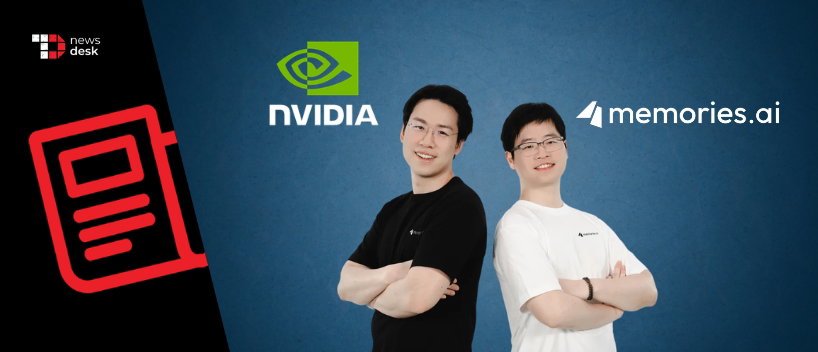
Founded by Shawn Shen and CTO Ben Zhou, the company is building a visual memory layer for wearables and robotics. The goal is to let AI store and recall videos from the real world. “AI is already doing really well in the digital world.
"What about the physical world? AI wearables, robotics need memories as well. … Ultimately, you need AI to have visual memories. We believe in that future,” Shen said.
The idea came while the duo was developing the AI behind Meta’s Ray-Ban glasses. They realized AI would be far more useful if it could remember the videos users recorded in real life. That insight led them to spin out of Meta in 2024 and start building both the models and the infrastructure to make visual memory possible.
Topics For More Insights:
So far, Memories.ai has raised $16 million and developed its Large Visual Memory Model (LVMM). According to Shen, building this visual memory layer required two key steps: setting up the system to store and organize videos, and gathering the footage needed to train the AI effectively.
To do that, the team created LUCI, a wearable device that collects real-world videos from data collectors. The LVMM will also run on Qualcomm processors and leverages NVIDIA’s Cosmos-Reason 2 and Metropolis tools to power its memory capabilities.
Shen believes the possibilities are huge. While wearables are the focus for now, this AI could let robots and devices see, remember, and act more like humans in the real world.
First published on Tue, Mar 17, 2026

Liked what you read? That’s only the tip of the tech iceberg!
Explore our vast collection of tech articles including introductory guides, product reviews, trends and more, stay up to date with the latest news, relish thought-provoking interviews and the hottest AI blogs, and tickle your funny bone with hilarious tech memes!
Plus, get access to branded insights from industry-leading global brands through informative white papers, engaging case studies, in-depth reports, enlightening videos and exciting events and webinars.
Dive into TechDogs' treasure trove today and Know Your World of technology like never before!
Disclaimer - Reference to any specific product, software or entity does not constitute an endorsement or recommendation by TechDogs nor should any data or content published be relied upon. The views expressed by TechDogs' members and guests are their own and their appearance on our site does not imply an endorsement of them or any entity they represent. Views and opinions expressed by TechDogs' Authors are those of the Authors and do not necessarily reflect the view of TechDogs or any of its officials. While we aim to provide valuable and helpful information, some content on TechDogs' site may not have been thoroughly reviewed for every detail or aspect. We encourage users to verify any information independently where necessary.
Loading comments...