
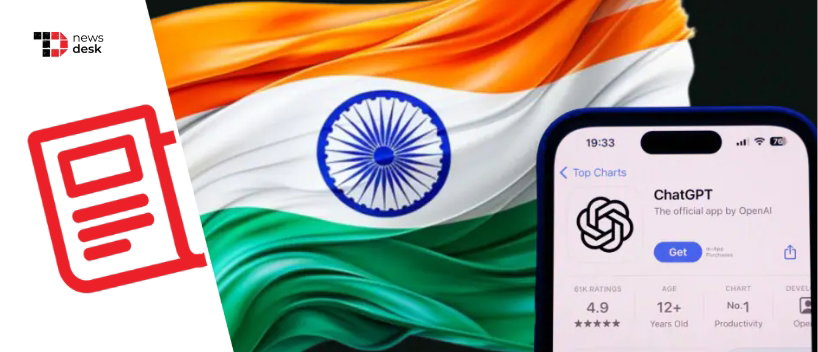
India is contributing 33% more data to ChatGPT than the United States, according to G20 Sherpa Amitabh Kant, who used the claim to highlight India’s growing AI footprint while warning that emerging economies risk paying heavily for refined AI models built on their own data.
TL;DR
- Amitabh Kant says India contributes 33% more ChatGPT data than the US
- Highlights India’s scale in AI engagement and digital infrastructure
- Warns refined AI models could be sold back to Global South at high costs
- Calls for inclusive, affordable AI development
India’s expanding presence in the global artificial intelligence landscape is becoming a key talking point in policy discussions.
Speaking at a public forum, India’s G20 Sherpa Amitabh Kant said that India provides 33% more data to ChatGPT compared to the United States. While the precise methodology behind the figure was not publicly disclosed, Kant cited it to emphasize the scale at which Indians are interacting with generative AI platforms.
India’s digital scale is substantial. With over 1.4 billion citizens and one of the largest internet user bases globally, the country has witnessed rapid adoption of AI tools across startups, enterprises, academia, and government services. High smartphone penetration and affordable data costs have further accelerated engagement.
Kant linked this growth to India’s digital public infrastructure, including Aadhaar, the Unified Payments Interface, and the broader India Stack framework. These systems have driven large-scale digitization of financial services, governance, and entrepreneurship, creating an environment conducive to AI experimentation and adoption.
However, Kant’s remarks went beyond celebrating usage numbers. He issued a caution about how global AI development could evolve.
“So the models are getting refined, and data for the Global South, they will create business models and sell you products at a very high cost tomorrow.”
His warning centers on the possibility that AI systems trained and improved using data generated from emerging markets could later be commercialized in ways that make access expensive for those very regions.
Kant stressed that artificial intelligence must be inclusive, affordable, and accessible. He argued that AI should not become concentrated in a handful of advanced economies or technology corporations that control compute infrastructure, foundation models, and commercialization pipelines.
Topics For More Insights
India’s linguistic diversity adds further complexity. With 22 officially recognized languages and hundreds of dialects, training AI systems to effectively serve Indian users requires significant vernacular data. This diversity, if leveraged responsibly, can enhance model robustness and contextual understanding at a global level.
At the same time, global debates around AI governance, safety standards, and equitable access to high-performance computing are intensifying. Countries across the Global South have raised concerns about unequal access to advanced chips, cloud infrastructure, and foundational models.
India has been positioning itself as a strong advocate for responsible AI. Through initiatives such as the IndiaAI Mission, the government aims to expand domestic AI capabilities, increase access to compute resources, and support startups working in artificial intelligence.
While OpenAI has not publicly released a country-wise breakdown of ChatGPT’s training data composition, Kant’s statement reflects the broader reality of India’s high engagement levels with generative AI systems.
As artificial intelligence continues reshaping industries from finance to healthcare and education, the central question is shifting from who builds AI to who benefits from it.
Kant’s message signals that for emerging economies, participation alone may not be enough. Ensuring equitable value creation and access will be critical as AI models grow more sophisticated and commercially embedded in global markets.
