

Financial Management Solutions
Google's New FinOps Tools Is Here To Stop Your AI Bill From Spiraling
Updated on Fri, Apr 24, 2026
Share
The company has introduced an autonomous FinOps Explainability agent, private preview access to Spend Caps, and new billing tools designed to help businesses better track, manage, and control rising artificial intelligence (AI) infrastructure costs.
But what exactly does it do?
TL;DR
- Google Cloud launched a FinOps Explainability agent that autonomously identifies what’s driving AI-related cloud costs
- New Spend Caps can automatically pause API traffic once project budgets are exceeded
- The feature supports Google AI Studio, Gemini Enterprise Agent Platform, Cloud Run, Cloud Run Functions, and Maps
- Google says FinOps cost reporting adoption rose 75%, while reducing customer analysis time by 18%
- New billing tools also offer deeper visibility into enterprise contract spending
As enterprises scale AI initiatives, cloud spending has become harder to predict.
Unlike traditional workloads, AI infrastructure costs can spike quickly due to fluctuating token usage, API traffic surges, storage demands, model changes, and shifting pricing structures.
While AI costs may appear straightforward on paper, quantity multiplied by price, the reality is far messier for FinOps and DevOps teams trying to identify where money is being burned.
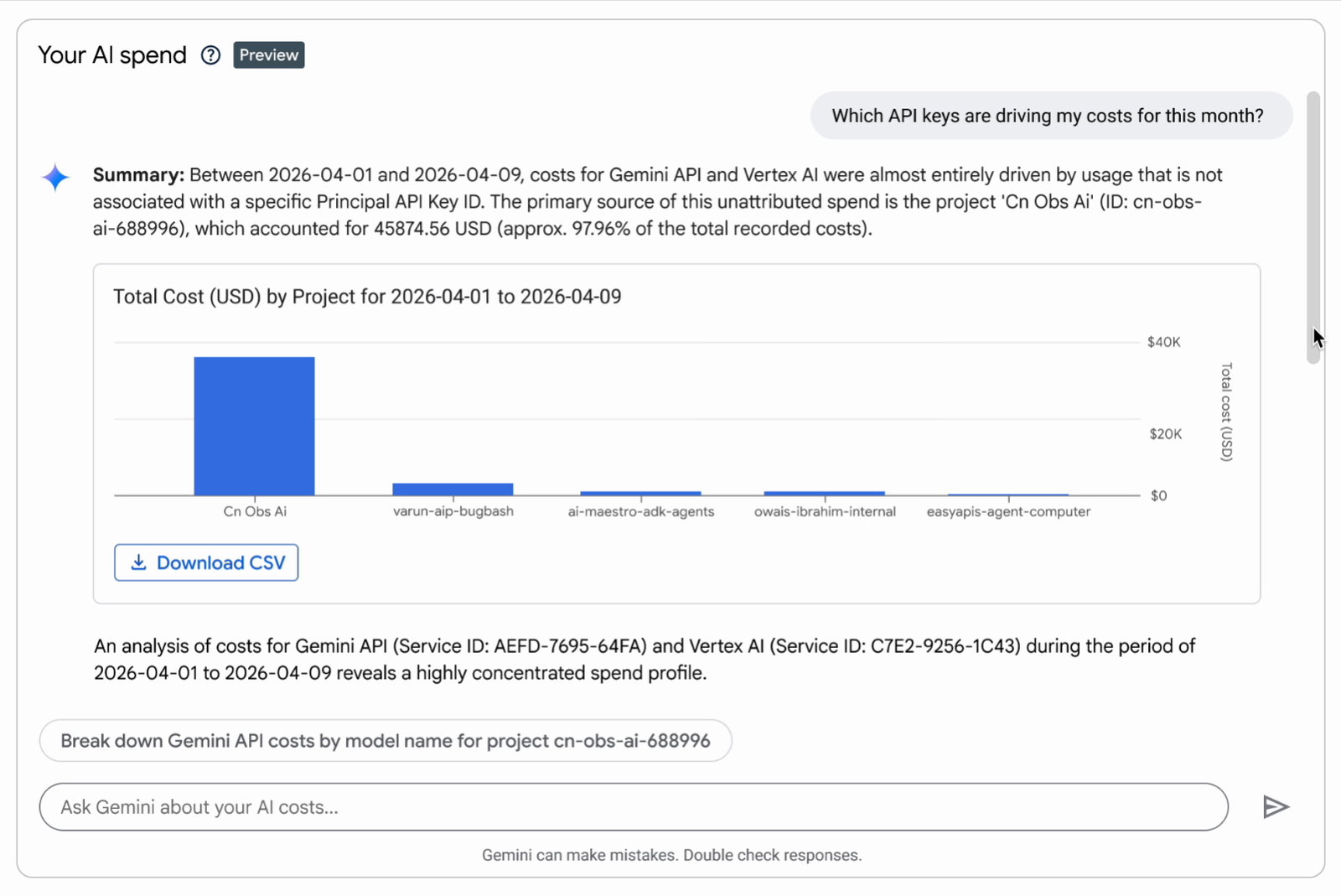
To address this, Google Cloud has launched its new FinOps Explainability agent inside Google Cloud Billing.
Built using Gemini, the tool is designed to autonomously investigate AI spending patterns and identify what’s driving costs across projects and services. It can answer specific questions such as how much a business spent on Gemini 1.5 Pro versus Gemini 1.5 Flash, identify which API keys are consuming the most budget, and break down spending across input and output token usage.
The idea is to remove the burden of manually sorting through fragmented billing reports while giving enterprises clearer visibility into the return on investment tied to their AI initiatives.
Google said businesses using its existing FinOps tools are already seeing measurable gains. Since launching Gemini Cloud Assist for FinOps last year, cost reporting adoption has surged by 75%, while the time customers spend analyzing FinOps costs has dropped by 18%.
Google Cloud Spend Caps Aim To Prevent AI Budget Overruns
Understanding AI costs is one challenge. Preventing runaway spending is another.
Google says traditional budgeting tools typically notify teams after spending thresholds are crossed, but fail to actively stop overspending. That becomes particularly risky in AI environments where GPU-heavy workloads, experimental deployments, or poorly optimized training jobs can drain budgets in a short period of time.
Its answer is Spend Caps.
Currently available through private preview, the feature allows FinOps and DevOps teams to set project-level spending limits across Google AI Studio, Gemini Enterprise Agent Platform, Cloud Run, Cloud Run Functions, and Maps.
Once spending reaches a predefined threshold, the system sends alerts and can automatically pause API traffic. Unlike harsher cost-control methods such as disconnecting payment methods, Google says this approach preserves infrastructure while giving teams the flexibility to resume services by simply suspending the cap.
The company believes this will be particularly useful for businesses experimenting heavily with AI research and development without wanting surprise bills.
Topics For More Insights
- Google’s Big AI Bet Just Got Real At Cloud Next 2026, Here Are Day 1's Key Reveals
- Google Expands Distributed Cloud At Next ’26 To Bring Gemini AI On-Prem, Edge, And Air-Gapped Environments
- Google Introduces Virgo Network For Large-Scale AI Training!
- Google Introduces Workspace Intelligence To Power Agentic Work Across Gmail, Docs, Drive, Chat And More
- Google Launches Cloud Fraud Defense As reCAPTCHA Evolves For The Agentic Web
- Google Launches Gemini Enterprise Agent Platform To Power Scalable Enterprise AI Agents!
- Google Unveils Eighth-Generation TPUs With Two New Chips Built For The Agentic AI Era
- Google Wants AI Agents To Stop Just Thinking & Start Doing With Its New Agentic Data Cloud
Google Cloud Expands Billing Visibility For Enterprise AI Spending
Alongside cost controls, Google is also introducing new billing capabilities aimed at improving commercial transparency.
Through enhanced billing account hierarchies, now in private preview, customers can view aggregated spending across multiple billing accounts, including Other Eligible Services spending.
Google is also rolling out contract commitment reporting, giving enterprises better visibility into how their cloud commitments are being used within existing agreements.
Combined with AI cost explainability and automated spending controls, Google appears to be positioning these tools as a way for enterprises to scale AI deployments without losing control of their budgets.
As companies continue pouring billions into AI infrastructure, Google’s latest move signals that managing AI costs may become just as important as building AI itself.
First published on Fri, Apr 24, 2026

Enjoyed what you read? Great news – there’s a lot more to explore!
Dive into our content repository of the latest tech news, a diverse range of articles spanning introductory guides, product reviews, trends and more, along with engaging interviews, up-to-date AI blogs and hilarious tech memes!
Also explore our collection of branded insights via informative white papers, enlightening case studies, in-depth reports, educational videos and exciting events and webinars from leading global brands.
Head to the TechDogs homepage to Know Your World of technology today!
Disclaimer - Reference to any specific product, software or entity does not constitute an endorsement or recommendation by TechDogs nor should any data or content published be relied upon. The views expressed by TechDogs' members and guests are their own and their appearance on our site does not imply an endorsement of them or any entity they represent. Views and opinions expressed by TechDogs' Authors are those of the Authors and do not necessarily reflect the view of TechDogs or any of its officials. While we aim to provide valuable and helpful information, some content on TechDogs' site may not have been thoroughly reviewed for every detail or aspect. We encourage users to verify any information independently where necessary.
Loading comments...