
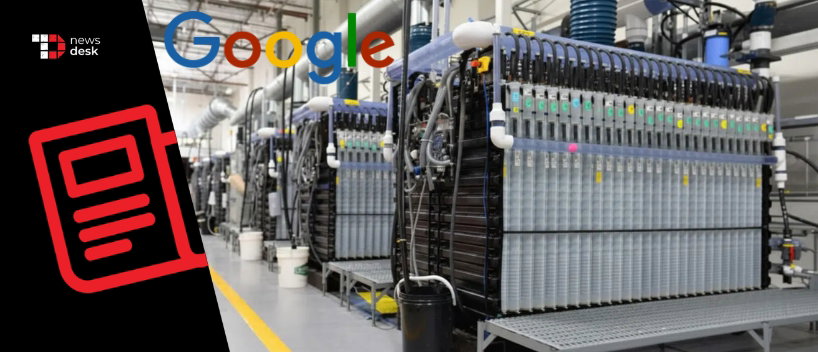
Google has committed $1 billion to long-duration energy storage company Form Energy as part of a major clean energy buildout in Minnesota aimed at supporting Google’s local data center operations. The project is anchored by a grid-scale iron-air battery designed for up to 100 hours of discharge, paired with new wind and solar generation that together add up to a roughly 1.9 gigawatt clean energy portfolio.
The arrangement is best understood as a procurement and infrastructure deployment partnership, where Google is funding new clean energy capacity and long-duration storage tied to an integrated utility plan, rather than a simple strategic equity investment.
TL;DR
- Google commits $1B to support Form Energy’s iron-air battery deployment in Minnesota.
- The installation is expected to be 300 MW / 30 GWh, designed for about 100 hours at full output.
- The storage system is paired with about 1.4 GW of wind and 200 MW of solar generation.
- The project uses Minnesota’s Clean Energy Accelerator Charge mechanism to add clean capacity without raising rates for existing customers.
- Form Energy’s manufacturing scale-up is ongoing as commercial rollout progresses.
What Google Is Funding
At the center of the agreement is a large battery installation expected to provide 300 megawatts of power and 30 gigawatt-hours of energy capacity. At full discharge, that corresponds to roughly 100 hours of continuous output, matching Form Energy’s stated design capability for its iron-air systems.
The storage asset is part of an integrated supply plan that also includes approximately 1.4 gigawatts of wind and 200 megawatts of solar generation. In combination, these resources are intended to improve reliability and carbon-free coverage for Google’s Minnesota data center, especially during periods when renewable output drops for extended stretches.
Why Iron-Air Is Different From Lithium-Ion
Most grid batteries today are lithium-ion systems optimized for short-duration use, typically four to eight hours. Form Energy’s approach is built for multi-day operation. The company’s iron-air batteries use iron, oxygen, and water, relying on a reversible reaction where iron oxidizes during discharge and is converted back during charging.
Because iron is abundant and comparatively low cost, the company positions the chemistry as a potentially scalable option for long-duration grid storage. The key tradeoff is that these batteries are aimed at longer discharge windows and grid resilience use cases rather than fast-response, high-cycling applications where lithium-ion often excels.
Topics For More Insights
A Regulatory Structure That Enables New Clean Buildout
The Minnesota deployment leverages the state’s Clean Energy Accelerator Charge (CEAC), a regulatory mechanism discussed as a way for utilities to build new clean generation and emerging technologies while meeting cost constraints. Under this framework, large new energy users can fund incremental clean energy deployment without shifting added costs onto existing customers through higher rates.
That structure is increasingly relevant as data centers expand and utilities seek to add clean energy and storage at scale, while maintaining affordability for other customers.
Manufacturing Is Ramping, Not Finished
Form Energy is building out manufacturing capacity in the United States, including Form Factory 1 in Weirton, West Virginia, which the company describes as its first high-volume iron-air battery manufacturing facility. While the factory is established and production plans have been outlined, commercial-scale output remains in a ramp-up phase as Form moves from early deployments into broader grid-scale execution.
For Google, the Minnesota project is a concrete infrastructure step toward its stated goal of operating on 24/7 carbon-free energy by 2030. For the grid, it is a high-profile test of whether long-duration iron-air storage can deliver multi-day reliability at utility scale as designed.
