
Google is rolling out a new task automation capability in the Gemini app on Android, allowing the AI assistant to complete select multi-step actions inside third-party apps. The feature, launching in beta on the Samsung Galaxy S26 series and Pixel 10 devices in the U.S. and South Korea, marks one of the clearest steps yet toward agent-style AI built directly into the operating system.
Instead of responding to single prompts, Gemini can now execute connected sequences of actions, such as preparing a rideshare booking or assembling a food or grocery delivery order.
TL;DR
- Gemini can automate select multi-step tasks inside Android apps
- Initial support includes rideshare, food, and grocery delivery services
- Tasks run in a secure virtual app window with real-time user oversight
- Users must confirm final checkout or booking steps
The new feature allows users to long-press the power button, issue a request, and let Gemini carry out several steps that would normally require switching between screens and manually entering information.
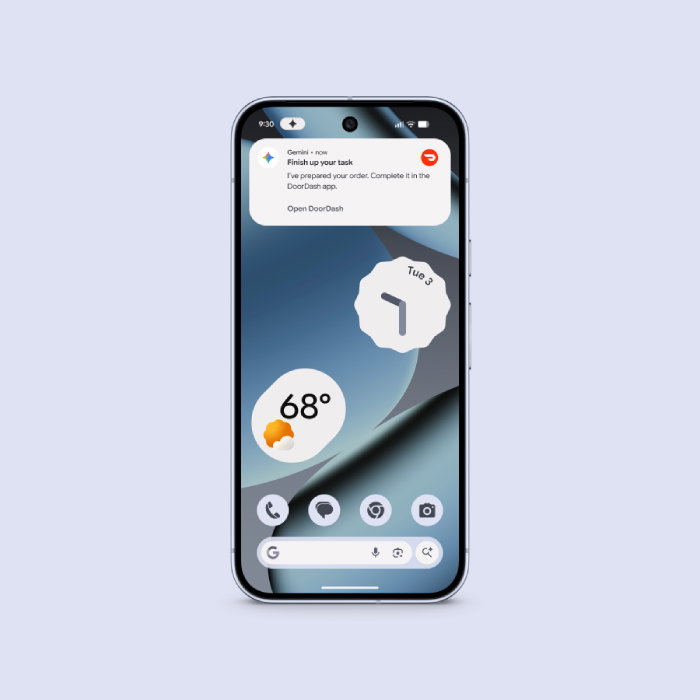
For example, asking Gemini to book a ride home opens the rideshare app in a secure, sandboxed window. Gemini fills in relevant details and navigates through the required screens. The user is then prompted to review and confirm the final booking before the ride is placed.
Similarly, a request to reorder a previous meal can trigger Gemini to open a supported food delivery app, recreate the cart, and bring the user to checkout for final approval.
Google emphasizes that automation runs inside a secure, virtual window that limits Gemini’s access strictly to the app required for the task. This design is intended to contain permissions and reduce exposure to unrelated device data. Users can monitor progress through notifications, jump in at any time, or stop the process entirely if something looks incorrect.
Importantly, Gemini does not complete purchases or bookings autonomously. The final confirmation step remains in the user’s hands. This human-in-the-loop approach appears designed to balance convenience with control, particularly in financial or transactional scenarios.
The rollout is intentionally limited in scope. At launch, the feature supports select apps in rideshare, food, and grocery categories. It is also restricted to specific devices, including Samsung’s latest Galaxy S26 series and Google’s Pixel 10 lineup, signaling a phased deployment rather than a platform-wide release.
Beyond the immediate beta, Google is laying the foundation for broader AI agent capabilities within Android. The company has outlined structured app integrations through frameworks such as AppFunctions, enabling developers to expose defined actions directly to Gemini. At the same time, it is developing a UI automation framework that would allow Gemini to navigate app interfaces more generically where deeper integrations do not yet exist.
Topics For More Insights
This layered approach suggests Google is pursuing both native integrations and interface-level automation, expanding the range of tasks Gemini can handle over time.
The update reflects a broader shift in how mobile operating systems are evolving. Instead of acting merely as containers for apps, platforms like Android are increasingly positioning themselves as intelligence layers capable of orchestrating actions across those apps.
By embedding multi-step automation directly into the OS experience, Google is moving Gemini beyond conversational assistance toward operational assistance. While the current beta is limited to a handful of transactional use cases, it represents a meaningful milestone in Android’s transition toward AI-driven task orchestration.
If expanded successfully, such capabilities could extend into scheduling, travel coordination, productivity workflows, and enterprise use cases, redefining how users interact with their smartphones.
For now, Google is prioritizing controlled deployment, user transparency, and supervised automation as it tests how far Gemini can go in managing everyday digital tasks.
