
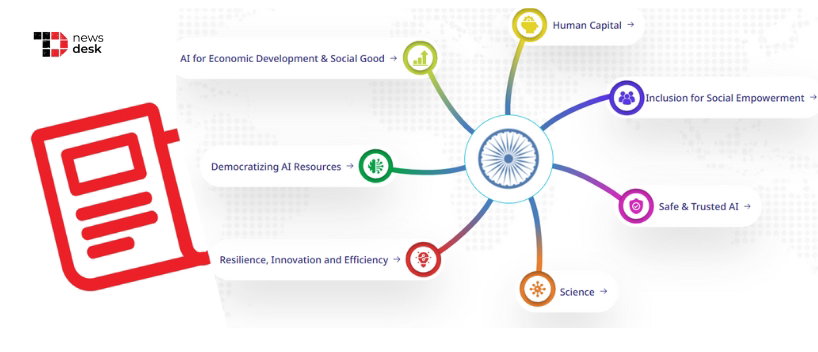
The India AI Impact Summit 2026 introduces the idea of “seven chakras” to describe how India views artificial intelligence as a holistic national priority. As presented in public broadcast coverage, the framework is conceptual and symbolic, offering direction rather than a prescriptive policy blueprint.
This explainer clearly separates what has been explicitly stated in summit coverage from what can be interpreted through India’s existing artificial intelligence and digital governance trajectory.
TL;DR
- The seven chakras are a conceptual framework, not a formal policy checklist.
- Official descriptions remain thematic and high-level.
- Policy meanings discussed publicly are directional, not binding commitments.
- The framework emphasizes balance, interdependence, and societal impact.
What The Summit Explicitly States
Coverage of the India AI Impact Summit 2026 explains that the seven chakras are intended to represent interconnected focus areas required for artificial intelligence to deliver national impact. Speakers and official communication emphasize that no single pillar of AI development can function in isolation.
The summit messaging highlights that artificial intelligence should support public good outcomes, align with national priorities, and reflect India’s governance values. However, it does not publish an official list that rigidly names or defines each chakra in technical or regulatory terms.
Instead, the chakra metaphor is used as a communication device to signal balance, alignment, and systemic thinking to policymakers, industry leaders, researchers, and the public.
Interpreting The Chakras Through India’s Policy Context
The following interpretations are analytical in nature. They align the summit’s symbolic framing with India’s broader technology initiatives, but they are not direct quotations or formal declarations from the summit.
Capacity And Infrastructure
Discussions around readiness, scale, and deployment implicitly connect to India’s ongoing efforts to strengthen digital and computing infrastructure. This reflects continuity with earlier national technology programs rather than a newly announced policy direction.
Data And Digital Foundations
References to scale and impact point toward the importance of high-quality data and responsible data use. These ideas align with India’s existing emphasis on consent-based digital systems and population-scale platforms.
Human Capital And Skills
Mentions of talent development and research capacity echo long-standing policy focus on education, skilling, and workforce readiness. No new training targets or mandates were formally outlined at the summit.
Innovation And Applications
The summit highlights applied artificial intelligence use cases across governance, agriculture, and social sectors. However, it stops short of detailing funding mechanisms, timelines, or industrial incentives.Topics For More Insights
Inclusion And Accessibility
The framing suggests that artificial intelligence systems should work across languages, regions, and income groups. This principle is consistent with India’s digital governance philosophy but was not presented as an enforceable requirement.
Ethics, Trust, And Responsibility
Responsible AI is discussed as a guiding value rather than a regulatory framework. The summit messaging favors principles and safeguards over detailed compliance structures.
Governance And Global Engagement
References to leadership and cooperation indicate India’s intent to participate actively in global AI discussions, particularly from the perspective of developing economies. Specific international agreements or standards initiatives were not announced.
Why This Distinction Matters
Reading the seven chakras as finalized policy positions risks attributing commitments that have not been formally made. The framework is better understood as a directional signal that aligns stakeholders around shared values and long-term intent.
It functions as a conceptual scaffold that connects India’s technological ambitions with its governance philosophy, rather than a detailed roadmap.
Bottom Line
The seven chakras of the India AI Impact Summit 2026 should be seen as a values-driven framework, not a policy manual. They reflect continuity with India’s broader digital strategy and serve as a lens for future discussions, rather than immediate regulatory or programmatic action.
