

Blue Origin, the aerospace company founded by Jeff Bezos, has announced its most ambitious communications project yet, TeraWave, a global satellite internet network capable of moving data at speeds up to 6 terabits per second (Tbps).
The network aims to redefine enterprise-grade satellite connectivity and challenge existing leaders in the space communications sector.
Here's everything you need to know.
TL;DR
- Blue Origin announced TeraWave, a satellite network offering up to 6 Tbps data throughput.
- The system will deploy 5,408 satellites across low and medium Earth orbits.
- It targets enterprise, data center, and government clients, not consumers.
- The network will blend RF and laser-based optical links to maximize performance.
- Launches are expected to begin in late 2027, with a multi-orbit rollout.
Blue Origin’s Most Ambitious Move Yet
Blue Origin revealed that TeraWave will serve as a multi-orbit communications network, providing enterprise-grade, high-throughput data connectivity across the globe.
Unlike traditional consumer satellite internet services such as SpaceX’s Starlink, the TeraWave initiative focuses on commercial, industrial, and government organizations that require secure, high-capacity, symmetrical data transfer.
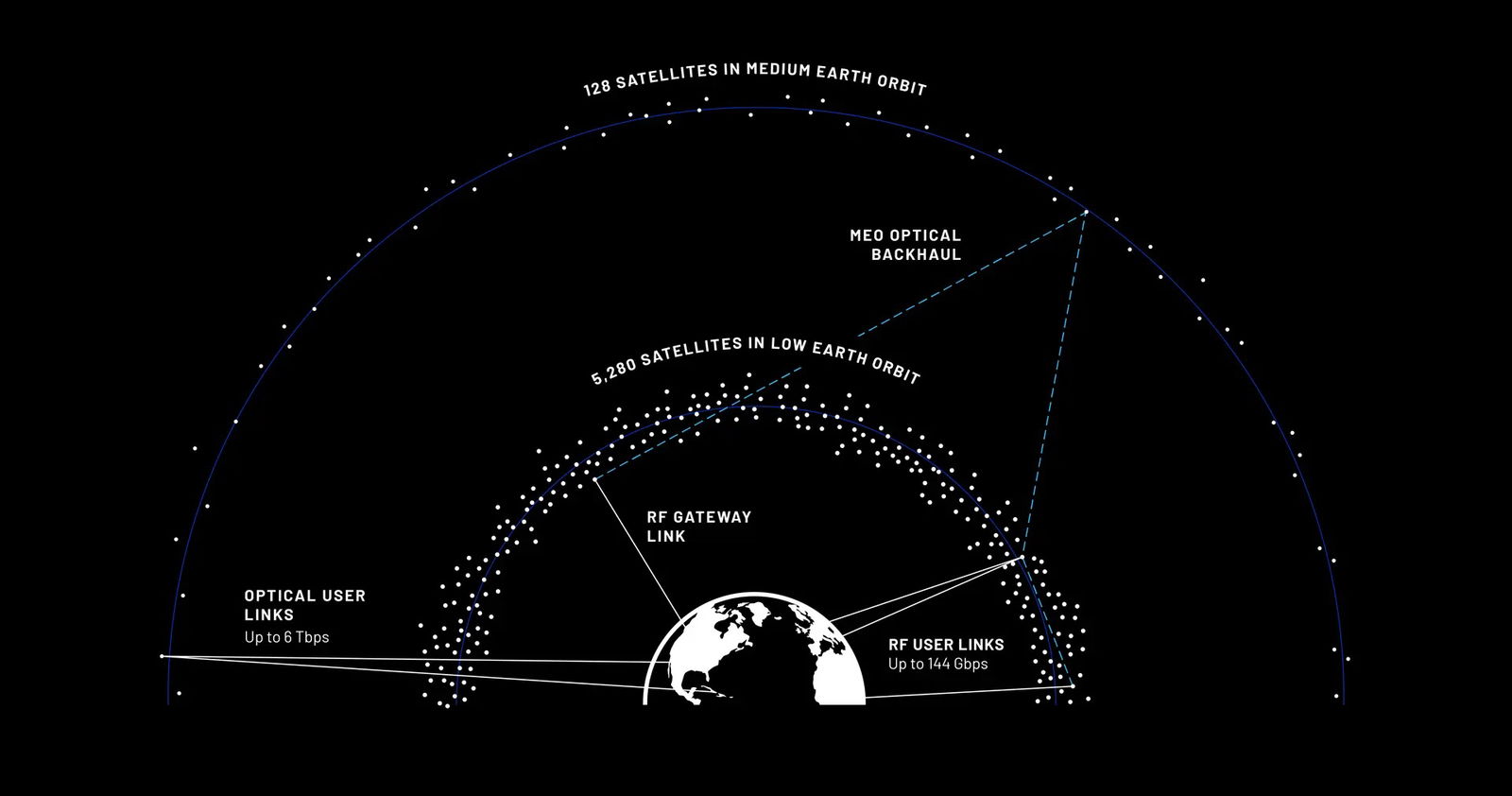
The company plans to deploy 5,408 satellites, comprising 5,280 in Low Earth Orbit (LEO) and 128 in Medium Earth Orbit (MEO).
LEO satellites will handle RF-based ground connectivity with throughput reaching 144 Gbps per link, while MEO satellites will enable inter-satellite and ground-based optical laser links capable of reaching up to 6 Tbps.
According to Blue Origin, the TeraWave network will bridge the gap between terrestrial fiber and orbital connectivity, offering performance and redundancy at a scale previously considered impractical for satellite systems.
Designed For Enterprise And Government, Not Consumers
TeraWave is not designed for everyday home users. Instead, it is positioned as infrastructure-grade connectivity aimed at enterprises, government agencies, and hyperscale data centers.
“We identified an unmet need with customers who were seeking enterprise-grade internet access with higher speeds, symmetrical upload and download speeds, more redundancy, and rapid scalability for their networks.
TeraWave solves for these problems,” a Blue Origin spokesperson said in an official statement shared with TechCrunch.
The company added that TeraWave will complement existing fiber optic infrastructure, enhancing connectivity in regions where terrestrial deployment is costly or logistically challenging.
Architecture And Deployment Timeline
Blue Origin stated that the first TeraWave launches will begin in Q4 2027, marking its first large-scale network project beyond its existing rocket and launch operations.
The design integrates optical laser interlinks for near-instant communication between satellites and ground stations, combined with advanced routing to optimize latency and redundancy.
Each TeraWave ground terminal will support enterprise-grade installations with minimal modification to existing network setups.
The constellation’s hybrid LEO-MEO architecture ensures that latency-sensitive and bandwidth-intensive tasks are distributed efficiently.
According to the company, the system will provide a reliable backbone for data-intensive applications across sectors such as defense, financial trading, maritime operations, and energy infrastructure.
Topics For More Insights
Competing In A Crowded Orbit
TeraWave’s introduction arrives as competition in the orbital internet market intensifies. SpaceX’s Starlink continues to dominate the consumer satellite space with roughly 10,000 satellites in orbit.
Meanwhile, Amazon’s Project Kuiper (now rebranded as Leo) is expected to target consumer broadband users later in 2026.
However, Blue Origin’s approach differs sharply. Instead of focusing on individual users, TeraWave is built for high-performance backbone communications, a move that could put it in direct competition with fiber carriers and private satellite networks rather than consumer ISPs.
Analysts noted that the announcement sent shockwaves through the satellite broadband sector. Shares of peers such as AST SpaceMobile and EchoStar fell after the reveal as investors reassessed the competitive landscape.
The Broader Vision For Blue Origin
TeraWave marks a significant expansion of Blue Origin’s ambitions beyond launch vehicles and space tourism. The company has been gradually diversifying into orbital infrastructure and satellite manufacturing, and this project represents its most substantial commitment to date in that direction.
“TeraWave represents the next evolution of Blue Origin’s mission, extending human reach beyond Earth not just physically, but digitally,” said a company executive familiar with the program.
With the TeraWave initiative, Blue Origin is positioning itself as a key player in the future of high-capacity space communications, bridging the gap between Earth’s data networks and orbital systems.
If successful, the project could provide a new global standard for enterprise connectivity and redefine how information travels around the planet.
