
Apple debuted its latest high-performance silicon, the M5 Pro and M5 Max, built on a new Fusion Architecture that combines two dies into a single system on a chip.
The new processors power the refreshed MacBook Pro lineup and target professionals handling AI, 3D rendering, simulations, and advanced code compilation.
The new MacBook Pro models powered by M5 Pro and M5 Max are available for pre-order starting tomorrow, with general availability beginning Wednesday, March 11.
The reveal came as part of Apple's event week, with the main day set for March 4 from 9 a.m. Eastern Time onwards.
This year's event breaks from its traditional keynote-style livestream. Instead of hosting a single broadcast event, the company is organizing what it calls a “special Apple Experience” for invited media across New York, London, and Shanghai.
Meanwhile, the general public can follow along digitally as Apple publishes announcements throughout the day via its Newsroom and official social media channels.
TL;DR
- Apple launches M5 Pro and M5 Max with new Fusion Architecture
- New 18-core CPU includes 6 super cores and 12 performance cores
- Up to 40-core GPU with Neural Accelerators in each core
- Up to 128GB unified memory and 614GB/s bandwidth
- Pre-orders begin March 4, availability starts March 11
Apple Introduces Fusion Architecture To Boost Pro Laptop Performance
At the center of Apple’s announcement is a new Apple-designed Fusion Architecture that connects two third-generation 3-nanometer dies into a single SoC using high-bandwidth, low-latency packaging.
The design integrates the CPU, scalable GPU, Media Engine, unified memory controller, Neural Engine, and Thunderbolt 5 controllers directly on the chip. By fusing two dies, Apple aims to scale performance without compromising power efficiency, a defining feature of its silicon strategy.
“M5 Pro and M5 Max are a monumental leap forward for Apple silicon, leveraging our new Fusion Architecture to scale the capabilities of Apple silicon while preserving its core tenets of performance, power efficiency, and unified memory architecture,” said Johny Srouji, Apple’s SVP of Hardware Technologies.
He added that both chips integrate “the world’s fastest CPU cores, a next-generation GPU with Neural Accelerators, a faster Neural Engine, and high-bandwidth, high-capacity memory,” enabling stronger on-device AI capabilities.
M5 Pro And M5 Max Specs Deliver Higher CPU, GPU, And AI Throughput
Both chips feature a new 18-core CPU design, made up of six high-performance super cores and 12 newly designed performance cores optimized for power-efficient multithreaded workloads.
Apple says the CPU delivers up to 30 percent faster performance for pro workflows compared to the previous generation. The super cores are designed for top-tier single-threaded performance, aided by improved front-end bandwidth, new cache hierarchy, and enhanced branch prediction.
On the graphics side, M5 Pro scales up to a 20-core GPU, while M5 Max extends to as many as 40 cores. Each GPU core includes a Neural Accelerator, contributing to over 4x peak GPU compute for AI tasks compared to the prior generation.
Graphics improvements include up to 20 percent higher performance over M4 Pro and M4 Max, and up to 35 percent better ray tracing performance in supported apps. Apple’s third-generation ray-tracing engine is aimed at boosting advanced visual effects and 3D rendering performance.
For AI and memory-heavy workloads, M5 Pro supports up to 64GB of unified memory with bandwidth reaching 307GB/s. M5 Max doubles that capacity to 128GB and pushes bandwidth to 614GB/s, supporting higher token generation for large language models and complex dataset processing.
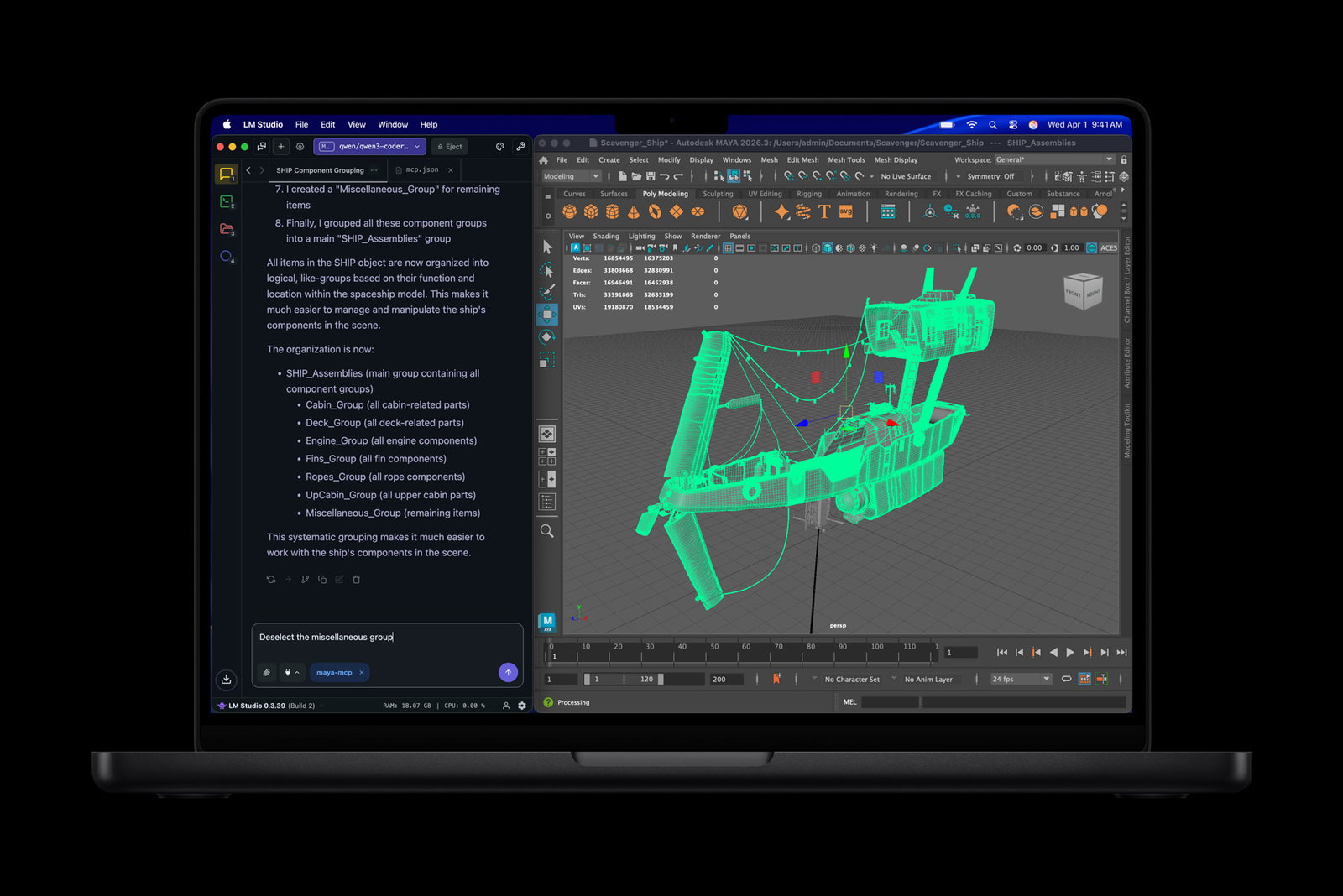
Apple says the chips enable accelerated code compilation and on-device agentic coding in tools like Xcode, while also powering simulations and dataset analysis in applications such as MATLAB and LM Studio.
Topics For More Insights
- Apple Event Week: Apple Unveils An Improved iPhone 17e At The Same Price Ahead Of Its March 4 Event
- Apple Event Week: Apple Launches New M4-Powered iPad Air With Faster Performance Just Before Its Event
- Apple Event Week: Apple Unveils New MacBook Air With M5 With Double Base Storage
- Apple Event Week: Apple Launches 14 & 16-Inch MacBook Pro With M5 Pro & M5 Max
- Apple Event Week: New Studio Display & Studio Display XDR Come With Thunderbolt 5 & 5K Retina XDR
Advanced Chip Technologies In The New MacBook Pro
Beyond raw performance, Apple highlighted additional chip-level technologies, including a faster 16-core Neural Engine with higher memory bandwidth for Apple Intelligence features, hardware-accelerated H.264, HEVC, AV1 decode, and ProRes encode and decode support through the Media Engine.
The chips also include Thunderbolt 5 ports with dedicated on-chip controllers and support for Memory Integrity Enforcement, described as an always-on memory safety protection that does not impact performance.
Apple positioned the launch within its broader Apple 2030 sustainability roadmap, which targets carbon neutrality across its footprint by the end of the decade.
The company noted that the power-efficient performance of M5 Pro and M5 Max helps reduce overall lifetime energy consumption of the MacBook Pro.
With M5 Pro and M5 Max, Apple is pushing further into AI-centric and compute-heavy professional workflows, reinforcing its in-house silicon strategy as competition in high-performance computing intensifies.
