

Artificial Intelligence
Why Most AI Projects Fail Before They Scale?
Share
Introduction
This line from Accepted captures the excitement many of us feel when we are overwhelmed by failures, whether it's a school project or a major AI-driven enterprise project.
Just like the group of friends in the movie who decide to start their own school, organizations often jump into AI with high expectations, thinking they will solve everything.
Although just like in the movie, they quickly realize that building something from scratch is not as easy as it seems.
The same goes for AI. It might seem easy to launch a small AI project but scaling it across an entire business is a whole different ball game. It takes the right team, solid processes, and a clear plan that goes beyond just getting the pilot up and running.
Usually, that’s where most AI projects struggle.
This article talks about exactly that. The challenges of AI projects and how to mitigate scaling risks.
So, before we dive into that, let’s first see what an AI project actually means for an enterprise.
TL;DR
-
AI projects struggle to scale: only 36% of companies have successfully scaled their generative AI solutions, and 13% report meaningful impact at the enterprise level.
-
40% of GenAI projects are expected to be canceled by 2027 due to unclear ROI and implementation complexity.
-
Poor data quality, inaccurate models, and a lack of proper data governance are the leading barriers to scaling AI beyond the proof-of-concept phase.
-
Effective AI scaling needs a clear strategy, integration, MLOps discipline, and strong change management.
What Is An AI Project In An Enterprise?
An AI project in an enterprise is a business initiative that uses AI to improve an outcome, then puts that capability into production so it can be used repeatedly and safely.

-
A business goal tied to a measurable outcome (cost, time, risk reduction, revenue impact, customer experience improvement).
-
Data inputs from enterprise systems like CRM, ERP, ticketing, finance, operations, product analytics, or knowledge bases.
-
A model or system (machine learning, predictive analytics, or generative AI).
-
A deployment path into workflows (apps, dashboards, customer journeys, agent desktops, internal tools).
-
Operations and controls to enable the system to be monitored, updated, governed, and trusted over time.
Now, the difference between pilot success and enterprise scale matters immensely. IDC research shows the scale of the conversion gap: 88% of observed AI proofs of concept did not reach widespread deployment, and for every 33 AI POCs a company launched, only four graduated to production.
With that baseline in place, the real question is simple: which part of the AI project consistently gets blocked as it moves from pilot to production to scale?
To answer that, let’s get on to the why AI projects struggle to scale.
Reasons Why Most AI Projects Fail Before They Scale
Here are some of the most common reasons why most AI projects fail before they scale:
-
Lack Of Clear AI Strategy And Business Alignment
Many AI initiatives start with excitement and tooling, then struggle to answer one question: what problem are we solving, for whom, and how will the business use the output?
For instance, RAND identifies misunderstanding or miscommunication of the problem as the first root cause of AI project failures. This sounds basic, yet it shows up constantly in enterprise settings where multiple stakeholders want different outcomes from the same system.
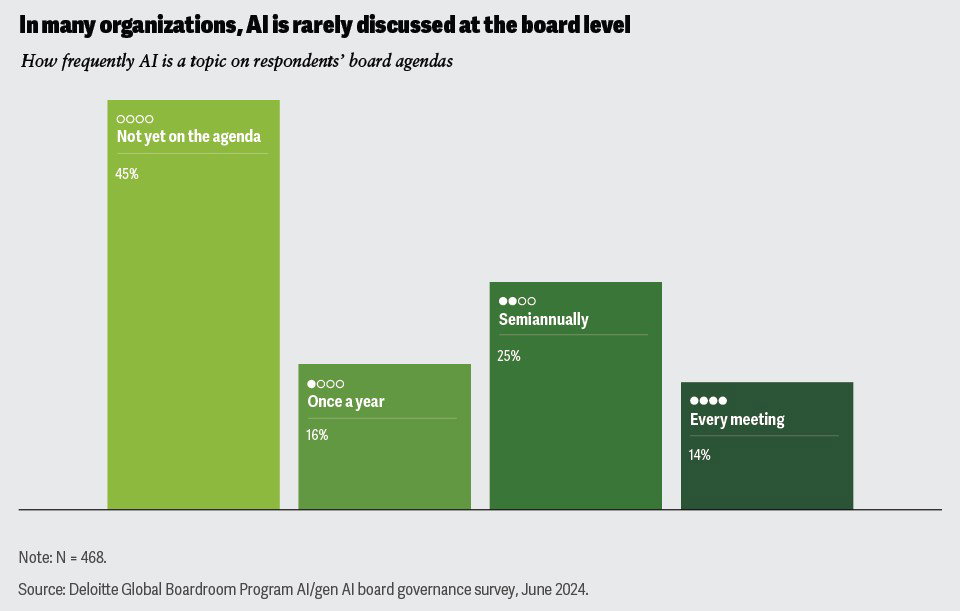
Board-level oversight often arrives late, making alignment more difficult. Deloitte’s Global Boardroom Program survey finds that 45% of respondents say AI is not yet on the boardroom agenda.Thus, scaling usually needs funding, governance, and cross-team coordination. You see, those are your leadership muscles, not just engineering tasks.
So, even with perfect alignment, AI still cannot scale on ambiguous or messy data foundations. -
Poor Data Quality And Data Readiness
AI systems do not scale across all data. They scale data that is accessible, governed, timely, and trusted across the organization.
IBM points to how often data issues become a real adoption blocker. The report notes that nearly half (49%) of executives cited data inaccuracies and bias as barriers to adopting agentic AI, according to the IBM Institute for Business Value. That is no longer a niche concern. It is an enterprise-wide constraint.
A well-known line from Andrew Ng keeps showing up in serious AI discussions because it matches reality: If 80 percent of our work is data preparation, then ensuring data quality is the important work of a machine learning team.Scale makes data issues louder. The same weak definitions, duplicates, access problems, and inconsistent governance that you can ignore in a pilot become deal-breakers when multiple teams depend on the output.
These data problems often explain why pilots look promising but then stall when teams try to move into production.

Topics For More Insights
-
AI Projects Remain Stuck In Pilot Or Proof-Of-Concept Stage
The pilot trap is real. Enterprises run POCs because they feel low risk. A POC proves something can work. It does not prove it can run.
Recent research from TechRadar shows that only about 36% of organizations have successfully scaled their generative AI solutions, and just 13% report significant enterprise‑wide impact from GenAI deployments. This highlights the scaling gap.
Gartner’s Rita Sallam frames the mood behind these decisions: “After last year’s hype, executives are impatient to see returns on GenAI investments, yet organizations are struggling to prove and realize value.”IDC’s Lenovo-linked finding adds another operational insight from the same CIO.com coverage: “The high number of AI POCs but low conversion to production indicates the low level of organizational readiness in terms of data, processes and IT infrastructure.”
Which means that production readiness is not a vague concept. It has a name in modern AI programs, and it is usually missing. -
Absence Of MLOps And Operational Infrastructure
Scaling AI means operating it. That includes deployment pipelines, monitoring, evaluation, versioning, feedback loops, retraining, and incident response. Many teams build models, but do not build the operating system around them.
When organizations skip MLOps, scale fails in predictable ways:-
Models drift as the world changes.
-
Outputs lose reliability and trust.
-
Teams cannot explain performance changes.
-
Updates become risky, slow, or impossible.
This is where governance and cost also collide. As the scope of GenAI widens, Gartner warns that the financial burden of developing and deploying GenAI models is increasingly felt. Operational gaps exacerbate those costs by requiring repeated work, making failures harder to diagnose, and leading teams to overinvest in patchwork fixes.
Even when systems are running, projects still fail if no one can demonstrate their business value.
-
-
Undefined ROI And Success Metrics
AI teams often measure what is easy (accuracy, latency, adoption clicks) rather than what leaders fund (risk reduction, time savings, revenue protection, cost avoidance, improved customer outcomes).
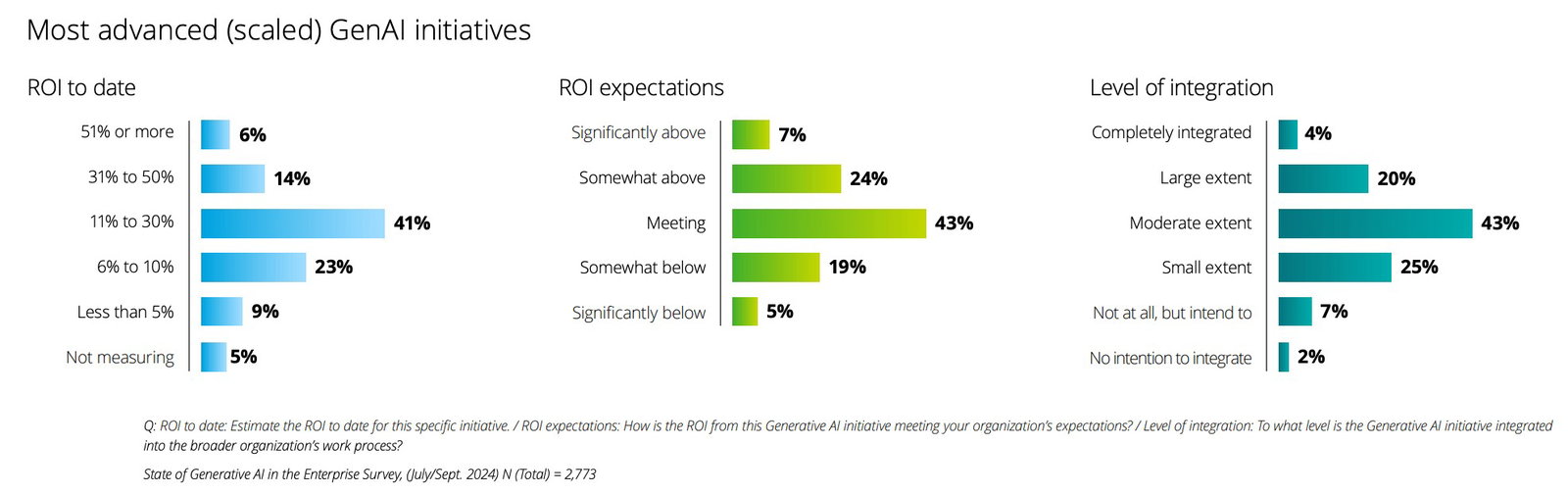
Deloitte’s enterprise GenAI survey results show how long this can take when foundations are not set early. It says organizations need at least a year to resolve ROI and adoption challenges, with 70% needing 12+ months to resolve ROI challenges. The same page notes that 76% say they’ll wait at least 12 months before reducing investment if value targets aren’t being met.That patience sounds generous. It also signals a risk: programs can linger without clear metrics, then be cut when budgets tighten or leadership changes.
This value is not only about measurement. It is also about whether people will actually use the system in their daily work. -
Low User Adoption And Change Management Gaps
Many AI projects fail quietly because users do not trust them, do not understand them, or do not see their value. Adoption is not a marketing problem. It is a design problem.
When AI outputs are not embedded into real workflows, teams treat them as optional. Optional tools do not scale.
Deloitte’s same survey data shows how heavy the adoption of work can be. It reports that 55–70% need 12+ months to resolve adoption challenges. That is a clear signal that training, trust-building, workflow fit, and organizational change are not nice-to-have activities.Thus, trust is also shaped by how safe and well-governed the system is, especially when AI touches sensitive data or decision-making.
-
Governance, Security, And Compliance Challenges
AI projects scale faster than the guardrails around them. That mismatch creates friction with security, legal, compliance, and risk teams, slowing deployments.
Gartner cites “inadequate risk controls” as one reason GenAI projects are abandoned after the POC. That line matters because it directly addresses the challenges enterprise teams face: privacy constraints, access control decisions, model risk reviews, vendor assessments, red-teaming, audit expectations, and regulatory uncertainty.
Deloitte’s board-focused perspective is also blunt about governance at scale. Lara Abrash is quoted in Deloitte’s board blog: AI is here, now. Organizations need to govern at scale.
Governance is not only policy. It is operational. It must show up in how data is handled, how prompts are controlled, how outputs are reviewed, how incidents are triaged, and who is accountable when the system fails.
Hence, the fastest way to make governance and operations fail is to build the wrong team shape around the work. -
Talent And Skill Gaps Across AI Teams
Enterprises often treat AI as only a data science problem. Scaling requires more than that: data engineering, platform engineering, MLOps, security, product management, and domain expertise.
CIO.com’s coverage of the IDC and Lenovo research highlights a lack of in-house AI expertise, data readiness issues, and unclear objectives as common failure drivers. The pattern is familiar: strong experimentation skills, weak production skills.
The fix is not “hire more data scientists.” The fix is building a complete AI delivery stack:-
Product owner with business accountability.
-
Data engineering and data governance ownership.
-
MLOps and platform capability for repeatable deployment.
-
Security and compliance partners embedded early.
-
Domain experts who define what good means.
-
Change management and enablement to drive adoption.
-


Now that we have understood why most of these AI projects fail, let’s wrap up this article.
Conclusion
In summary, AI projects fail before they scale for predictable reasons: unclear problem ownership, weak data foundations, pilot fatigue, missing MLOps, fuzzy ROI, low adoption, late governance, and mismatched team skills.
The teams that win are the ones that make AI production-ready early, measure value in business language, and govern risk before scale forces a stop.
How can one successfully scale their AI projects? Now, we know.
How to get AI ready? Get ready here.
Frequently Asked Questions
What Does AI Scaling Mean?
AI scaling is the process of scaling AI models and systems from pilot projects to enterprise-level deployments. This involves optimizing and managing large volumes of data, ensuring the models perform efficiently at scale, and integrating AI seamlessly across business functions to achieve long-term impact and value.
What Are The 3 AI Scaling Laws?
The three AI scaling laws are: Data Scalability, which emphasizes that AI success depends on the availability and quality of data; Model Scalability, which highlights the need for AI models to be optimized for performance as they grow; and Operational Scalability, which ensures that the underlying infrastructure can support AI systems in production environments for continued success.
What Are The Best AI Scaling Frameworks Recommended For Real-Time Analytics?
For real-time analytics, frameworks such as Google's TensorFlow, Apache Kafka, and Amazon SageMaker are highly recommended. These platforms provide robust tools for rapid data processing, high availability, and scalable AI models, enabling businesses to make timely, data-driven decisions.
Wed, Feb 4, 2026

Enjoyed what you've read so far? Great news - there's more to explore!
Stay up to date with the latest news, a vast collection of tech articles including introductory guides, product reviews, trends and more, thought-provoking interviews, hottest AI blogs and entertaining tech memes.
Plus, get access to branded insights such as informative white papers, intriguing case studies, in-depth reports, enlightening videos and exciting events and webinars from industry-leading global brands.
Dive into TechDogs' treasure trove today and Know Your World of technology!
Disclaimer - Reference to any specific product, software or entity does not constitute an endorsement or recommendation by TechDogs nor should any data or content published be relied upon. The views expressed by TechDogs' members and guests are their own and their appearance on our site does not imply an endorsement of them or any entity they represent. Views and opinions expressed by TechDogs' Authors are those of the Authors and do not necessarily reflect the view of TechDogs or any of its officials. While we aim to provide valuable and helpful information, some content on TechDogs' site may not have been thoroughly reviewed for every detail or aspect. We encourage users to verify any information independently where necessary.
Loading comments...