Artificial Intelligence
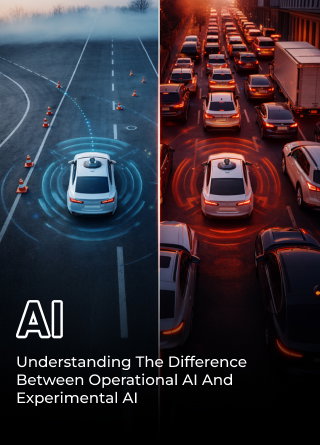
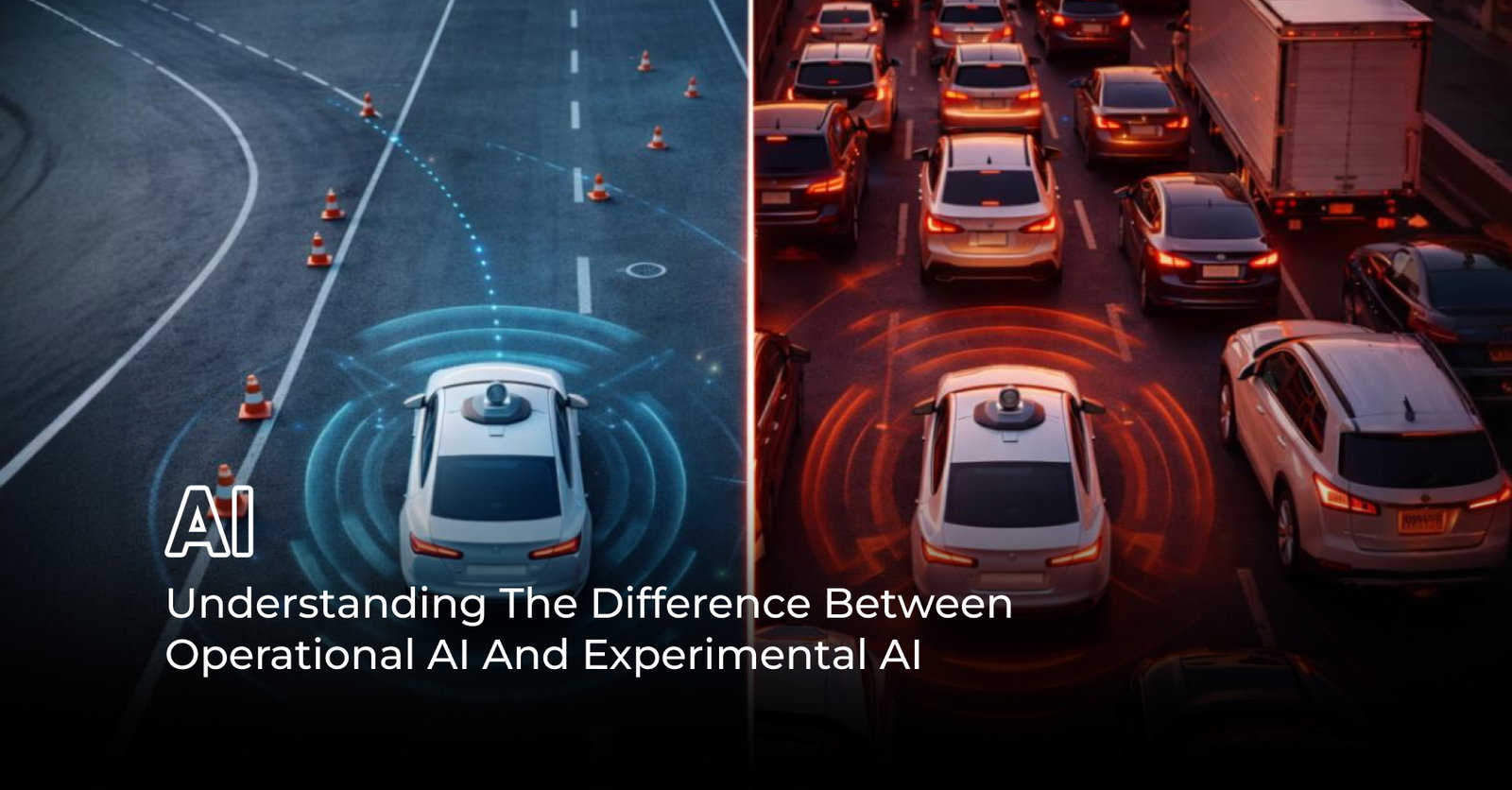
Understanding The Difference Between Operational AI And Experimental AI
Share
Introduction
Sometimes, you might explore a new shortcut suggested by the app. You hesitate for a moment, then try it to see if it might be faster. One is dependable and predictable, while the other is curious and experimental.
That same mix of trust and curiosity shows up in how businesses work. Companies rely on systems that run smoothly every day, but they also experiment with new ideas to see what could work better. Artificial intelligence (AI) follows this exact pattern.
Understanding this difference is becoming essential as AI shifts from hype to habit. Well, that brings us to the two sides of today’s AI story: Operational AI and Experimental AI.
Before discussing how they’re used, let’s first understand what they are and the roles they play. Read on!
TL;DR
-
Operational AI ensures stability, reliability, and predictable business outcomes.
-
Experimental AI drives learning, innovation, and testing new ideas safely.
-
AI is now about adoption, ROI, and tangible results and not just experimentation.
What Is Operational AI?
Operational AI is the version of AI that businesses rely on to keep things running smoothly. It’s not flashy, and it doesn’t experiment much, but that’s exactly the point. These systems are created to perform consistently, accurately, and at scale in real-world environments.
Around 78% of organizations now use AI in at least one business function, according to a Netguru report, showing it’s no longer just experimentation but part of daily operations.
As Arvind Krishna, chairman and CEO of IBM, put it, "AI has moved from experimentation to unlocking business value. The hype cycles have faded, and we are now thinking about adoption, ROI and business value."
This is how operational AI is deeply integrated into everyday business processes. It powers customer support chatbots, flags fraudulent transactions, forecasts demand, and automates workflows. Once deployed, it becomes part of the organization’s core infrastructure, much like a payroll system or an ERP platform.
The goal of operational AI is to deliver predictable outcomes with minimal risk. It’s trained, tested, governed, and monitored carefully before it ever goes live. Once it does, stability matters more than novelty.
To make sure it works smoothly every time, operational AI is built around a few key characteristics that keep it consistent and scalable.
What Are The Characteristics Of Operational AI?
Well, well, well… Operational AI doesn’t chase novelty or try to reinvent the wheel every day; it’s built to be steady, dependable, and consistent.
Consider these characteristics the autopilot settings that keep operational AI flying straight and steady.
-
Reliability
Built to work continuously and in real time, with minimal surprises.
-
Well-trained
Uses carefully curated datasets and follows strict performance benchmarks.
-
Scalability
Can handle large volumes of data, users, or transactions without slowing down.
-
High Performance Under Pressure
Designed for tasks like processing millions of payments or thousands of customer queries.
-
Governance & Compliance
Meets industry regulations, maintains audit trails, and ensures transparency.
-
Predictability
Little room for guesswork; decisions and outcomes are consistent.
These features give operational AI its steady hand and ensure business processes stay seamless and risks stay low.
With these characteristics in place, operational AI naturally fits into core business functions where consistency matters more than experimentation.
Common Use Cases Of Operational AI In Enterprises
In enterprise environments, operational AI typically works quietly in the background, supporting everyday processes that demand speed, accuracy, and consistency.
-
Customer Service
AI-powered chatbots and virtual agents handle routine queries, reduce response times, and ensure consistent support across channels.
-
Finance And Risk Management
AI models monitor transactions in real time to detect fraud, assess credit risk, and flag anomalies before they escalate.
-
Supply Chain And Logistics
Operational AI helps forecast demand, optimize inventory levels, and anticipate disruptions to keep operations running on schedule.
-
Human Resources
From resume screening to workforce planning, AI supports HR teams by streamlining hiring processes and predicting future talent needs.
Across industries, the goal remains the same: to improve efficiency, reduce errors, and deliver reliable outcomes at scale.
What Is Experimental AI?
Experimental AI is where curiosity gets the wheel. Unlike operational AI, these systems are not built to deliver instant results or run perfectly from day one. Their purpose is to explore, test, and see what happens. Some ideas work, some don’t, and that’s the point. This kind of AI exists to test assumptions, experiment with new approaches, and learn from every outcome, whether it’s a success or a lesson learned.
According to IBM, AI adoption is picking up speed. While 42% of large enterprises are already using AI, 40% are still testing it, and most are now investing more to move faster. Well, this growing momentum explains why experimentation matters so much right now.
Overall, Experimental AI enables teams to try, adjust, and learn, with the best ideas eventually becoming long-term systems.
What Are The Characteristics Of Experimental AI?
This is where ideas are allowed to wander a bit. These curious, flexible systems are defined by a few key characteristics that let teams explore, experiment, and learn without pressure.
-
Flexibility
Models are updated, retrained, or replaced frequently to allow teams to test different approaches.
-
High Risk Tolerance
Can afford to fail since these systems are not mission-critical or customer-facing.
-
Iterative Development
Designed for rapid testing, feedback, and refinement rather than long-term stability.
-
Exploratory Data Use
Works with smaller, less-polished datasets to uncover patterns and behaviors.
-
Learning-Driven Outcomes
Focuses on insights and discovery instead of immediate accuracy or business impact.
These characteristics make experimental AI a space for exploring and discovering what works best.
As a result, experimental AI focuses more on discovery than execution, influencing how and where organizations apply it.

Common Use Cases Of Experimental AI In Enterprises
In enterprises, experimental AI is used to explore new ideas, test possibilities, and experiment with approaches before scaling them across the organization.
-
Product Innovation
Teams use AI to try out new product concepts, test features, and explore personalized customer experiences before anything reaches the market.
-
Marketing And Content
Marketing teams rely on AI to experiment with different content styles and messages, learning what clicks with audiences without risking live campaigns.
-
Manufacturing And Operations
AI is used to safely test production scenarios, fine-tune workflows, and explore predictive maintenance ideas before applying them on the factory floor.
-
Healthcare And Research
Researchers turn to AI to uncover patterns in medical imaging, genomics, and drug discovery, often long before these models are ready for real-world deployment.
Across industries, experimental AI serves as a low-risk testing ground that helps organizations learn faster, discover new possibilities, and turn early insights into dependable, operational systems.
Operational AI Vs. Experimental AI: Key Differences Explained
| Aspect | Operational AI | Experimental AI |
| Primary Goal | Stability and efficiency | Exploration and learning |
| Risk Tolerance | Very low | High |
| Deployment | Production-ready environments | Labs, pilots, sandboxes |
| Data Quality | Clean, validated datasets | Raw or evolving datasets |
| Governance | Strict compliance and monitoring | Minimal governance |
| Success Metric | Accuracy, uptime, ROI | Insights, discoveries, feasibility |
Topics For More Insights:
Can Operational AI And Experimental AI Work Together?
Absolutely. In many organizations, they already do.

Experimental AI is where teams explore ideas and see what’s possible without pressure. Operational AI is the practice of putting ideas that actually work into practice. One supports learning, the other supports business.
What starts as an experiment doesn’t have to stay that way. When a model proves useful and reliable, it can be refined, reviewed, and gradually integrated into everyday operations. This approach enables teams to innovate without risking the systems that customers and employees rely on.
In 2026, many companies are establishing clear paths from experimentation to production and ensuring new ideas can grow into real solutions without disrupting what’s already working.
Final Thoughts
Operational AI and experimental AI aren’t competing with each other. They’re more like teammates. Operational AI is there to keep things steady. It does the reliable, behind-the-scenes work that businesses depend on every single day. Experimental AI, on the other hand, is where curiosity lives. It’s where teams try things out, see what sticks, and learn what doesn’t work.
Understanding this difference changes how organizations use AI. Instead of forcing half-baked ideas into production or playing it too safe, teams can move at the right pace.
As AI becomes just another tool in the business toolkit, it’s this balance between stability and exploration that makes the difference.
Frequently Asked Questions
What Is The Difference Between Operational AI And Experimental AI?
Operational AI is built for stable, real-world use, where accuracy, reliability, and compliance matter most. Experimental AI is used to test ideas, explore new models, and learn from outcomes before anything is put into everyday use.
Is Experimental AI Risky For Businesses?
Experimental AI carries a higher risk but is typically limited to controlled environments, such as labs or pilot programs. This allows teams to experiment safely without impacting customers or core operations.
Do Small And Mid-Sized Businesses Need Both Operational And Experimental AI?
Small and mid-sized businesses don’t always need both operational and experimental AI simultaneously. Most small and mid-sized businesses start with operational AI to handle everyday needs such as automation, analytics, and customer support. Experimental AI usually comes into play later, once the business is more stable and ready to explore new ideas, test possibilities, and invest in innovation beyond day-to-day efficiency.
Wed, Feb 11, 2026

Enjoyed what you read? Great news – there’s a lot more to explore!
Dive into our content repository of the latest tech news, a diverse range of articles spanning introductory guides, product reviews, trends and more, along with engaging interviews, up-to-date AI blogs and hilarious tech memes!
Also explore our collection of branded insights via informative white papers, enlightening case studies, in-depth reports, educational videos and exciting events and webinars from leading global brands.
Head to the TechDogs homepage to Know Your World of technology today!
Disclaimer - Reference to any specific product, software or entity does not constitute an endorsement or recommendation by TechDogs nor should any data or content published be relied upon. The views expressed by TechDogs' members and guests are their own and their appearance on our site does not imply an endorsement of them or any entity they represent. Views and opinions expressed by TechDogs' Authors are those of the Authors and do not necessarily reflect the view of TechDogs or any of its officials. While we aim to provide valuable and helpful information, some content on TechDogs' site may not have been thoroughly reviewed for every detail or aspect. We encourage users to verify any information independently where necessary.
Loading comments...