
Artificial Intelligence
Top 5 Jobs AI Is Replacing In 2026
Share
TL;DR
-
ILO says one in four jobs worldwide is potentially exposed to GenAI, although transformation remains more likely than full replacement.
-
Data Entry Keyers face a 25.9% projected employment decline in the US through 2034.
-
Telemarketers, customer service representatives and bookkeeping clerks also face measurable declines.
-
Routine information processing and administrative work remain among the activities closest to current AI capabilities.
-
Workers can respond by strengthening AI literacy, domain expertise, judgment, communication and oversight skills.
Introduction
The shift happening in workplaces today is less like a sudden system shutdown and more like a factory assembly line gradually being automated station by station. Some roles are still fully human-operated, while others are already handled by machines that process, sort and respond at scale.
Artificial Intelligence (AI) is no longer a side project. OECD data shows AI adoption among businesses across member countries rose from about 7% in 2021 to 20% in 2025. The International Labour Organization (ILO) says one in four jobs worldwide is potentially exposed to Generative AI, but transformation is more likely than outright replacement.
So, which jobs are actually under pressure? Let's follow the employment data.
Is AI Really Replacing Jobs In 2026?
"Jobs AI will replace" makes a strong headline. Labor-market evidence is more complicated.
A March 2026 study based on The CFO Survey found little overall AI-driven headcount reduction so far. However, executives expect routine clerical workers' share of the workforce to decline 0.76% in 2026 and 2.19% by 2028. Administrative work, data entry and customer service were among the activities most often named for replacement.
Anthropic's 2026 labor-market research also found no systematic rise in unemployment among highly AI-exposed workers, although hiring into exposed occupations appears to have weakened for workers aged 22 to 25.
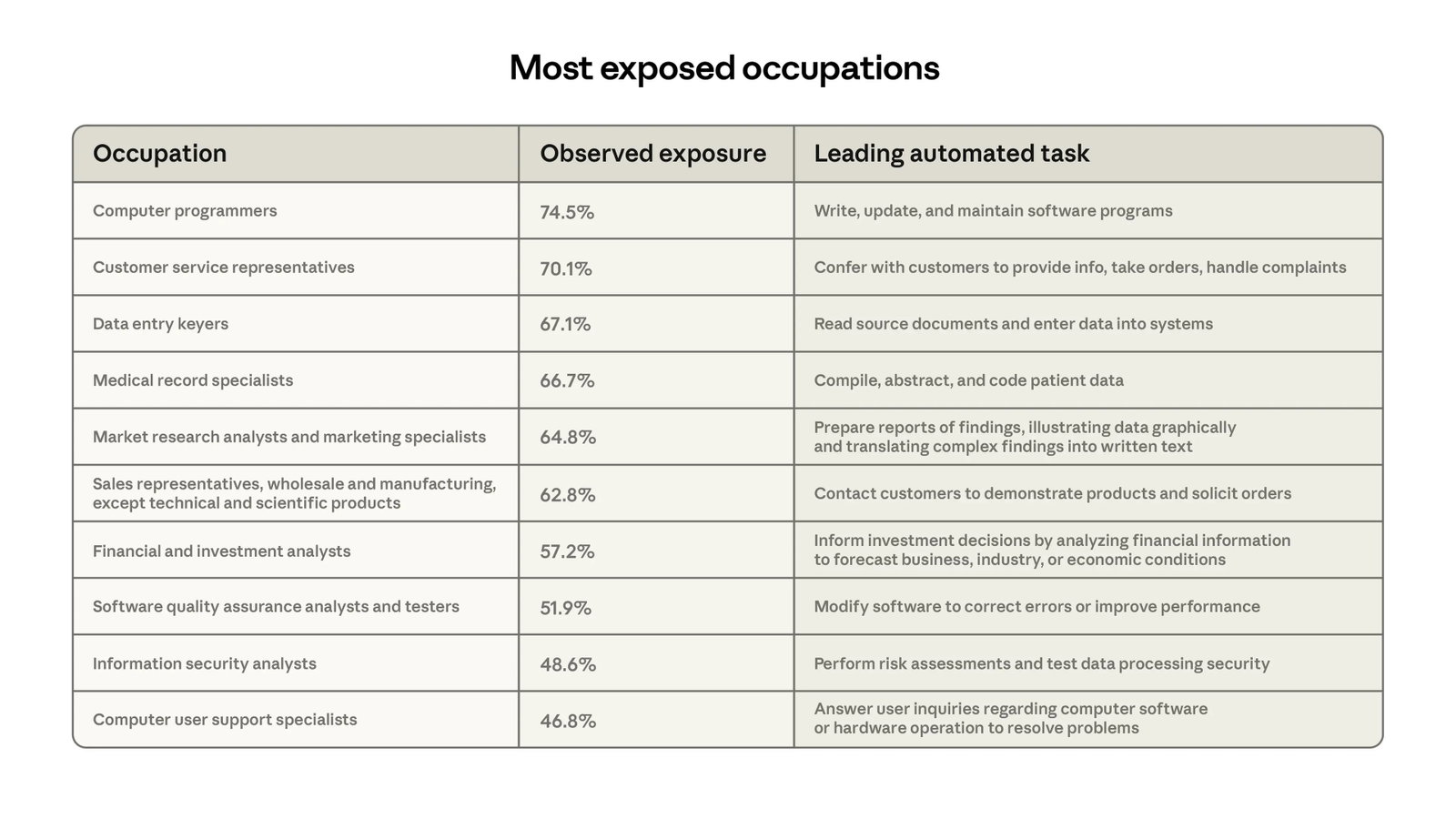
AI displacement is showing up first through fewer routine tasks, changing job descriptions and potentially slower entry-level hiring.
What Makes A Job Vulnerable To AI Replacement?
The OECD's 2026 AI exposure research found current AI systems are closest to occupations built around routine information processing, administrative work and codifiable tasks. Jobs requiring interpersonal understanding, responsibility and complex judgment remain harder to automate.
That distinction explains our refreshed top five.
Top 5 Jobs AI Is Replacing Or Reshaping In 2026
-
Data Entry Clerks
If a job can be described as "read this, capture that and put it there," AI has a natural opening.
Optical Character Recognition (OCR), document-processing systems and AI models can extract information from invoices, forms and records. Anthropic's 2026 research found Data Entry Keyers had 67% observed AI task coverage.
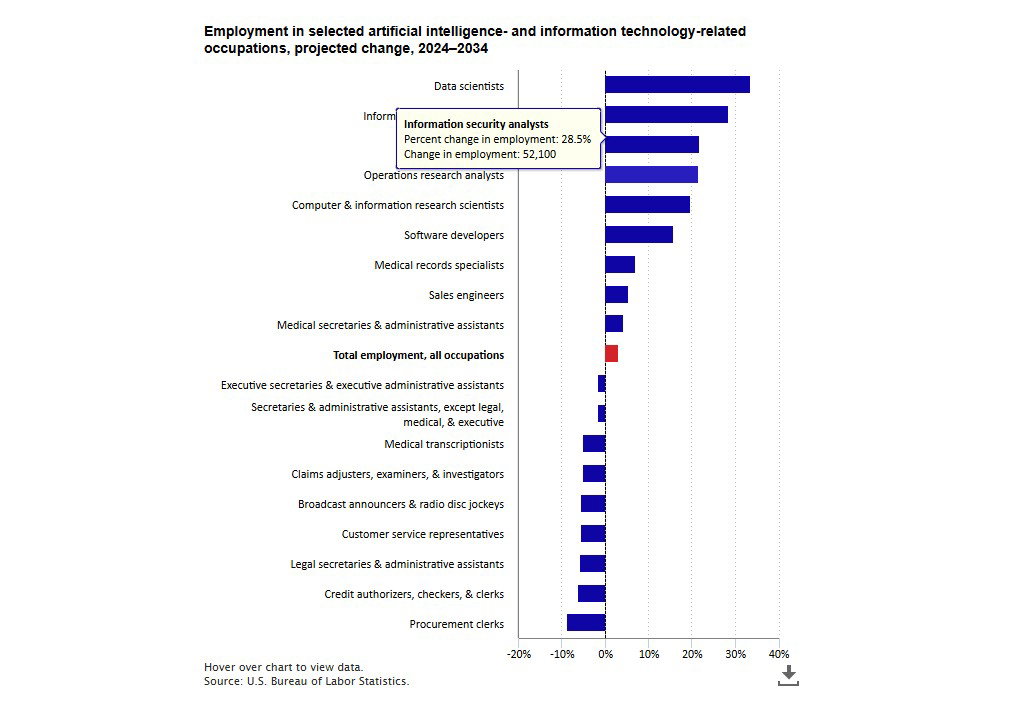
The U.S. Bureau of Labor Statistics (BLS) projects employment for Data Entry Keyers to fall 25.9% between 2024 and 2034, from about 141,600 jobs to 104,900. -
Telemarketers And Outbound Call Agents
Telemarketing has another AI-friendly formula: high call volumes, repeatable scripts and predictable qualification questions.
Modern voice agents can conduct conversations, retrieve information and complete predefined actions. Microsoft's 2026 real-time voice agents combine dynamic conversations with structured workflows.
The BLS projects Telemarketer employment to decline 22.1% from 2024 to 2034, dropping from roughly 67,400 roles to 52,500.
Humans still matter when persuasion depends on relationships, negotiation or unusual objections. -
Customer Service Representatives
Customer service is where AI job replacement becomes particularly visible because many interactions begin with the same requests: check an order, reset access, update an account or answer a policy question.
Anthropic ranks Customer Service Representatives among occupations with the highest observed AI exposure. Meanwhile, BLS expects employment to decline 5.5% by 2034, representing about 153,700 fewer jobs.
That does not make customer service human-free. Amazon Connect's AI agents can resolve customer issues autonomously while escalating cases that require human involvement. Routine resolution is being automated while people increasingly handle exceptions and sensitive problems. -
Bookkeeping, Accounting And Auditing Clerks
There is an important distinction here: AI is pressuring bookkeeping clerks, not eliminating accountants.
Software can classify transactions, reconcile records and assist with routine reporting. BLS projects Bookkeeping, Accounting and Auditing Clerk employment to decline 5.8% between 2024 and 2034, or about 94,300 positions.
Professional Accountants and Auditors, however, are projected to grow 5% over the same period. Repetitive financial processing is easier to automate than interpretation, advisory work, controls and professional judgment. -
General Office Clerks
The fifth spot changes from our 2025 list.
Proofreaders looked highly vulnerable to GenAI, but current BLS projections show Proofreaders and Copy Markers declining only 0.6% through 2034. General Office Clerks face a clearer 6.7% decline, representing about 177,800 fewer jobs.
These roles often involve document preparation, record updates, basic correspondence and information routing, all workflows AI assistants and automation platforms can absorb.
How Can Workers Stay Relevant As AI Changes Jobs?
Trying to become "AI-proof" misses the point. A better strategy is becoming difficult to automate end-to-end.
Learn the AI tools entering your profession. A bookkeeper who can supervise automated reconciliation has more leverage than one competing with it manually. A customer service professional who handles escalations and improves AI workflows moves further from routine queue work.
Then strengthen complementary skills. The OECD highlights critical thinking, creativity and collaboration as increasingly important for working effectively with AI.
Finally, deepen domain expertise. AI can generate an answer quickly, but organizations still need people who can judge whether it fits the customer, regulation or business objective.
As Till Leopold, Head of Work, Wages and Job Creation at the World Economic Forum, put it, "Trends such as generative AI and rapid technological shifts are upending industries and labour markets." The WEF also says 77% of employers plan to upskill workers in response to AI.
We explore the same shift in Skills Over Titles: The Future Of Work.
Conclusion
Ryan Howard was right that technology would change Dunder Mifflin. He was wrong to assume installing technology solved the people problem.
AI is repeating that lesson on a larger scale.
Data entry, telemarketing, routine customer service, bookkeeping support and office work are under measurable pressure. Yet 2026 evidence does not show AI wiping out entire professions overnight. It is removing tasks unevenly, changing hiring needs and raising the value of work that requires judgment, context and accountability.
The safest career move is not running from AI. It is moving toward the parts of your profession that still need you.
Frequently Asked Questions
Are Higher-Paid Jobs Safe From AI?
Not necessarily. Anthropic found workers in its most AI-exposed group earned 47% more on average than workers with zero observed exposure. Exposure, however, does not automatically mean displacement.
Which Jobs Are Growing Because Of AI?
BLS projects strong 2024–2034 growth for Data Scientists at 33.5%, Information Security Analysts at 28.5% and Software Developers at 15.8%, showing that AI can create demand alongside displacement.
Are Physical Jobs Safe From Generative AI?
They are generally less exposed to GenAI because many tasks require physical presence or dexterity. However, robotics and other automation technologies can create different risks.
Tue, Oct 7, 2025

Enjoyed what you've read so far? Great news - there's more to explore!
Stay up to date with the latest news, a vast collection of tech articles including introductory guides, product reviews, trends and more, thought-provoking interviews, hottest AI blogs and entertaining tech memes.
Plus, get access to branded insights such as informative white papers, intriguing case studies, in-depth reports, enlightening videos and exciting events and webinars from industry-leading global brands.
Dive into TechDogs' treasure trove today and Know Your World of technology!
Disclaimer - Reference to any specific product, software or entity does not constitute an endorsement or recommendation by TechDogs nor should any data or content published be relied upon. The views expressed by TechDogs' members and guests are their own and their appearance on our site does not imply an endorsement of them or any entity they represent. Views and opinions expressed by TechDogs' Authors are those of the Authors and do not necessarily reflect the view of TechDogs or any of its officials. While we aim to provide valuable and helpful information, some content on TechDogs' site may not have been thoroughly reviewed for every detail or aspect. We encourage users to verify any information independently where necessary.
Loading comments...