
Wearable Technology
Everything You Need To Know About Smart Glasses
Share
Overview
Closer.
Because the more you think you see, the easier it’ll be to fool you.
Because what is seeing? You’re looking but what you’re really doing is filtering, interpreting, searching for meaning.
My job? To take that most precious of gifts you give—your attention—and use it against you.
This was the opening monologue from 2013’s crime thriller, Now You See Me. In the movie, J. Daniel Atlas (Jesse Eisenberg) is referring to the art of magic. However, we feel they are an apt fit for smart glasses.
Of course, smart glasses aren’t used against you but for you. Yet, the unique interactive visual experience they offer certainly fools the brain into thinking the projected images exist in the real world. (We’re smart enough to know they don’t actually exist in the real world!). #brainy
These brilliant consumer electronic devices use onboard microcontrollers to provide users with a wide range of applications similar to smartphones—and then some.
After all, smart glasses are magic, too—and so much more!
What Are Smart Glasses?
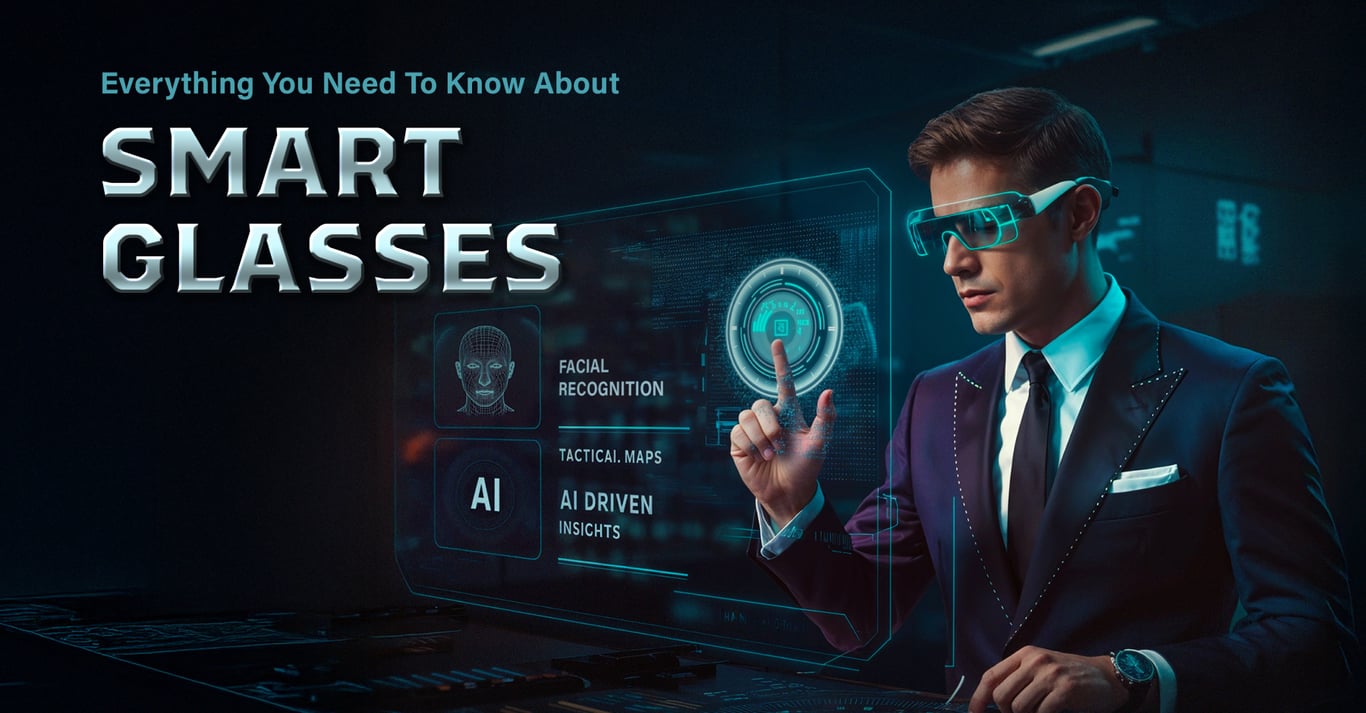
As you can glean from the name, smart glasses combine the use of technology with regular eyeglasses to deliver interactive and immersive visual experiences. They can be used for a wide range of purposes across diverse industries.
They usually leverage wireless connectivity, such as Bluetooth and Wi-Fi, to connect with apps on other devices such as smartphones, tablets, smart watches, and more.
Smart glasses form one aspect of wearable technology that offer visual stimulation. Depending upon the level of immersivity they offer, smart glasses are broken down into three primary types—augmented reality (AR), virtual reality (VR), or hybrid (mixed reality).
Typically, smart glasses refer to the devices that look and feel like traditional glasses but add intelligent, digital displays that deliver enhanced visual experiences. However, true AR/VR experiences are delivered by bigger, heavier and more complex devices known as headsets.
Today, we’re going to explore about smart glasses rather than AR/VR headsets, but it’s important to know their differences. Read on!
What’s The Difference Between Smart Glasses And AR/VR Headsets?
The primary difference between these two depends upon the experiences they deliver.
Smart glasses are designed to leverage AR technology to overlay digital content on top what a user sees in the real world, allowing them to see part of the real world and part of the display. On the flipside, VR headsets immerse users into virtual worlds by completely cutting out what a user sees in the real world.
When it comes to physical attributes, smart glasses are lighter and easy to where anywhere. They look like traditional eyewear. They can use transparent lenses, tinted lenses, or monochromatic lenses that allow users to adjust the tint levels. This makes them efficient to use on the go.
VR headsets are larger, heavier, and are often wired. They fit over a user's whole head and thus are better suited for stationary use. Additionally, the pricing for majority of smart glasses is lower than AR/VR headsets.
Despite these differences, these two types share a common foundation!
What Is The History Of Smart Glasses?
Whether you believe it or not, the history of smart glasses and VR headsets stretches all the way back to the 1960s when American computer scientist Ivan Sutherland introduced the concept, calling it “The Ultimate Display.”
He described what he thought the finished product would be like, saying “The ultimate display would, of course, be a room within which the computer can control the existence of matter. A chair displayed in such a room would be good enough to sit in.”
Sutherland went on to create a head-mounted, three-dimensional display capable of visually overlaying a user’s physical environment. The display even had a suspending counterbalance mechanical arm, while it used ultrasonic transducers to track the head movement.
Since then, progress remained relatively slow in comparison to the last ten to fifteen years, and of course, we’re a bit away from smart glasses or VR headsets capable of manifesting changes in the real, physical world.
However, the base principles set by Sutherland remain true even in the designing of modern smart glasses, including a display, processors, sensors, image rendering, and more.
So, how do modern smart glasses work?
How Do Smart Glasses Work?
Smart glasses host a miniature computer on board (known as a microcontroller), which allows it to run applications locally or connect to the internet or cloud-based applications. This allows users to complete various daily personal and professional tasks.
On the other end of the circuit is an advanced, complex, and powerful display system that projects images in a user’s line of vision. This could be by superimposing imagery on the glasses overlaying the real world or projecting it into their eyes directly. Did you know they can even come with prescriptive lenses? #NowYouSeeClearly
To deliver such experiences, smart glasses make use of cameras, sensors, buttons, and Bluetooth, Wi-Fi, and other wireless technology. For audio capabilities, they leverage microphones and built-in speakers or bone conduction technology.
Smart glasses offer a variety of functions, features, and capabilities, including calling, emailing, capturing photos, recording videos, browsing the web, voice control, surfing social media platforms, watching movies, navigation, receiving notifications, tracking physical activity, getting live translations, controlling smart home devices, monitoring health, using AI assistants, and more. Naturally, Artificial intelligence (AI) technology has become a big hit with modern smart glasses!
With such diverse use cases—and more being added every day—it’s no surprise that the market is flooding with smart glasses. In fact, reports indicate that the global smart glasses market is expected to grow from $878.8 million in 2024 to $4,129.3 million by 2030 with a CAGR of 29.4%.
So, don’t forget check out The Best Smart Glasses In 2025!
It’s no wonder that smart glasses are used in numerous professional sectors, while others are trialing and finding new use cases. So, where are they finding use?
What Are The Use Cases Of Smart Glasses?
Smart glasses find applicability in numerous industries, ranging from healthcare to manufacturing to events and more. Its use cases span:
-
Communication
As with smartphones, tablets, and other devices, communication plays a crucial role in the capabilities of smart glasses.
-
Entertainment
Who says entertainment isn’t a need, but only a luxury? Smart glasses provide users with a unique and immersive visual experience, making them ideal for top-notch entertainment. They can also be used to listen to music, podcasts, audio books, or other media files.
-
Gaming
With great power comes great responsibility, and with great smart glasses come great gaming experiences through virtual worlds and AR video games, capable of delivering exceptional audio-visual services is unparalleled.
-
Education
School or college students can leverage smart glasses to gain virtual lessons, offering them more practical learning approaches, including step-by-step instructions, translations, and simulations.
-
Training
It’s not just academic students who can learn, businesses can empower their new recruits to receive training sessions, as well as veteran employees to learn new skills using smart glasses.
-
Healthcare
When it comes to medical training, smart glasses offer visual aids that can also be helpful in critical situations such as surgeries and other complex procedures. Additionally, they could help doctors gain quick access to patient data, medical records, and diagnostic information.
-
Data Visualization
When it comes to professional usage, smart glasses have been used in industries such as manufacturing, logistics, designing, financial, and more, as it enables quick instructions, fast retrieval of data, real-time information, and more.
-
Accessibility
Smart glasses can be used to assist people with varying health issues, including visual impairment, hearing issues, and others, guiding them with auditory and visual navigation.
-
Convenience
Smart glasses are smaller, easier to handle, and more convenient to use than smartphones or smart watches as they reduce the level of physical effort required.
-
Media Capture
Users can click photos and record videos using smart glasses, allowing them to capture moments instantly. It also allows them to execute these tasks more discreetly than pulling out and holding a smartphone.
-
Security
Cameras on smart glasses allow users to verify the credentials of various professionals, including police officers, traders, cold callers, etc. It can also be used to gather contextual warnings and safety information in everyday life.
With so many use cases, smart glasses come with a laundry list of advantages. However, they also come with a few downsides.
What Are The Disadvantages Of Smart Glasses?
Like most technological innovations (or literally anything that exists anywhere), smart glasses also come with some bugs in the system. These include:
-
Privacy
One of the biggest risk factors that smart glasses throw up is privacy. While users can discretely click pictures or videos, it could negatively affect people who don’t want to be clicked or recorded. These devices could also collect biometric data and behavioral aspects of people in this manner. #ConsentMatters
-
Security
Security is one bittersweet aspect of smart glasses. While it allows users to verify the identity of who they’re interacting with, it could also kill any existing anonymity as facial recognition algorithms can run locally on smart glasses. #KeepTheMysteryAlive
-
Copyright Infringement
The recording capabilities could also end in copyright infringements, as users could record exclusive exhibitions or ticketed shows. #StopPiracy
-
Health Hazards
While the projection of images and data into the line of sight of people is helpful, it could also leave them distracted, resulting in accidents. Experts also believe such devices could cause a loss of peripheral vision. #DoYouSeeTheProblem
-
Radiation
Then there’s the problem we’ve feared for years—radiation. Prolonged exposure to such devices could cause a laundry list of health and fitness issues. No, Apple smart glasses won’t help keep the doctor away. #StayHealthy
With that, it’s time to power off these smart glasses!
Conclusion
Come in close.
Closer.
Because the more you think you see, the easier it’ll be to fool you.
Because what is seeing? You’re looking but what you’re really doing is filtering, interpreting, searching for meaning.
My job? To take that most precious of gifts you give—your attention—and use it for you.
We adjusted the last dialogue to better suit smart glasses.
After all, smart glasses simply project images into a user’s line of sight, either overlaying imagery on tint-adjustable lenses or directly on their eyes. Yet, it has transformative potential for everything from entertainment to healthcare, training to security, and more.
Smart glasses are revolutionizing how we interact with the world, with a seamless blend of convenience and innovation (despite some minor challenges).
So, the next time you put on a pair of smart glasses, remind yourself: this is just awesome technology, not a new kind of magic!
Frequently Asked Questions
How Do Smart Glasses Work?
Smart glasses use built-in microcontrollers, sensors, and wireless connectivity to project digital content into the user’s field of view. They can overlay augmented reality elements onto the real world, provide hands-free access to information, and perform tasks like navigation, media playback, and communication.
What Are The Main Types Of Smart Glasses?
Smart glasses are typically categorized into three types: augmented reality (AR), virtual reality (VR), and hybrid models. AR smart glasses overlay digital information onto the real world, while VR headsets create fully immersive environments. Hybrid models offer a mix of both technologies for versatile use cases.
What Are The Benefits Of Using Smart Glasses?
Smart glasses enhance convenience by offering hands-free access to digital content, improving productivity, and enabling real-time information retrieval. They are used in industries like healthcare, business, and entertainment for applications such as remote assistance, training, navigation, and accessibility support.
Tue, Mar 18, 2025

Enjoyed what you read? Great news – there’s a lot more to explore!
Dive into our content repository of the latest tech news, a diverse range of articles spanning introductory guides, product reviews, trends and more, along with engaging interviews, up-to-date AI blogs and hilarious tech memes!
Also explore our collection of branded insights via informative white papers, enlightening case studies, in-depth reports, educational videos and exciting events and webinars from leading global brands.
Head to the TechDogs homepage to Know Your World of technology today!
Disclaimer - Reference to any specific product, software or entity does not constitute an endorsement or recommendation by TechDogs nor should any data or content published be relied upon. The views expressed by TechDogs' members and guests are their own and their appearance on our site does not imply an endorsement of them or any entity they represent. Views and opinions expressed by TechDogs' Authors are those of the Authors and do not necessarily reflect the view of TechDogs or any of its officials. While we aim to provide valuable and helpful information, some content on TechDogs' site may not have been thoroughly reviewed for every detail or aspect. We encourage users to verify any information independently where necessary.
Loading comments...