
Software Development
React Vs. Other Frameworks: A Competitive Analysis
Share
Overview
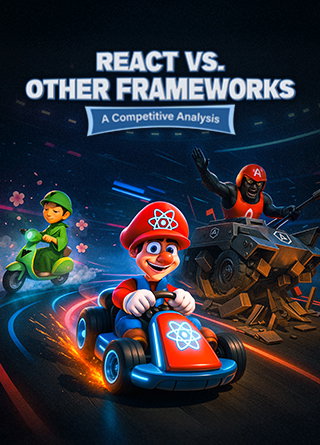
It’s chaotic, colorful, and wild fun. You choose your character—each with its unique quirks—then race through unpredictable tracks filled with speed boosts, banana peels, and the occasional blue shell heartbreak.
Here’s the thing: your choice of character and kart matters. Want raw power? Pick Bowser. Prefer agility and control? Peach might be your go-to. Need balance and versatility? Mario is the classic jack-of-all-trades racer who adapts to almost every track. There’s no one-size-fits-all, though—it depends on how you want to race.
Well, imagine the same idea, but for frontend frameworks.
In the world of frontend development, React is the Mario of the game. The default pick. The one most developers trust.
Whether they're building a simple startup site or a massive enterprise app, chances are, they reach for React. It’s quick, flexible, has a massive fan base, and seems to ace every aspect: performance, community, compatibility—you name it. Even when paired with powerful backend frameworks to build full-stack applications, React often remains the go-to choice for crafting dynamic user interfaces.
However, here’s the catch—just like in Mario Kart, sometimes the default choice isn’t the best. Angular brings power-packed tools for heavy-duty builds, and Vue provides elegant and simple ways for rapid development. So why does React still lead the race?
This blog dives into that question—comparing React against other major players to unpack not just who’s better but why React continues to dominate the frontend lane.
Ready to explore? Let’s race into the topic!
-(1)-217.jpg.aspx "TechDogs-\"React Vs. Other Frameworks: A Competitive Analysis\"")
If frontend development were a global sport, React would be the crowd-favorite champion. Whether you're browsing job boards, checking GitHub repos, or talking to fellow devs, React is everywhere. However, just like any reigning champ, it faces fierce challengers: Angular, Vue, Svelte, and a few hungry up-and-comers itching for gold.
So… why React? Is it just hype, momentum, or is there something fundamentally stronger about how it’s built and what it offers?
This article is your guide to understanding how React stacks up against its rivals. We'll break down the key differences, so you can make an informed decision.
Let's start by defining what React is.
What Is React?
React, created by Meta (formerly Facebook) in 2013, is a JavaScript library to build interactive user interfaces. Its component-based architecture and virtual Document Object Model (DOM) enable it to handle UI updates efficiently, ensuring seamlessly interactive experiences with minimal re-renders.

Among its greatest strengths is flexibility, as React is designed to be flexible and framework-agnostic, so it doesn’t force a rigid structure or methodology. You can pair it with whatever libraries suit your workflow—from routing (like React Router) to state management (Redux, Zustand, Recoil—you name it). With tools like Hooks, Next.js, and React Native in the ecosystem, it has grown far beyond the browser.
Now, with great popularity comes a few doubts: Is it always the right choice, and why bother comparing React to other frameworks at all?
Well, choosing the right tool for the job can save you time, money, and headaches, and the "Stack Overflow Developer Survey 2024" highlights React as a commonly used web framework. For developers, it means learning the right skills to stay competitive. For businesses, it means building efficient and scalable applications that meet their specific needs. It's all about making informed decisions, right?
So now that we know what React is, let's compare it to its rivals. Although first, let's get to know them better.
Who Are React's Key Competitors?
React might be the superhero of front-end frameworks, but it's not the only player in town. So, who are the other contenders vying for the front-end throne? Here are the top contenders:
-
Angular
Angular is like Luigi in Mario Kart—often overshadowed by the flashier Mario (React), but absolutely solid once you get to know him. Backed by Google, Angular is dependable, feature-rich, and built for stability. It’s not the fastest off the line, but once it’s up to speed, it delivers a structured, full-framework experience that’s ideal for large, complex applications.
With built-in tools for routing, form handling, HTTP requests, and dependency injection, Angular brings everything to the race—no need to bolt on any extras. It thrives in enterprise-level settings where maintainability, performance, and consistency are key. Although the learning curve is steeper, Angular is suitable for development teams that value convention over configuration. -
Vue.js
Vue.js is like Toad in Mario Kart—lightweight, nimble, and surprisingly powerful once you get the hang of it. It’s approachable, beginner-friendly, and perfect for developers who want to ease into frontend frameworks without a steep learning curve. Just like Toad’s zippy handling on twisty tracks, Vue’s progressive architecture lets you start small and scale up gradually as your app (or team) grows.
Its template-based syntax feels intuitive, especially for those coming from HTML backgrounds, and with official tools like Vue Router and Pinia for state management, Vue isn’t just friendly—it’s fully equipped. Vue is steadily gaining ground in the dev world, with growing adoption across startups and modern web projects. Don’t let its cuteness fool you though—this one’s a serious contender! -
Svelte
Svelte is like Yoshi in Mario Kart—light, fast, and often underestimated. Unlike other browser-based frameworks, Svelte shifts the heavy lifting to compile-time. The result? Smaller bundles, faster load times, and snappy performance straight out of the gate. Just like Yoshi, Svelte feels smooth and effortless once you're on track as there’s less boilerplate, no virtual DOM, and a refreshingly minimal syntax.
It may not have a massive ecosystem or fan base like React or Angular (yet), but it’s catching up quickly among developers who value performance, simplicity, and innovation. For teams looking to break free from traditional framework conventions and move ahead with lean, modern code, Svelte is a joyride.
Now, these may be the top three competitors today, but there are other emerging frameworks that you (and React) should look out for. -
Emerging Frameworks For Web Development

Frameworks like SolidJS, Qwik, and Preact are gaining traction for their ultra-light bundles and performant rendering. They're the rising stars of the web dev framework world, offering innovative approaches to building user interfaces. So, keep an eye on them, as they might just be the next big thing.


So, there you have it with React's main competitors. Each framework has its strengths and weaknesses, and the best choice depends on your specific project requirements.
Now, let's compare React to these contenders, shall we?
How Does React Compare To Its Competitors?
So, how does React compare to these popular and emerging web development frameworks on the market? Let's break it down.
| Category | React | Angular | Vue.js | Svelte |
| Performance | Efficient with virtual DOM, but the bundle size can grow | Heavier load times, optimized via AOT compilation | Fast with small bundles, great for performance | Compiles to optimized JS, minimal runtime |
| Learning Curve | Easy if familiar with JavaScript | Steep, TypeScript-heavy | Gentle and intuitive | Concise but conceptually different |
| Developer Experience | Modular, learn-as-you-go | Comprehensive but complex | Template-based, easy ramp-up | Minimal syntax, unique approach |
| Ecosystem & Community | Massive ecosystem, strong community, high demand | Backed by Google, a smaller community | Growing community, good tooling | Small but rapidly growing community |
| Scalability | Highly scalable with React Native support | Ideal for enterprise-scale apps | Moderately scalable | Good for lean, fast apps |
| Best Use-Cases | Flexible SPAs, cross-platform apps | Enterprise-grade systems | Startups, rapid development | Performance-sensitive projects, small builds |
Summary:
-
React: Combines speed, flexibility, and a massive ecosystem. Easy to adopt, endlessly scalable, and supported by the largest dev community, making it the top choice for everything from startups to enterprise apps.
-
Angular: Powerful but heavy. Great for enterprise apps but comes with a steep learning curve.
-
Vue.js: Simple and lightweight. Good for quick builds, but less flexible at scale.
-
Svelte: Fast and clean. Ideal for small apps but still niche due to its smaller ecosystem.
The takeaway? React leads the pack!
However, each framework on this list has its unique strengths and trade-offs. Angular offers structure, Vue brings simplicity, and Svelte pushes performance. However, React strikes a balance between flexibility, scalability, and community support, making it the go-to choice for many developers and teams.
Yet, it is critical to remember that the best framework is the one that fits your specific goals, team skills, and project scope.
With that said, let’s break down how to make that decision!
What Are The Deciding Factors To Choose A Framework?
So, you're standing at the crossroads, trying to figure out what framework to explore apart from React, right?
Well, trying to figure out which frontend framework to hitch your wagon is like picking a kart for your Mario Kart race; the choice can define the entire race and its outcome. So, let's break down the key factors that influence the decision.
When Is React The Best Choice?
React shines when you need a robust and mature ecosystem. With it, you get:
-
A Massive Community: Need help? Stack Overflow's got your back. Additionally, finding React developers is generally easier than finding someone familiar with obscure, ancient programming languages.
-
Extensive Libraries And Tools: From state management to testing, the React ecosystem is overflowing with options.
-
Proven Track Record: React has been around the block, powering everything from tiny startups to Facebook itself. That's a solid vote of confidence.
When Is Angular The Best Choice?
Angular is precise, structured, and built for the long haul. It's a great fit for:
-
Large, Complex Applications: Angular's structure helps keep things organized when you're dealing with a massive codebase on enterprise levels.
-
Teams That Value Consistency: Angular's strict guidelines enforce a consistent coding style, which can be a lifesaver when multiple developers are working on the same project.
-
Projects That Need TypeScript: Angular is a TypeScript-first framework, which can improve code quality and maintainability, especially in large-scale projects.
When Is Vue Or Svelte The Best Choice?
Vue and Svelte are the indie darlings of the frontend world. They're lightweight web frameworks, perfect for projects requiring performance with simplicity. Consider these frameworks when:
-
You Have A Smaller Team: Vue and Svelte are easier to learn and use than Angular, which can be a big advantage for smaller teams.
-
You Need Rapid Development: The simplicity of Vue and Svelte allows for faster prototyping and development cycles.
-
Performance Is Critical: Svelte, in particular, is renowned for its blazing-fast performance, thanks to its compile-time optimizations.
Ultimately, the best framework depends on your specific needs. Here's a quick checklist:
-
Project Scope: Is it a small side project or a massive enterprise application?
-
Team Expertise: What frameworks are your developers already familiar with? What are they willing to learn?
-
Performance Needs: How important is speed and efficiency? Do you need to optimize for mobile devices?
-
Future Roadmap: What are your long-term goals for the project? Will the framework scale to meet your future needs?
Choosing a framework isn't just about picking the "best" one. It's about finding the right tool for the job. Consider your project's unique requirements, your team's skills, and your long-term goals. Don't be afraid to experiment and try different frameworks to see what works best for you.
According to the Stack Overflow Developer Survey 2024, React leads the pack with roughly 39.5% usage, while Angular and Vue.js come in at 17.1% and 15.4%, respectively. Similarly, the State of JavaScript 2024 survey shows even stronger support for React, with 82% of respondents saying they actively use it, compared to 51% for Vue and 50% for Angular.
These statistics highlight React’s dominant position in the frontend world. Yet, popularity doesn’t always equate to suitability. The most ideal framework is one that aligns with your team’s skills, project’s needs, and long-term goals.
Wrapping It Up!
So, after all this talk about React and its rivals, what's the real takeaway?
Well, it's not about picking a 'winner' in some kind of showdown. Honestly, each of these frameworks—React, Angular, Vue, and even the others—have their own thing going on.
Think of it like choosing the right tool for a job. You wouldn't use a hammer to screw in a lightbulb, right? It's the same idea here.
React is extremely popular for good reasons: it's flexible, has a huge community, and offers a wealth of ready-made components to help you build things quickly. However, sometimes another framework might be a better fit for your project, especially if you have specific business requirements or a team that's already proficient with another framework.
The key thing is to understand what each one brings to the table and then pick the one that makes the most sense for what you're trying to build. It's all about making smart choices for your project, not just following the crowd.
Frequently Asked Questions
What Is React Used For?
React is a frontend JavaScript library for building dynamic, component-based UIs—especially single-page applications (SPAs). Its virtual DOM ensures efficient updates, and reusable components streamline development. It's perfect for interactive web interfaces and mobile apps via React Native.
What Is The Best Alternative To React?
Vue.js is widely considered the best alternative to React. It offers a simpler learning curve, built-in reactivity, and strong community support. Developers often choose Vue for its ease of integration, flexibility, and clean syntax—especially in smaller or mid-sized projects.
Is React Backend Or Frontend?
React is strictly a frontend library, focusing on the view layer in browsers. Backend responsibilities (databases, APIs, server logic) are handled by different technologies like Node.js, Python, or Java.
Fri, Jul 18, 2025

Liked what you read? That’s only the tip of the tech iceberg!
Explore our vast collection of tech articles including introductory guides, product reviews, trends and more, stay up to date with the latest news, relish thought-provoking interviews and the hottest AI blogs, and tickle your funny bone with hilarious tech memes!
Plus, get access to branded insights from industry-leading global brands through informative white papers, engaging case studies, in-depth reports, enlightening videos and exciting events and webinars.
Dive into TechDogs' treasure trove today and Know Your World of technology like never before!
Disclaimer - Reference to any specific product, software or entity does not constitute an endorsement or recommendation by TechDogs nor should any data or content published be relied upon. The views expressed by TechDogs' members and guests are their own and their appearance on our site does not imply an endorsement of them or any entity they represent. Views and opinions expressed by TechDogs' Authors are those of the Authors and do not necessarily reflect the view of TechDogs or any of its officials. While we aim to provide valuable and helpful information, some content on TechDogs' site may not have been thoroughly reviewed for every detail or aspect. We encourage users to verify any information independently where necessary.
Loading comments...