

Financial Management Solutions
Neobanks Explained: Are They Really Better Than Traditional Banks?
Share
Introduction
The strange part is that, for a long time, the wait felt normal. We planned our days around it and accepted it as the cost of getting things done. That change opened the door for neobanks that move as fast as our lives do.
Neobanks are fully digital banks you use entirely on your phone or computer to manage accounts, pay bills, and handle everyday banking online.
The real question is whether they are actually better than traditional banks, or simply better suited for a certain kind of user. Making sense of that change starts with understanding what a neobank is and how it works. Keep reading to know!
TL;DR
-
Neobanks are fully digital banks that make everyday banking fast, simple, and easy on your phone.
-
They don’t have branches and usually work with licensed banks to provide secure financial services.
-
Accounts open quickly, updates happen fast, and apps are built around how people actually manage money.
-
Great for digital-savvy users, freelancers, and small businesses, while traditional banks still handle complex needs.
-
Neobanks work alongside traditional banks, giving more options instead of replacing them completely.
What Is A Neobank And How Does It Work?
Neobanks, where “neo” simply means new, are banks built for today’s digital world. They don’t have physical branches and work entirely through apps and online platforms. While all neobanks are digital banks, not every digital bank is a neobank. Traditional banks may have good apps, but they still operate through branches. Neobanks exist only online and are designed to be used on your phone. They cover everyday banking needs like opening accounts, sending and receiving money, paying bills, and withdrawing cash using debit cards. Some also offer features like investments and credit services, all in one place.

With that foundation in place, it’s worth looking at what truly sets neobanks apart from traditional banking models.
How Neobanks Are Different From Traditional Banks?
The biggest difference between neobanks and traditional banks isn’t what they offer, but how they’re built. If we talk about traditional banks, they have been around for decades. Their digital services were added over time on systems originally meant for branch visits and paperwork. Neobanks started later, with a clean slate. They were built for apps, online access, and people who do most things on their phones.
That difference shows up in small but noticeable ways. Neobanks had the advantage of starting fresh. Without older systems holding them back, they could design banking around how people actually use money today. For users, that usually means fewer steps, better visibility into their finances, and banking that fits into their day instead of slowing it down.
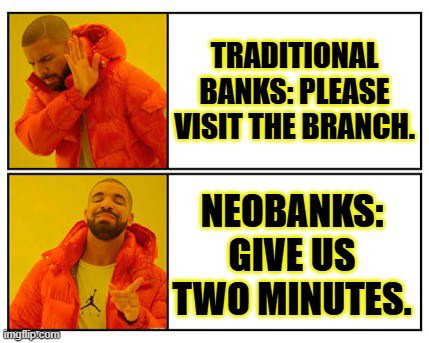
Opening an account with a neobank can take minutes instead of days. Changes and updates roll out faster. Costs matter too. Without branches and large in-person teams, neobanks spend less to operate. That often leads to lower fees or simpler pricing.
As more users experience these benefits firsthand, it becomes clear why neobanks are catching on so quickly. Those reasons are worth looking at more closely.
Why Are Neobanks Gaining Popularity So Fast?
The rise of neobanks was not driven by novelty. It was driven by alignment. As money management moved onto phones and daily decisions became more real-time, banking experiences had to adapt. Neobanks grew by meeting people where they already were, and a few clear shifts explain why that adoption accelerated. That change shows up in a few clear ways.
-
Built To Reduce Everyday Costs
Without physical branches to maintain, neobanks run with much lower operating costs. Those savings often show up in simpler pricing, fewer routine charges, and clearer fee structures. More importantly, leaner operations let neobanks reinvest more quickly in product improvements and customer support rather than in physical infrastructure.
-
Designed For Instant Access
Neobanks are built to cut out the delays that once made banking feel slow. Accounts are opened online, identity checks happen digitally, and users can start using their accounts almost right away. Branch visits, forms, or long waits are now handled inside the app, often in just minutes. That kind of speed is something that people expect.
-
Experiences Shaped Around The App
Neobanks are built as digital products from the start, not as online versions of offline systems. Their apps are simpler to use, easier to navigate, and give instant feedback as you go. Features like alerts, spending insights, and controls are built in, not added later. For many users, this makes banking feel less like a task and more like something that just works in the background.
-
More Flexibility In How Services Are Delivered
Neobanks are not bound by decades-old operational models; they can adapt faster. While some still operate within regulatory frameworks through licensed partners, their product layers are more flexible. This allows them to experiment, iterate, and respond to user behavior without the same structural constraints that slow traditional institutions.
Speed and flexibility may drive interest, but adoption ultimately depends on usefulness. That brings us to the services neobanks provide.
What Services Do Neobanks Typically Offer?
Neobanks keep banking simple and accessible by delivering everyday services entirely through digital platforms. Instead of offering complex or niche products, they focus on meeting the financial needs people deal with daily.
For individual users, this usually includes:
-
Current or checking accounts
-
Debit cards and digital payments
-
Real-time transaction tracking and instant alerts
-
In-app account management and balance monitoring
-
Basic budgeting and spending insights
Many neobanks also make it easier to send money internationally or manage multi-currency accounts, which is especially helpful for frequent travelers or people working across borders. In certain regions, they may also offer credit options such as overdrafts, credit cards, or small loans. This is typically in partnership with regulated financial institutions rather than offering these services directly.
For businesses, neobanks typically offer:
-
Business accounts with multi-user access
-
Expense tracking and payment approvals
-
Invoicing and payout tools
-
Integrations with accounting or payroll software
For both individuals and businesses, neobanks prioritize simple features, transparent pricing, and easy digital access over complex financial offerings.
Topics for More Insights
Neobanks Vs Traditional Banks: A Side-By-Side Comparison
| Aspect | Neobanks | Traditional Banks |
| Account Setup | Fully digital, usually completed in minutes | Mix of online and in-branch steps |
| Access Model | App-first, no physical branches | Branches plus digital channels |
| Fees & Charges | Fewer routine fees, simpler pricing | More layered fee structures |
| User Experience | Designed primarily for mobile use | Digital layered over legacy systems |
| Speed of Updates | Faster feature and product updates | Slower, governed by legacy processes |
| Range of Services | Focused on core banking functions | Broader financial product portfolio |
| Customer Support | In-app chat and digital support | Branch, phone, and digital support |
| Trust Signals | Built through transparency and security | Long operating history and scale |

Both approaches serve different needs, which makes the next question less about comparison and more about fit.
Who Should Use Neobank And Who Should Not?
Neobanks tend to work best for users who are comfortable managing finances digitally. This includes younger users, freelancers, startups, and professionals who value speed, visibility, and flexibility. They’re also a strong choice for people who want straightforward banking without frequent visits to branches. If your needs revolve around payments, savings, and day-to-day money management, neobanks often cover those bases well.
Traditional banks still make sense for users who rely on in-person services, need complex financial products, or prefer long-standing institutional relationships. Large loans, business financing, and certain advisory services are areas where traditional banks remain strong. Increasingly, users are choosing a hybrid approach: a neobank for daily spending and a traditional bank for long-term or high-value needs. For some, that balance offers the best of both worlds.
Well, before making that choice, it’s worth looking at how neobanks handle security, regulation, and trust.
Can Neobanks Be Trusted?
Trust is often the biggest hesitation, and understandably so. Most well-known neobanks operate under strict regulations, either by holding banking licenses or working closely with licensed banks. Customer funds are usually kept with regulated institutions and covered by deposit protection schemes, depending on the region.

On the technology side, neobanks invest heavily in encryption, fraud detection, and real-time monitoring. In some cases, their security systems are more modern than those used by older institutions.
Still, some concerns are valid. Because everything is digital, users rely entirely on apps working smoothly. When there’s an outage or slow support, it can feel more frustrating without a physical branch to turn to.
The key is in knowing how a particular neobank works, how your money is protected, and what safety measures are in place.
Final Verdict: Are Neobanks Really Better Than Traditional Banks?
Neobanks aren’t universally better, and they’re not trying to be.
They’re built for a world that values speed, clarity, and mobile access. For many users, that makes them feel more aligned with daily life than traditional banks. For others, especially those with complex financial needs, traditional institutions still offer depth and reassurance that digital platforms are working toward.
The smarter way to look at this shift is not as a replacement, but as an expansion of choice. Banking is no longer one-size-fits-all. It’s increasingly shaped around how people live, work, and manage money today.
In that sense, neobanks aren’t just changing where we bank, but what we expect from banking itself.
Conclusion
Banking today looks very different from the slow, paper-heavy routines many of us grew up with. Much like how streaming replaced scheduled TV, neobanks have reshaped everyday banking around speed, access, and convenience. Yet, that doesn’t mean traditional banks are outdated. They still offer depth, scale, and in-person support that many people rely on.
Neobanks aren’t here to replace traditional banks but to give more choice. For some, they will be the main stage. For others, a supporting act. What matters most is finding a setup that fits how you actually live, spend, and manage money today.
Frequently Asked Questions
What Is A Neobank?
A neobank is a digital-only bank that operates through mobile apps and online platforms, without physical branches, offering everyday banking services like accounts, payments, and debit cards.
How Are Neobanks Different From Digital Banks?
Neobanks exist entirely online, while digital banks are traditional banks that also offer online and mobile services alongside physical branches.
Are Neobanks Safe To Use?
Most neobanks operate under strict regulations by partnering with licensed banks, using strong security systems and deposit protection schemes to keep customer funds safe.
Wed, Jan 21, 2026

Enjoyed what you've read so far? Great news - there's more to explore!
Stay up to date with the latest news, a vast collection of tech articles including introductory guides, product reviews, trends and more, thought-provoking interviews, hottest AI blogs and entertaining tech memes.
Plus, get access to branded insights such as informative white papers, intriguing case studies, in-depth reports, enlightening videos and exciting events and webinars from industry-leading global brands.
Dive into TechDogs' treasure trove today and Know Your World of technology!
Disclaimer - Reference to any specific product, software or entity does not constitute an endorsement or recommendation by TechDogs nor should any data or content published be relied upon. The views expressed by TechDogs' members and guests are their own and their appearance on our site does not imply an endorsement of them or any entity they represent. Views and opinions expressed by TechDogs' Authors are those of the Authors and do not necessarily reflect the view of TechDogs or any of its officials. While we aim to provide valuable and helpful information, some content on TechDogs' site may not have been thoroughly reviewed for every detail or aspect. We encourage users to verify any information independently where necessary.
Loading comments...