
Computing
All About Google's Ironwood TPU: Is It Really A Step Up?
Share
Overview
Once upon a time, there lived in a garden a humble caterpillar named Arnold. He was a regular caterpillar—he had no fancy tricks or shortcuts, just persistence.
He would inch his way along branches and leaves, slowly but steadily. After all, nature has its own rhythm. He would explore the world around him leaf by leaf, day by day, believing that this was the only way to move forward.
Yet, nature had other plans.
One day, Arnold stopped crawling. He spun himself a cocoon, unsure of what came next. Days passed. Stillness. Then change, and the fluttering of wings.
Arnold emerged, not as a better crawler, but as something completely different: a butterfly.

Suddenly, the world's possibilities opened up. What once took hours now took seconds. What was once unreachable became accessible. Arnold didn’t just move faster—he moved smarter. He could glide on the breeze, pivot in an instant, and scale trees in moments.
Well, folks, that’s the difference between evolution and transformation—and it’s exactly what’s happening in the world of Artificial Intelligence (AI).
Google's Ironwood TPU is here, and the buzz is real. The million-dollar question is: is it just hype, or does it truly mark a significant leap forward?
Think of it like this: AI used to be about building the ultimate race car—training the biggest, smartest models possible, but that’s only half the story. Now, it’s about winning the actual race—executing operations in real time and at scale. Similar to Arnold, Google's Ironwood TPU is not built to help AI systems crawl, but fly.
So, let’s dive into Google’s latest TPU, explore the features, break down its working, compare it to the competition, and finally, find out if Ironwood really delivers on its promise.
Dive in!
The Importance Of Google's Ironwood Tensor Processor Unit (TPU)
Before modern systems, AI used to be about training models. However, in today’s world, it’s less about the training and more about getting the trained tricks to work instantly. That’s exactly what Google’s Ironwood TPU is designed for!

A TPU is nothing but a specialized processor designed to accelerate machine learning tasks, particularly those involving neural networks.
Built to handle the demands of real-time AI, Ironwood is purpose-made for inference at scale (more on inference later). Whether it’s powering Large Language Models (LLMs) or complex Mixture of Experts (MoE) architectures, Ironwood ensures AI tasks can be performed with speed and precision.
It is the behind-the-scenes accelerator that makes Google's AI applications feel seamless, whether it's generating responses in milliseconds or analyzing data on the fly. Its deep integration with Google’s Pathways system makes Ironwood easy to scale across devices and workloads, removing friction from the AI deployment pipeline.
In simple terms, Ironwood is about making AI useful, usable, and ultra-fast.
Google reports that Ironwood delivers twice the performance per watt compared to its predecessor, Trillium. That means enterprises get more compute power with less energy wastage, critical for both cost and sustainability.
Speaking of powerful progress, how did we get here in the first place?
Let’s rewind the clock and look at how Google’s TPUs evolved—step by step—to make Ironwood possible.
The Evolution Of Google's TPUs
Google's TPUs have come a long way. It's like watching Arnold turn into a butterfly but instead of wings, it's got serious AI processing power.
So, let's take a quick look at how Google's chips have evolved:
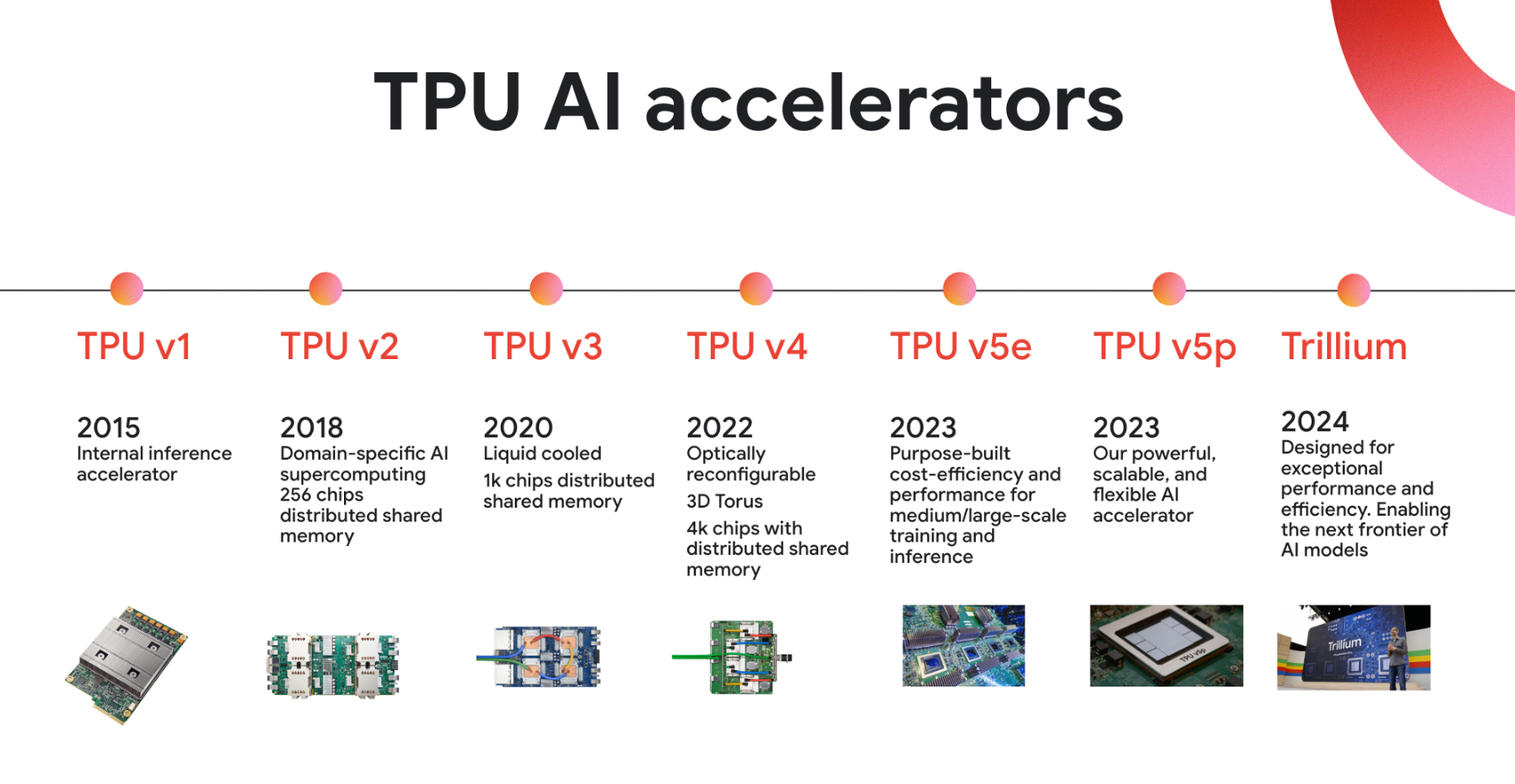
-
TPU v1 (2015–2016)
Google’s first custom AI chip was built just for inference. Used internally for things like Search and Translate, it was fast for its time, but was a one-trick pony without training. -
TPU v2 (2017)
TPU v2 added floating point support, so it could train models too, not just run them. Google opened this one up to developers via the cloud for training and inference. -
TPU v3 (2018)
Doubling the performance to 90 TFLOPs and introducing liquid cooling with V3 was necessary as Google was training open-source beasts like BERT. This was also the start of truly large-scale AI modeling at Google. -
TPU v4 (2021–2022)
Built for cloud-native AI with massive clusters, more efficient computing, and a focus on scaling large models such as MUM and GLaM, v4 marked a turning point in cloud-first AI acceleration. -
TPU v5 (??)
Google never publicly released this one, but insiders say it existed. Possibly a stepping stone between v4 and what came next, it remains hidden behind-the-scenes. -
TPU v5p (2023)
This one cranked up training capacity with 8,960-chip “superpods.” Used for training frontier models like Gemini, this silent powerhouse was designed for extreme training workloads. -
TPU v6 / Trillium (2023–2024)
A game-changer in performance per watt and part of Google’s “AI Hypercomputer” push, v6 supported some of Google’s most advanced models such as Gemini 1.5. -
TPU v7 / Ironwood (2024–2025)
Finally, a Google TPU designed just for inference. A beast with 4,614 TFLOPs, 192 GB HBM, and 7.2 TB/s bandwidth, Ironwood is perfect for training LLMs, real-time AI systems, and scaling with Pathways.
So, from a humble beginning to dominating AI chips, Google’s TPUs have grown smarter, stronger, and a whole lot faster. Now, with Ironwood, we’re looking at their most advanced version yet.
So, what exactly makes this chip so powerful? Let’s break down the technical specs!
Technical Specifications Of Google's Ironwood TPU
So, what's under the hood of this AI powerhouse? Let's break down the specifications of this TPU.
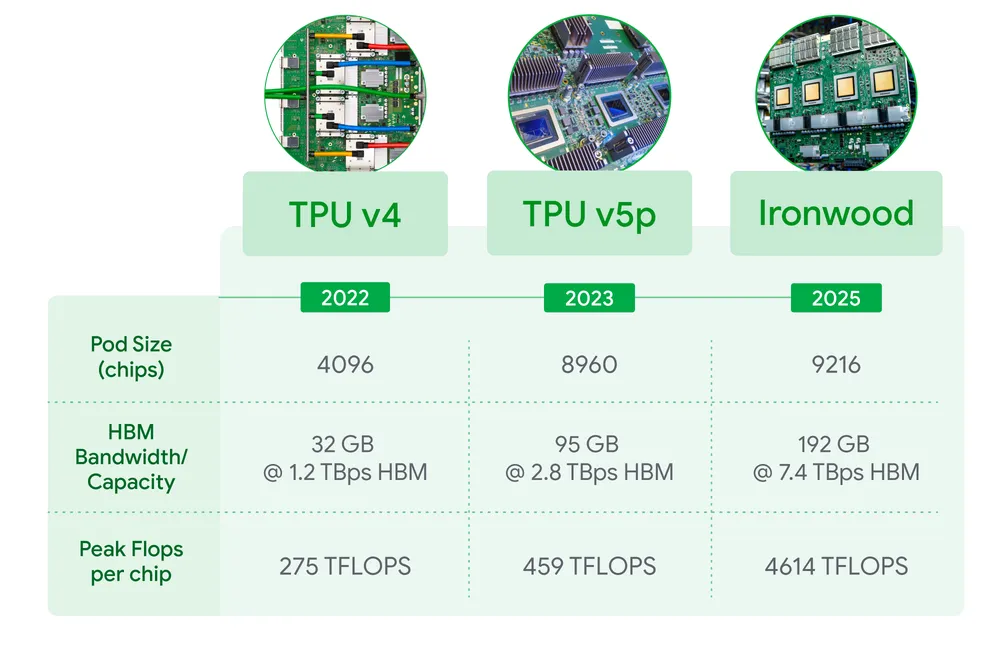
1. 4,614 TFLOPs/chip
Each Ironwood TPU chip boasts a whopping 4,614 TFLOPs. Now, if you gang up 9,216 of these chips in a pod, you're looking at 42.5 exaFLOPs of computing muscle. That's enough power to make some serious AI magic happen. It's like having a supercomputer within your data center, ready to tackle even the most demanding inference tasks.
2. 192 GB HBM/chip With 7.2 TB/s Bandwidth
Each TPU chip is equipped with 192 GB of High Bandwidth Memory (HBM), pushing data at a blistering 7.2 TB/s. To put that in perspective, that's six times faster than the previous generation (Trillium), replacing data bottlenecks for lightning-fast processing.
3. Upgraded Interconnect Fabric
The interconnect fabric has been a serious upgrade, as it means faster and smoother data flow between AI chips. Think of it as widening the "highways" for data to travel on, so there's no more traffic jams. This is crucial for scaling AI models across multiple chips and ensuring optimal performance.
4. Energy Efficiency
Ironwood isn't just about raw power; it's also about being smart with energy. Google claims that it's twice as energy-efficient as Trillium, and nearly 30 times more efficient than the original TPU v1. This efficiency translates to significant cost savings and a smaller carbon footprint.
Ironwood's specifications represent a significant leap in AI inference capabilities. By combinaing raw processing power, high bandwidth memory, and an efficient interconnect fabric, Ironwood is a formidable tool for deploying AI models at scale.
With these specs in mind, how does Ironwood stack up against the competition? Let's see!
Google's Ironwood Vs. The Competition
Nvidia and AMD have been big names in the AI hardware game, so how does Google's Ironwood stack up agianst them? Let's break it down an compare:
|
Feature |
Google Ironwood TPU |
NVIDIA Blackwell B200 |
AMD Instinct MI300A |
|
Primary Use Case |
Inference (LLMs, MoE, real-time AI) |
Training & Inference (LLMs, HPC, Generative AI) |
HPC & AI (Training & Inference) |
|
Peak Performance (FP8) |
4,614 TFLOPs per chip |
144 PFLOPs inference per system |
1,961.2 TFLOPs per APU |
|
Memory Capacity |
192 GB HBM per chip |
1,440 GB total GPU memory per system |
128 GB Unified HBM3 |
|
Memory Bandwidth |
7.2 TB/s per chip |
8 TB/s per system |
5.3 TB/s per APU |
|
Interconnect Bandwidth |
1.2 TB/s bidirectional Inter-Chip Interconnect (ICI) per chip |
Up to 1.8 TB/s NVLink per GPU |
4th Gen AMD Infinity Fabric |
|
Power Consumption |
Not publicly disclosed; 2x performance per watt over Trillium |
~14.3 kW per DGX B200 system |
550–760 W per APU |
|
Scalability |
Up to 9,216-chip pods delivering 42.5 ExaFLOPs |
DGX SuperPOD configurations with multiple DGX B200 systems |
Integrated CPU-GPU APU design for efficient scaling |
|
Integration |
Deep integration with Google’s Pathways system for seamless scaling |
Combines with NVIDIA Grace CPUs in GB200 superchips |
Combines 24 Zen 4 CPU cores with 228 CDNA3 GPU compute units in a single APU |
|
Availability |
Available through Google Cloud |
Available via NVIDIA partners |
Available through AMD partners |
Key Takeaways:
-
Google Ironwood TPU: Optimized for inference tasks, offering high performance per watt and seamless integration with Google's AI infrastructure.
-
NVIDIA Blackwell B200: Designed for both training and inference, providing massive memory capacity and bandwidth suitable for large-scale AI workloads.
-
AMD Instinct MI300A: An APU that combines CPU and GPU capabilities, aiming for efficient performance in HPC and AI applications.
So, while each chip brings its own strengths to the table, Google’s Ironwood stands out with its focus on real-time inference and energy efficiency, making it a strong contender in today’s AI-driven world.
Yet, impressive specs are only half the story. The real question is: how can teams and enterprises actually access and deploy Google's Ironwood?
Let’s explore where and how Ironwood fits into the cloud ecosystem.
Availability And Deployment Of Google's Ironwood TPU
While Ironwood was announced by Google in April 2025, it is expected to reach general availability later in the year.

Key Details
-
Two Configurations: Ironwood will be available in two configurations: a smaller 256-chip pod and a larger 9,216-chip pod.
-
Compute Power: Each Ironwood chip can deliver a peak performance of 4,614 TFLOPs.
-
Total Performance: When scaled to 9,216 chips, a single pod offers up to 42.5 exaFLOPs of compute power, making it more than 24 times as powerful as the world's largest supercomputer, El Capitan, which offers 1.7 exaFLOPs per pod.
-
Seamless Integration: Ironwood is designed to integrate seamlessly with Google's existing AI infrastructure, including the Pathways system, allowing for efficient scaling across workloads and devices.
-
No Model Rebuilding: Developers can leverage Ironwood's capabilities without the need to rewrite or refactor existing AI models, facilitating a smoother transition and faster deployment.
So, is Ironwood a game-changer?With AI projects demanding real-time processing power, it just might be the upgrade the AI world has been waiting for.
Wrapping It Up!
So, after all this talk about Google’s Ironwood TPU, what’s the verdict? Well, if you’re looking for an AI chip that’s not just fast but also smart, Ironwood might just be your new best friend.
Sure, it’s designed for inference, which is a big deal if you want your AI to make quick decisions without breaking a sweat. Yet, let’s be real: whether it comes acriss as a step up or just a fancy AI upgrade depends entirely on your needs.
Either way, Google's Ironwood is definitely worth keeping an eye on!
Frequently Asked Questions
What Is Ironwood TPU?
Ironwood is Google’s latest TPU (Tensor Processing Unit) optimized for AI inference. It delivers 4,614 TFLOPs per chip, 192 GB HBM, and is designed to scale real-time AI tasks across Google Cloud with high energy efficiency.
What Is TPU In Google Colab?
In Google Colab, a TPU is a free hardware accelerator used to speed up machine learning tasks. It's ideal for deep learning models and offers faster computation than CPUs or GPUs for certain TensorFlow-based workloads.
What Is The Difference Between GPU And TPU?
A GPU is a general-purpose accelerator used in graphics and AI, while a TPU is purpose-built by Google specifically for machine learning tasks, particularly deep learning. TPUs offer higher efficiency for large-scale model training and inference.
Wed, Apr 23, 2025

Enjoyed what you read? Great news – there’s a lot more to explore!
Dive into our content repository of the latest tech news, a diverse range of articles spanning introductory guides, product reviews, trends and more, along with engaging interviews, up-to-date AI blogs and hilarious tech memes!
Also explore our collection of branded insights via informative white papers, enlightening case studies, in-depth reports, educational videos and exciting events and webinars from leading global brands.
Head to the TechDogs homepage to Know Your World of technology today!
Disclaimer - Reference to any specific product, software or entity does not constitute an endorsement or recommendation by TechDogs nor should any data or content published be relied upon. The views expressed by TechDogs' members and guests are their own and their appearance on our site does not imply an endorsement of them or any entity they represent. Views and opinions expressed by TechDogs' Authors are those of the Authors and do not necessarily reflect the view of TechDogs or any of its officials. While we aim to provide valuable and helpful information, some content on TechDogs' site may not have been thoroughly reviewed for every detail or aspect. We encourage users to verify any information independently where necessary.
AI-Crafted, Human-Reviewed and Refined - The content above has been automatically generated by an AI language model and is intended for informational purposes only. While in-house experts research, fact-check, edit and proofread every piece, the accuracy, completeness, and timeliness of the information or inclusion of the latest developments or expert opinions isn't guaranteed. We recommend seeking qualified expertise or conducting further research to validate and supplement the information provided.
Loading comments...