

Computing
5 Cloud Computing Security Challenges In 2024
Share
Overview
It’s quite like the Charles Xavier School for the Gifted from the X-Men series, except this one is located in the sky, nestled among the clouds and hidden from normal people (truly sky high!). Yet, trouble finds them in the form of an old enemy who’s posing as an insider. Uh-oh, trouble in the cloud!
The last two sentences would’ve sent a shiver down the spine of cloud database engineers, data center technicians and businesses. They aren’t strangers to trouble in the cloud!
As businesses shift to cloud computing seeking higher flexibility, scalability and reliability in managing, processing, analyzing, storing and sharing data, they must be wary of the looming threats that endanger their cloud environment.
This is why we’re going to explore the top 5 Cloud Computing Security Challenges In 2024 that businesses need to heed. Read on!
.jpg.aspx "TechDogs-\"5 Cloud Computing Security Challenges In 2024\"")
As we mentioned, businesses are in love with cloud computing. Don’t believe us? Here are some numbers to validate the claim: 60% of the world’s corporate data is stored in the cloud. Furthermore, USD 1 trillion is the expected valuation of the global cloud computing market by 2028.
Interesting, right? Check out more such Mind-Blowing Computing Stats That You Must Know In 2024!
Getting back to the topic at hand, cloud computing adoption is only going to increase as time goes on. Hence, it’s vital that businesses ensure they’re secured from external and internal threats, especially considering the rise of cybercrime and digital threats.
Ransomware organizations are on the prowl to exploit vulnerabilities in a business’s security systems and gain access to their data to extract money from them. In fact, reports find that the average time span between two cyber-attacks on the global scale is 39 seconds!
Given the importance businesses place on cloud computing, it’s critical that they ensure they secure themselves from various threat vectors by following the best practices while understanding the most common security challenges in cloud computing.
So, let’s dive into the 5 Cloud Computing Security Challenges In 2024 that businesses need to look out for!
5 Cloud Computing Security Challenges In 2024
As cloud computing technology advances, so do the threats faced by businesses using this powerful technology. Whether businesses are using private cloud, public cloud or hybrid solutions, they must pay proper attention to the security of their cloud infrastructure by understanding common security challenges and emerging threats. In fact, Statista found that the global market for cloud security is projected to reach $37 billion by 2026.
So, without any further ado, here are the common security challenges of cloud computing:
Challenge 1: Advanced Security Threats
Advancements in artificial intelligence (AI) in the last few years have given birth to generative AI and LLMs (Large Language Models). Yet, this technology has also trickled down to cybercriminals who can use it to exploit vulnerabilities in a business’s security through automation, AI-powered DDoS (Distributed Denial of Service) attacks or by discovering new attack surfaces and adjusting threat vectors in real-time. Hence, businesses must remain careful of such advanced threats.
Speaking of advanced threats, businesses also face the dangers of Advanced Persistent Threats (APTs). These include highly sophisticated attacks that infiltrate cloud environments and remain undetected for a long and ultimately get away with sensitive information and data. This is done in the form of zero-day vulnerabilities, advanced malware, social engineering and more. Essentially, they are tough to defend against.
We recommend businesses conduct regular threat hunting and penetration testing and invest in advanced threat detection systems to identify and respond appropriately.
Challenge 2: Unauthorized Access
As businesses find the need to increase productivity, turnaround time and efficiency in their processes, they turn to outsourcing to numerous external contractors, freelancers and third-party service providers. A lot of these external workers require access to sensitive data to perform their duties, for which they may be provided access or security credentials or be allowed overprivileged access to business data.
This move also increases the risk of breaches, as these workers could steal, leak or modify such data for personal gain. Alternatively, it leaves a business at the mercy of the third party's security efforts, which can be unpredictable and tough to monitor.
Furthermore, this challenge also gives rise to shadow IT, which consists of employees connecting their own devices or software solutions at the workplace. This makes it tough for IT security teams to monitor and secure them, especially if they’re unaware of them. Essentially, users can easily transfer sensitive business data without notifying security teams.
Businesses must hence enforce stronger access controls that regulate different levels of access and permissions based on roles and identity, while regularly checking privileges and adjusting as required. Additionally, third-party vendors must be properly vetted, especially for their security measures, to eliminate the risk of unauthorized access.
 Source
Challenge 3: Misconfigured Cloud Settings
Cloud computing solutions come with a variety of benefits, including a range of security settings. Yet, these settings need to be properly configured to see their best potential. Unfortunately, this isn’t always the case, as misconfigured settings remain one of the most persistent challenges faced by businesses using cloud environments. These include access controls that aren’t properly configured, ports that are open or overall weak security settings.
These challenges can lead to threats like data infiltration, where hackers exploit open or unrestricted outbound ports to transfer sensitive business data from cloud environments to other devices. Using insecure automated cloud backups that aren’t encrypted in transit or at rest can also be breached, while link-based file sharing can find its way into the hands of anyone with the URL. Businesses sometimes make use of several cloud services that come with diverse settings, increasing the complexity of configurations and raising the risk of misconfigured settings.
Businesses should automate security and configuration scans, develop and implement rigorous security policies and provide comprehensive training to security teams on cloud security best practices.
Challenge 4: Malicious Insiders
Sometimes the biggest threat looms within the organization – just like it did in Sky High!
Businesses can safeguard themselves from external threats as much as they want but occasionally the risk could be in-house employees who come with malicious intent. Think of an employee who is about to be removed from the business systems or one who feels they were mistreated (Office Space, anyone?). Such malicious threats are tougher to prevent because it’s nearly impossible to know when an old or new employee could abuse their access to deploy a cyber-attack, delete applications or data or plant ransomware.
Moreover, this could also be done by third-party service providers or other external contractors with access to the cloud environment. Either way, businesses can offset such threats by implementing stronger threat systems, policies and practices, while also opting to use a zero-trust security model, enforcing least privileges, limiting permissions, using multi-factor authorization and monitoring employee activities closely.
Challenge 5: Improperly Trained Employees
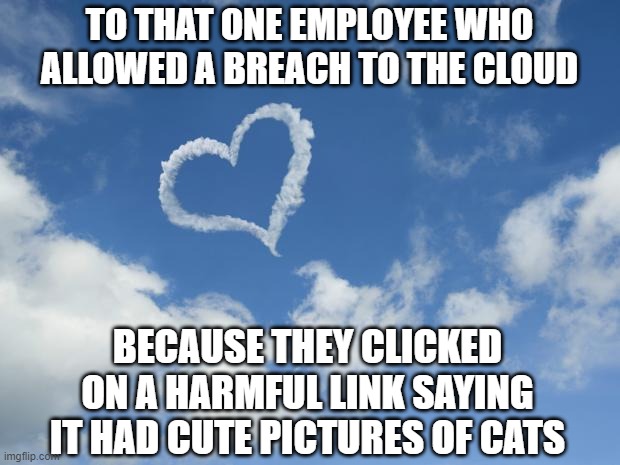
We mentioned how malicious employees can intentionally lead to cloud breaches – but sometimes, employees may accidentally create problems through negligence. This could happen when an employee interprets a phishing email as a legitimate source and shares their login details with a bad actor, who then gets access to the cloud. Alternatively, an employee may share URL links of sensitive data and information with team members or third parties but forget to limit access.
Hence, negligence on the part of employees in misconfiguring security settings or indulging in shadow IT practices, knowingly or unknowingly, can compromise the business cloud infrastructure.
This is why businesses must indulge in proper training and education for their employees as well as external workers. They must be made aware of cloud security best practices, read for telling signs of illegitimate behavior, learn how to detect and report potential threat vectors and more. Businesses can send fake, simulated emails to check staff responsiveness and how many could identify telling signs. Training sessions and awareness programs must be made a continuous process to reduce the risk of insider breaches in cloud environments.
 Source
Cloud Secured – Mission Successful!
Cloud computing is a promising technology that businesses use to enhance their productivity, innovation and scalability. This is why businesses must ensure that their cloud systems, applications and data remain protected from external and internal threats.
While there are more security challenges that pose threats to cloud computing, these 5 are among the most common ones faced by businesses. Tackling these challenges will help you ensure that your cloud is secure and even if an incident occurs, robust measures are in place. We know it’s easier said than done but now you know what the top challenges you need to focus on for cloud computing security!
Frequently Asked Questions
What Are The Advanced Threats Faced By Businesses In Cloud Computing Security?
Businesses in cloud computing security often face advanced threats fueled by artificial intelligence (AI), including AI-powered DDoS attacks, automation-driven vulnerability exploitation and real-time adjustment of threat vectors. Additionally, Advanced Persistent Threats (APTs) pose significant risks, utilizing sophisticated techniques such as zero-day vulnerabilities and advanced malware to infiltrate and persist within cloud environments. Combatting these threats necessitates regular threat hunting, penetration testing and investment in advanced threat detection systems.
How Can Businesses Mitigate The Risks Of Unauthorized Access In Cloud Computing?
Unauthorized access poses a significant risk to cloud computing security, especially as businesses engage external contractors and third-party service providers. Overprivileged access, shadow IT and unpredictable security measures of third-party vendors exacerbate the threat landscape. To mitigate these risks, businesses must enforce stringent access controls based on roles and identities, regularly audit and adjust privileges and thoroughly vet third-party vendors for their security measures.
What Measures Can Businesses Take To Address Misconfigured Settings In Cloud Computing Environments?
Misconfigured settings remain persistent challenges in cloud computing security, leading to vulnerabilities such as open ports and weak access controls. These configurations can facilitate data infiltration and unauthorized access, particularly across diverse cloud services. Businesses can address these challenges by automating security scans and checks, implementing rigorous security policies and providing comprehensive training to security teams on cloud security best practices.
Fri, Mar 22, 2024

Enjoyed what you read? Great news – there’s a lot more to explore!
Dive into our content repository of the latest tech news, a diverse range of articles spanning introductory guides, product reviews, trends and more, along with engaging interviews, up-to-date AI blogs and hilarious tech memes!
Also explore our collection of branded insights via informative white papers, enlightening case studies, in-depth reports, educational videos and exciting events and webinars from leading global brands.
Head to the TechDogs homepage to Know Your World of technology today!
Disclaimer - Reference to any specific product, software or entity does not constitute an endorsement or recommendation by TechDogs nor should any data or content published be relied upon. The views expressed by TechDogs' members and guests are their own and their appearance on our site does not imply an endorsement of them or any entity they represent. Views and opinions expressed by TechDogs' Authors are those of the Authors and do not necessarily reflect the view of TechDogs or any of its officials. While we aim to provide valuable and helpful information, some content on TechDogs' site may not have been thoroughly reviewed for every detail or aspect. We encourage users to verify any information independently where necessary.
Loading comments...