
Data Management
Top Trends 2022 - Big Data
Share
Overview
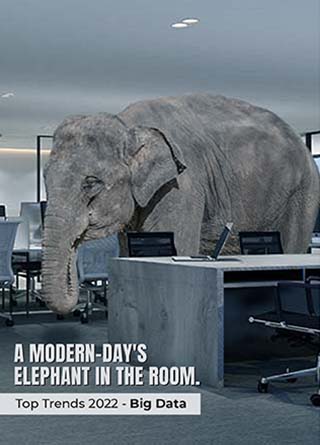
Whoever decided to call it “Big Data” was probably trying to be subtle. The important question here is – with an ever-increasing amount of data, how do you manage, store and analyze it. Even if by some miracle, you do manage to tame this data, what is its potential? Where’s this data going to lead you? What can you accomplish with this data? So many questions!
While it would be difficult for us to figure out where Big Data is going to take us an eternity later, we have managed to find out its potential in the near future, specifically the year ahead. So, hop on as we decode the top Big Data Trends of 2022!
.jpg.aspx "TechDogs-A Modern-Days's Elephant In The Room.-\"Top Trends 2022 - Big Data Trends\"")
Human emotions are not easy – we might feel elated at one moment and then dejected in the other. Comprehending how a person feels and how to respond to them empathetically and optimistically at all times is not easy. Imagine having to do that for 8,316 people at once. Hearing all of them out together, understanding them and responding adequately. Sounds like a herculean task, right? Well, probably for normal beings but not for Samantha. #HatsOffToYou
We’re sure you’ve figured it out by now - we’re talking about Samantha from the 2013 movie “Her.” The intelligent operating system manages to analyze preferences of her 8,316 owners respectively and communicates with them as naturally as any human would. Even though it was a work of fiction, it definitely brought forth the potential of Big Data and that’s totally real! Leveraging Big Data to analyze ideal responses and interact with people in a realistic manner that matches their expectations can be a real soon. #NotGonnaLie
The story of Big Data goes back 70 years when companies began to realize that they’re heading towards an ‘information explosion’ and decided to leverage it for growth by organizing, storing and analyzing it. Rest, as we all know, is history but this article is about the future – so let’s focus on that and understand the top trends that will shape Big Data 2022!
Trend 1: Big Data Will Bring In The Age Of TinyML And AutoML

You have already heard a lot about the Artificial Intelligence (AI) and Machine Learning (ML) revolution, haven’t you? Big Data is going to take it a step further by bringing in the age of TinyML and AutoML.
For the unacquainted, TinyML is a sub-segment of Machine Learning that uses small and low-powered devices such as micro-controllers that are deployed at the edge of devices. As Samantha would break it down for Theodore, it means you can carry out Machine Learning processes, with much less energy and storage while still being able to get the required outcome. #EfficiencyMatters
At the same time, AutoML or the Modern ML also is increasingly gaining popularity wherein the entire Machine Learning process is automated with close to zero human interaction, solely based on the use of Big Data that helps these systems to utilize raw data and create final deployable ML models on their own. Together, these two trends would bring in the age of super automation which Forbes predicts would take care of not only 64% data collection and 70% data processing but also 80% of all the physical work of businesses! #WeLoveAutomation
TechDogs’ Opinion: The relationship between Big Data and AI and ML have been symbiotic from the longest time. How? Well, AI and ML help in handling more advanced data management tasks such as metadata management, mapping and data cataloging while Big Data allows for smarter automation and advanced Machine Learning capabilities.
Together, they offer the world a vision driven by robots and advanced systems. Having said that, we believe this should not raise concerns of “massive overlays and mass firings.” On the contrary, an MIT study (and we agree!) suggests that “AI will continue to fuel massive innovation across the globe and will create many sectors for growth and employment.” We think that the overall management and business growth will still be human-driven, the change would be that your human resources would now be empowered by automated Machine Learning and intelligent TinyML devices.
Trend 2: There Will Be More Data Lakes Flowing This Year

For the longest time, data analytics meant taking data from your CRM and ERP tools, importing it to your data warehouse (which are now based on the cloud!) to feed business intelligence (BI) tools. That’s changing now!
See these data warehouses were like today’s chatbots – structured and standard. You would get only templatized responses from them. Now, the business world has found its Samantha, where there’s no structure. That means you can take any possible data and import it directly into what’s known as a data lake – sans any pre-processing.
A continuing Big Data trend for 2022 is the emergence of data lakes and all the tech giants including Google, Amazon, Microsoft Azure and IBM have already tapped into it. The data lakes can funnel any type of data including log files, genomics data, audio, video, image files and everything else. So, you have a much broader scope of data, making your analytical capabilities even more efficient. Invariably, the global data lakes market is all set to expand at a whopping 28% CAGR by 2023.
TechDogs’ Opinion: Data lakes have managed to successfully work with semi-structured data that has some sort of consistent scheme like CSV files, Parquet files (free and open-source column-oriented data storage format of Apache Hadoop) and other semi-structured data. However, we at TechDogs, believe that data lakes are just a milestone in a very long data management journey. Why, you may ask? That’s because 80% of the world’s data is unstructured and data lakes cannot yet tackle it. They need some way of indexing and inferring a common template for unstructured data to be able to manage it and that’s one innovation we’re eagerly waiting for in the data analytics sector! #FingersCrossed
Trend 3: Everyone Will Go For A Data Fabric Approach

Data fabric is a new concept that arranges different kinds of data in a robust and flexible architecture, making data management a lot simpler, particularly on the cloud or other unified platforms. With data fabric, you not only get complete visibility of data but also the ability to move, replicate and access data across hybrid and cloud storage resources.
Well, so what does that mean for businesses, Samantha? It means you can have the right data in the right place at the right time – and we’re sure we don’t have to explain how critical that can be for analysts relying on real-time data. So, if you want to keep certain medical scan images for patient analysis and others to train a Machine Learning model to identify the disease based on the scans, you need not keep it all at the same place. Segment the files, copy them and use and when needed because you centrally control which data resides where at all times. That’s probably why data fabric has been listed as the best analytical tool by Gartner. You wouldn’t want 8,316 conversations from different paramours getting mixed up together, right? #SamanthaNeedsDataFabric
TechDogs Opinion: Data fabric is a double-edged sword with amazing benefits for businesses lined up at both ends! We are sure that on one hand, it would help businesses deal with their many data silos that are created due to innumerable business functions and their respective processes for ingestion, discovery, curation, integration and preparation of data. On the other hand, data fabric as a platform will automate these processes to bring all this data and make data management processes consistent across the board. It will standardize data management practices and practicalities across hybrid multi-cloud environments and tools. We think this will be a big boon for businesses with remote teams of data analysts and business intelligence specialists by standardizing the data pipeline.
Trend 4: Big Data Will Meet Multi-Cloud And Hybrid Cloud

Industries were already in the process of adopting cloud technology and resources when the pandemic hit the accelerator pedal for them. If we look back, it was strange how all the burden fell on workers who wanted to access data through non-physical means. Well, after more than two years of WFH (that’s “working from home”), we have realized how much cloud-based solutions have kept the ball rolling. That’s why 2022 will be all about multi-cloud and hybrid approaches for managing business data.
The popularity of the cloud has led to a never-ending diversity of cloud technology. Through hybrid multi-cloud architecture, companies will have better data flexibility and recovery. It may be hard to believe but according to Flexera’s State Cloud Report of 2020, over 93% of companies are currently using multi-cloud strategies and more than 87% are into the hybrid cloud approach. This is because of the simple workflow that comes from the connection of both on-premises and private cloud resources.
TechDogs Opinion: Undoubtedly, spreading data over multiple cloud platforms will be more comfortable for companies as they will get higher security and more advanced data management. Think of it this way, companies would be able to store more sensitive data on a private networks and other data on more affordable yet publicly available networks. We believe that this will give software designers a chance to come up with better end-to-end data management solutions based on the adoption of hybrid and multi-cloud approaches. In fact, we think the time is not far when data management will be pretty transparent and businesses will be in complete control of their Big Data through these one-stop cloud solutions.
Trend 5: Predictive Data Analytics Will Set The Business Stage On Fire

Were you able to predict the ending of “Her?” Even though we all wanted it to be a happily ever after, deep down we all knew that love with an intelligent operating system is not going to end well. Just like that, we all know that in 2022 Big Data analytics is going to become more predictive and less reactive.
Here’s what that means. You will have so much data that you would be able to identify patterns and trends and forecast the next logical turn that the industry or market will take. In fact, predictive analytics is already making its way into the stock market and product research. Yes, you can have a complete report on which share will be dipping down or if a product’s possible success in a particular region will better in January or March, based on analyzing trends over a long period of time.
In fact, experts suggest that predictive data analytics would also empower climate researchers to predict and plan for natural disasters and other crises beforehand. If only we could have predicted the ending of “Her!”
TechDogs Opinion: When it comes to better data analytics capabilities, predictive analytics alone would not shape the way forward. We believe that businesses will also need to look for the right analytics at the right place. What does that essentially mean? This has two parts to it: with the trend of leveraging bigger and bigger datasets for analytics, conversations around the quality of data, how well the data is structured and how accurate the analytics are, is already coming into the picture. So, the first part would be to go for a smaller data set if that means working with a much reliable data set aka right analytics.
The second part is the right place - instead of going for Big Data that needs to be collected centrally and requires a lot of time and money, businesses will start looking for analytics that can happen wherever the data is. This will mean more IoT-based deployments and edge connectivity to harness quality data and analyze it quickly at source.
To Sum Up
Big Data is no less than the fuel you add to speed up your company’s progress. We are sure you will have to rely a lot a massive dataset for any upcoming projects, however handling such a continuous flow of data is a big struggle. Things are slowly becoming seamless and these 2022 Big Data trends are going to transform the way we work with large-volume data to gain actionable insights. From integrating TinyML/ AutoML and hybrid cloud functionalities to improving data accessibility and quality through data lakes and data fabric – Big Data will evolve to newer heights in 2022.
Thu, Feb 10, 2022

Enjoyed what you read? Great news – there’s a lot more to explore!
Dive into our content repository of the latest tech news, a diverse range of articles spanning introductory guides, product reviews, trends and more, along with engaging interviews, up-to-date AI blogs and hilarious tech memes!
Also explore our collection of branded insights via informative white papers, enlightening case studies, in-depth reports, educational videos and exciting events and webinars from leading global brands.
Head to the TechDogs homepage to Know Your World of technology today!
Disclaimer - Reference to any specific product, software or entity does not constitute an endorsement or recommendation by TechDogs nor should any data or content published be relied upon. The views expressed by TechDogs' members and guests are their own and their appearance on our site does not imply an endorsement of them or any entity they represent. Views and opinions expressed by TechDogs' Authors are those of the Authors and do not necessarily reflect the view of TechDogs or any of its officials. While we aim to provide valuable and helpful information, some content on TechDogs' site may not have been thoroughly reviewed for every detail or aspect. We encourage users to verify any information independently where necessary.
Loading comments...