
Pharmaceutical Technology
Pharmaceutical Technology Trends Advancing Drug Development In 2026
Share
TL;DR
-
Internet of Medical Things (IoMT): 85% of healthcare providers already use IoMT (Market.us). Connected healthcare devices enable real-time pharma monitoring, reducing batch failures and improving formulation precision.
-
AI In Pharma: Pfizer, Tempus, and CytoReason partnerships show AI drug discovery in action. Digital twins grow at 20%+ annually (Grand View Research), driving smart drug manufacturing across biologics and complex molecules.
-
3D Printing In Pharmaceuticals: The market is projected to reach $6.85 billion by 2033 (Mark Wide Research). Triastek’s Nanjing facility will produce up to 300 million personalized tablets annually.
-
Blockchain In Pharma: The market reaches $8.5 billion by 2033 (Market Size and Trends). 55% of pharma companies now use or test blockchain for drug supply chain transparency (Sci-Tech Today).
-
Green Chemistry In Pharma: Usage has grown 40% over five years (Gitnux). Over 60% of pharma companies now have sustainability targets for 2030, covering everything from bio-based materials to renewable energy in production.
Introduction
Just as brewing the perfect cup demands the right temperature, timing, and balance, developing a drug demands exactly the same. The formula for 2026 is five technologies working in precise combination, and each one amplifies the others.
The pharmaceutical technology trends 2026 is built on are not incremental upgrades. They are structural shifts. The IoMT market for connected healthcare devices is valued at $63.7 billion in 2026. AI in pharma and biotech is projected to grow from $2.35 billion in 2025 to $7.61 billion by 2034. Green chemistry in pharma has grown 40% in five years. These are not pilots. They are the new standard.
Emerging pharma technologies in 2026 span five areas: IoMT for connected healthcare, AI in pharma for smart drug manufacturing and AI drug discovery, 3D printing in pharmaceuticals for personalized medicine, blockchain in pharma for drug supply chain transparency, and green chemistry in pharma for sustainable production. Five areas. One direction: medicines that are smarter, safer, and more accessible than ever before.
The story of pharmaceuticals, much like a great novel, keeps advancing, with each chapter building on the last. In 2026, the plot has changed. Technology is no longer a supporting character. It is the author driving pharma innovation 2026 forward.
Here are the five pharmaceutical technology trends 2026 is built on, and what they mean for the industry, for healthcare providers, and for patients.
Trend 1: Internet of Medical Things (IoMT) Will Transform Connected Healthcare
Until recently, the growing web of connected healthcare devices, also known as the Internet of Medical Things (IoMT), largely operated independently. By 2025, more devices connected through the internet, helping doctors track patients remotely and hospitals streamline care. But most solutions still lacked deep integration across systems.
In 2026, IoMT reshapes the pharmaceutical world. It changes how drugs are developed, tested, and manufactured. Real-time data from connected healthcare devices lets pharma companies fine-tune formulations and maintain strict quality standards. Continuous IoT-based monitoring across manufacturing lines detects issues early, reduces defects, prevents contamination, and avoids costly batch failures.
How Is The Industry Responding?
According to Market.us, 85% of healthcare providers already use IoMT for patient engagement, remote monitoring, or smart facility use cases. Meanwhile, with an estimated value of $63.7 billion in 2026, connected medical devices are expected to hold the largest share of the IoMT market. For instance, in 2025, Philips and Medtronic partnered to add Medtronic’s monitoring tools into Philips’ IntelliVue systems, making connected care more mainstream, a trend that will grow in 2026 and beyond.
As researcher Suman Deb noted, “The Internet of Medical Things (IoMT) has the potential to radically improve healthcare by enabling real-time monitoring, remote diagnostics, and AI-driven decision making.”
Challenges To Watch
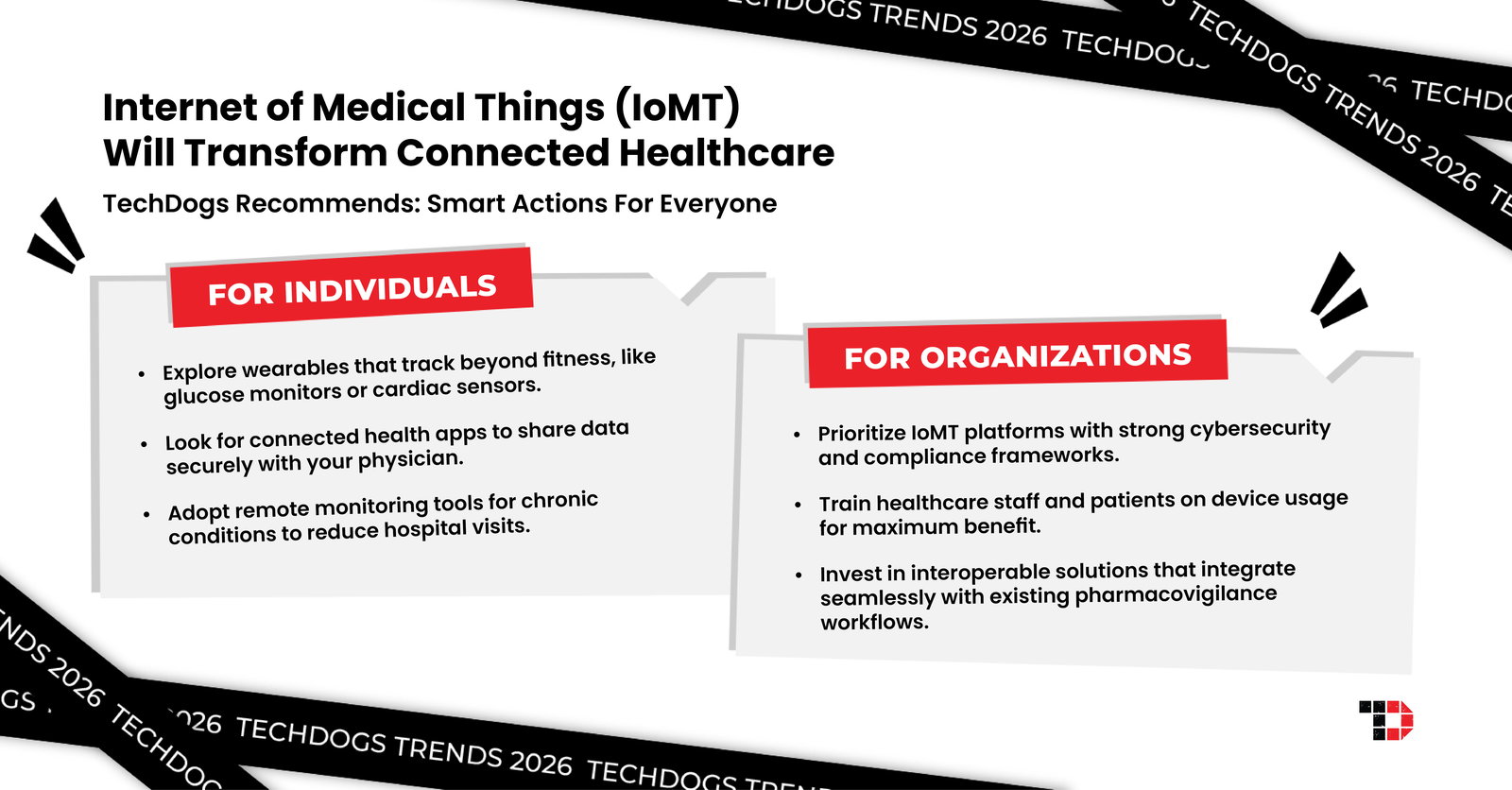
Despite its promise, IoMT isn’t simple to adopt. Security risks are high, as millions of connected devices can be targets for cyber-attacks. Interoperability remains an issue, as many devices don’t work smoothly together while managing huge volumes of patient data puts pressure on systems and raises privacy concerns. Patients also need proper training and confidence to use these technologies effectively.
TechDogs Recommends: Smart Actions For Everyone
Trend 2: AI In Pharma Will Revolutionize Smart Drug Manufacturing With Digital Twins
For years, pharmaceutical manufacturing relied on rigid processes, manual checks, and after-the-fact quality testing. Until 2025, automation and early AI pilots began to show results in streamlining production through optimizing supply chains, predicting equipment failures, and reducing costly downtime. Adoption remained uneven, with many facilities still running traditional batch processes and siloed systems.
In 2026, AI is transitioning from pilot projects to a central pillar of pharmaceutical production. Machine Learning (ML) models monitor real-time data across production lines. They predict quality issues before they arise and adjust processes automatically. Digital twins, virtual replicas of production lines, now let companies test changes and improve efficiency without halting operations. From continuous manufacturing of complex biologics to AI drug discovery and predictive maintenance, AI in pharma drives higher yields, fewer errors, and faster time-to-market. Operational waste falls sharply as a result.
Internet of Medical Things (IoMT): A network of connected healthcare devices, sensors, and software that collect and exchange real-time patient and process data, enabling remote monitoring, predictive diagnostics, and AI-driven decision-making across both clinical and pharmaceutical manufacturing settings.
How Is The Industry Responding?
Grand View Research predicts that the use of digital twins in the pharmaceutical industry will grow at a rate of over 20% annually until 2030, as companies seek safer methods to test process changes without impacting real-world production. In fact, Pfizer, one of the world’s largest biopharmaceutical companies, has adopted AI in partnership with Tempus, CytoReason, and Gero, utilizing it in drug discovery, clinical trials, and patient analysis. One clear result was the faster development of COVID-19 treatment Paxlovid, with AI supporting the clinical trials.
Alessandro Zannini, U.S. Sales Director at Stevanato Group, put it directly: “Automation and digitalization are increasingly emerging as key trends in manufacturing, helping pharma companies reach higher product quality, enhanced performance, increased customization, and time savings. These advancements can improve inspection accuracy, boosting detection rates while minimizing false rejection rates.”
Challenges To Watch
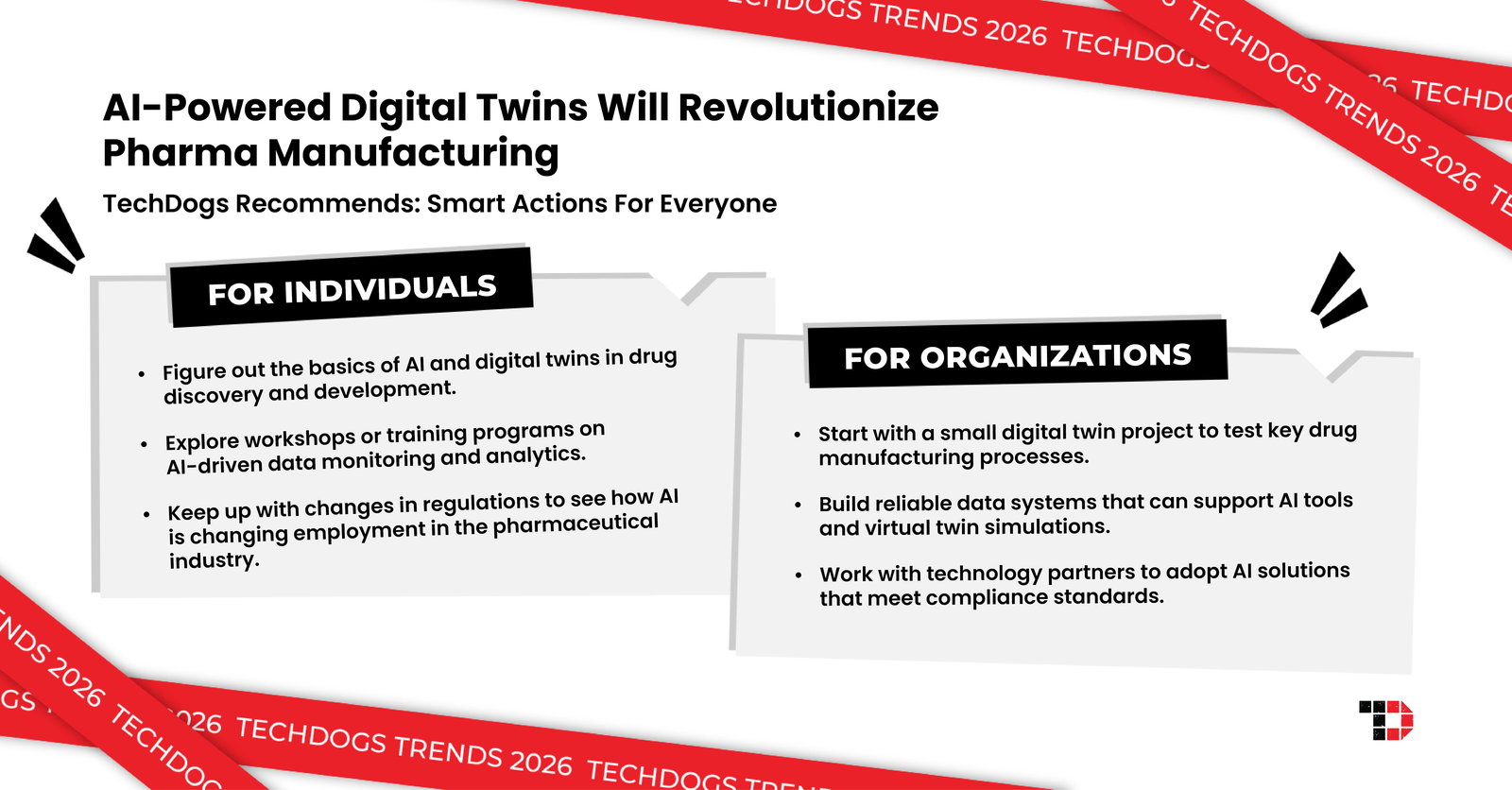
Many older facilities with legacy infrastructure are unable to adopt sophisticated technologies like digital twins. While AI is easier to implement, it can be less useful if the clinical data is incorrect or flawed. Regulations change slowly, so any medical AI solution needs to be authorized and audited. Also, pharma workers need to learn new skills and be trained, so they can use AI securely and effectively in production settings.
TechDogs Recommends: Smart Actions For Everyone
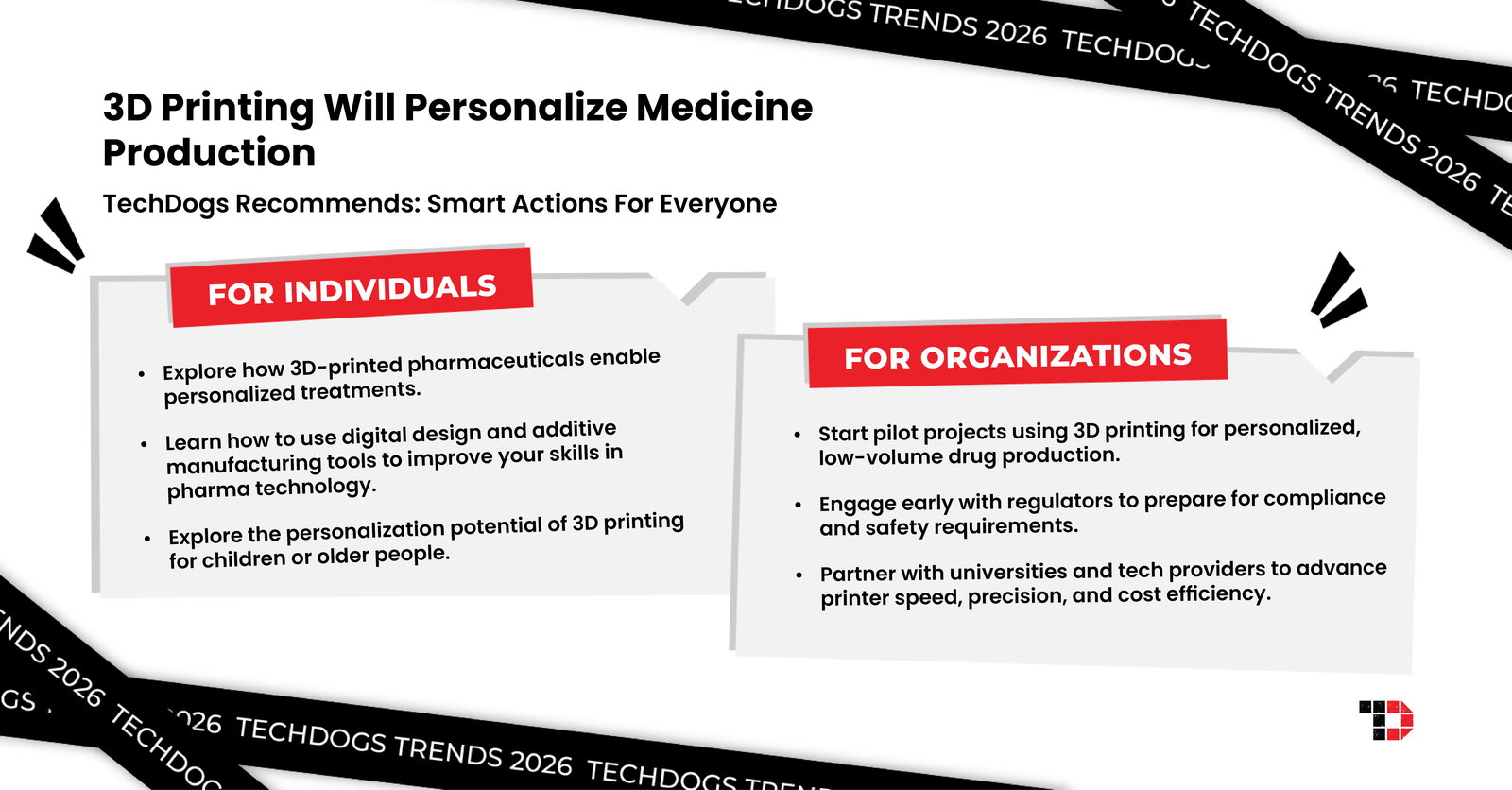
Trend 3: 3D Printing In Pharmaceuticals Will Personalize Medicine Production
3D printing, powered by additive manufacturing, has been gaining traction in the creation of pharmaceutical dosage forms and medical devices. This new method combines smart, multi-functional materials to develop medicines that can change properties, shape, or drug-release behavior over time, offering a new level of personalization. However, it has been challenging to integrate these innovations into commercial pharmaceuticals due to compliance issues.
This year, the pharmaceutical sector has made significant progress by pairing 3D printing with advanced technologies like AI and Internet of Things (IoT). While AI accelerates medication design by predicting how materials will behave, IoT ensures precision in every stage of production. Connected sensors and monitoring systems track variables like temperature, humidity, and material flow in real time, maintaining consistency and quality. Like IoMT-driven connected healthcare, 3D printing in pharmaceuticals makes manufacturing more intelligent, efficient, and patient-centered.
How Is The Industry Responding?
According to Mark Wide Research, the 3D printing in pharmaceuticals market was worth around $1.45 billion in 2024 and is projected to reach $6.85 billion by 2033, a clear sign of how rapidly the technology is scaling.
Adding to this momentum, Triastek, a Chinese company known for its experimental 3D-printed drugs, is establishing what could become the world's largest commercial 3D-printed drug operation in Nanjing. Once fully operational, the facility is expected to produce up to 300 million tablets annually, marking a significant step toward large-scale, personalized medicine production.
Yet, as Bradley Rothenberg, CEO of Engineering software developer nTop, emphasizes, “We view 3D printing as a transformative manufacturing technology. However, 3D printing’s journey towards profitability and widespread acceptance will take time.”
Challenges To Watch
Scaling remains the biggest hurdle. 3D printers cannot yet handle mass-market medication volumes, and regulations are still catching up to ensure safety and quality. For smaller players, hardware and material costs remain prohibitive. Integrating 3D printing in pharmaceuticals into existing supply chains also demands careful planning to avoid bottlenecks.
TechDogs Recommends: Smart Actions For Everyone
Trend 4: Blockchain In Pharma Will Reinforce Drug Supply Chain Transparency
Blockchain in pharma spent years as a proof-of-concept rather than a production tool. Early programs tracked pharmaceuticals to stop counterfeiting and meet the U.S. DSCSA requirements. They proved blockchain could improve drug supply chain transparency. programs was simply to keep track of pharmaceuticals to stop counterfeiting, and to follow laws like the U.S. Drug Supply Chain Security Act (DSCSA). These programs proved that blockchain could make supply chains more transparent, but most companies still relied on conventional systems and manual records.
In 2026, blockchain in pharma is gaining real ground as the need for secure, traceable, and compliant operations intensifies. It’s now being used to track medicines from the factory to the pharmacy, helping ensure authenticity and patient safety. Beyond supply chains, blockchain is also securing clinical trial data, protecting patient records, and using smart contracts to automate compliance tasks. What was once experimental is now becoming a reliable tool that adds trust, accuracy, and accountability across the pharmaceutical ecosystem.
How Is The Industry Responding?
According to Market Size and Trends, the blockchain in pharma market was worth approximately $1.45 billion in 2024 and is projected to reach $8.5 billion by 2033, reflecting rapid adoption. Sci-Tech Today reports that 55% of pharmaceutical companies now test or use blockchain to track medicines and strengthen drug supply chain transparency.
As rightly highlighted by Sidley’s Eva von Mühlenen and Daniel Fritz, executive directors of the PharmaLedger Association, “Blockchain is not only the preserve of the fintech industry, but may have multiple uses for life sciences companies, including providing a consent structure for clinical trials to give enhanced patients more control over their own data.”
Challenges To Watch
Although blockchain has its benefits, its implementation is not that simple for the pharma industry. The process is costly and challenging to integrate with existing systems. Plus, large supply chains stress about speed and scalability, but different rules in different countries will make it harder to create a unified blockchain database globally.
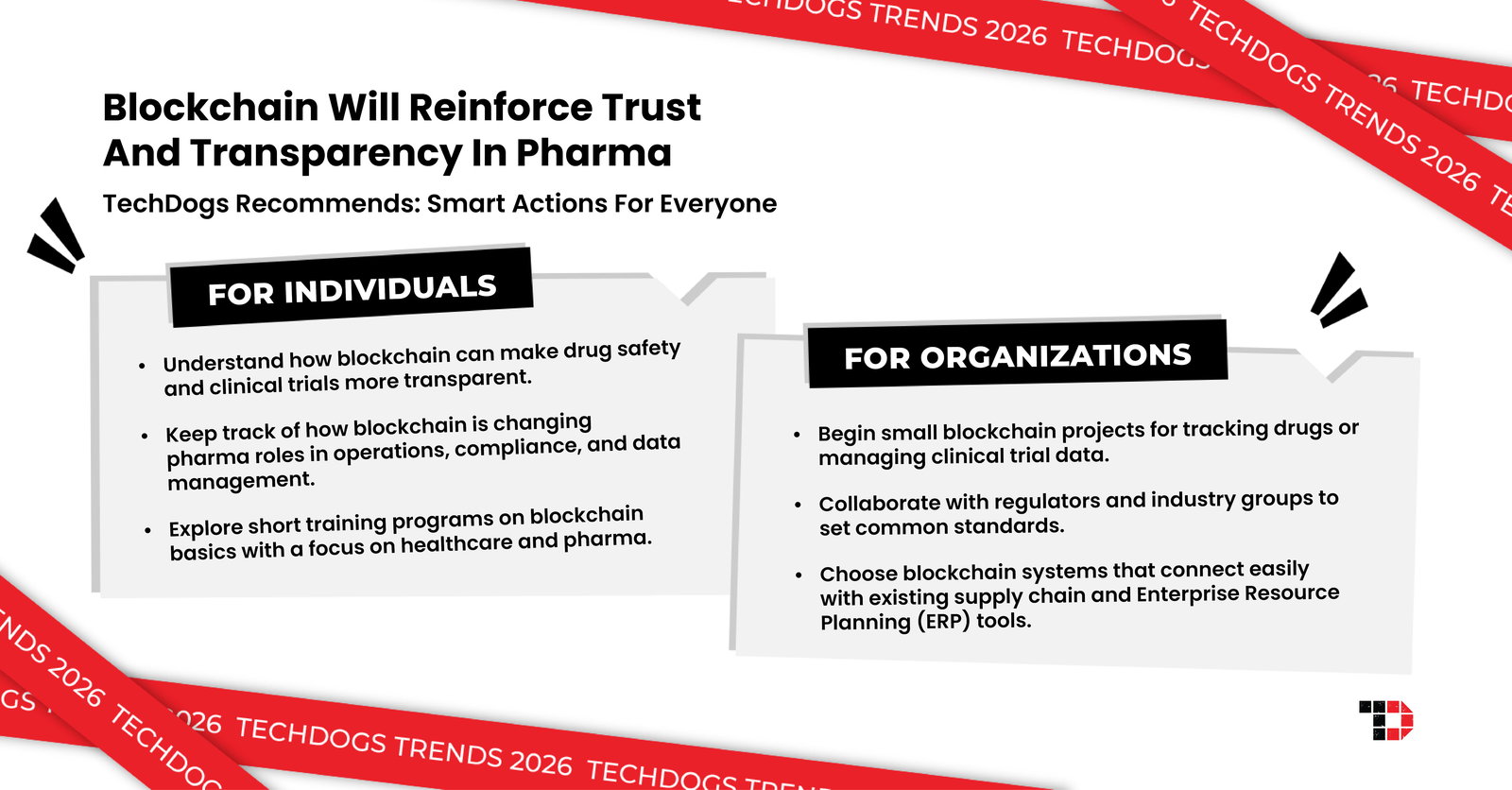
TechDogs Recommends: Smart Actions For Everyone
Trend 5: Green Chemistry In Pharma Will Drive Sustainable Manufacturing Practices
Until recently, the pharmaceutical industry's focus on sustainability was on cutting down on waste and using less energy. However, stricter environmental rules and awareness have made firms rethink how drugs are developed.
In 2026, green chemistry in pharma, which reduces hazardous substances, cuts waste, and improves process efficiency, is gaining real momentum. Pharmaceutical companies are now designing eco-friendly processes from the research stage, reducing emissions, water usage, and chemical waste. Regulatory bodies are also placing greater emphasis on environmental sustainability and safer chemical processes, as adopting green chemistry helps companies meet standards such as REACH in the EU and EPA regulations in the US. From eco-friendly packaging to cleaner production processes, pharmaceutical companies are building toward a zero-waste operating model.
How Is The Industry Responding?
According to Gitnux market data, the use of green chemistry in pharma manufacturing has grown by 40% over the past five years. At the same time, more than 60% of companies have set clear sustainability targets for 2030, showing a strong move toward greener production. This includes sourcing renewable or bio-based materials, replacing harsh chemicals with enzymes or microbes, and increasing renewable energy usage across production, testing, and shipping.
As Buxing Han, a green chemist at the Institute of Chemistry, Chinese Academy of Sciences in Beijing, said, “Only part of the resources that are extracted from the Earth are transformed into products; most end up as waste. However, these mountains of waste, and the environmental damage they may cause, can be avoided by following certain design principles with green chemistry being a way to sustainability.”
Challenges To Watch
Sustainability requires more than short-term efforts. So, despite wider adoption, green chemistry still faces hurdles like high upfront costs and limited access and competition for renewable materials. Expanding eco-friendly methods across the pharmaceutical pipeline takes immense amounts of effort and coordination, while maintaining strict quality and regulatory standards, leading to low ROI for the first few years of implementation.
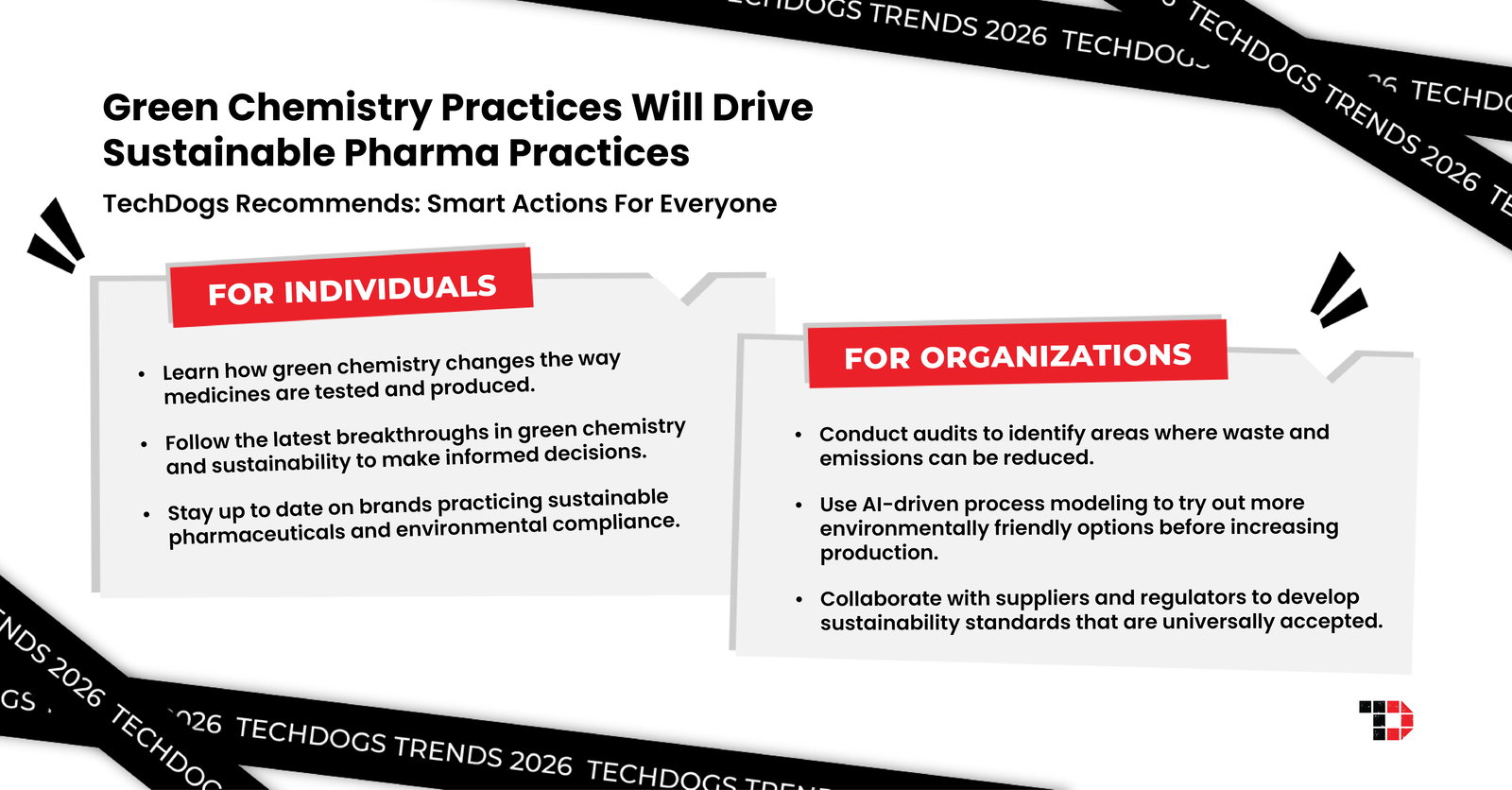
TechDogs Recommends: Smart Actions For Everyone
Conclusion
The top five pharmaceutical technology trends 2026 has surfaced share one signal: the industry is shifting from reactive to precision-driven. IoMT expands connected healthcare. AI in pharma accelerates smart drug manufacturing. 3D printing in pharmaceuticals unlocks personalized medicine. Blockchain in pharma strengthens drug supply chain transparency. Green chemistry in pharma makes it all sustainable.
Just as every great novel connects its threads into something meaningful, pharma innovation 2026 is connecting these five trends into a smarter, safer, and more patient-centered future for medicine. The next chapter is already being written.
Frequently Asked Questions
What Are The Top Pharmaceutical Technology Trends To Watch In 2026?
The top pharmaceutical technology trends 2026 organizations must watch include IoMT for connected healthcare, AI in pharma for smart drug manufacturing and AI drug discovery, 3D printing in pharmaceuticals for personalized medicine, blockchain in pharma for drug supply chain transparency, and green chemistry in pharma for sustainable production.
How Is Blockchain Improving Trust In The Pharmaceutical Industry?
Blockchain in pharma builds trust by creating tamper-proof, end-to-end records that track medicines from factory to pharmacy. According to Sci-Tech Today, 55% of pharmaceutical companies now test or use blockchain for drug supply chain transparency. It prevents counterfeit drugs, secures clinical trial data, and automates compliance through smart contracts.
Why Is Green Chemistry Practice Important For The Future Of Pharma?
Green chemistry in pharma reduces waste, emissions, and hazardous materials at every stage of drug production. According to Gitnux, its use in pharma manufacturing has grown 40% over five years, and over 60% of companies now have clear sustainability targets for 2030, helping them meet REACH and EPA standards while cutting costs.
Wed, Oct 29, 2025

Enjoyed what you read? Great news – there’s a lot more to explore!
Dive into our content repository of the latest tech news, a diverse range of articles spanning introductory guides, product reviews, trends and more, along with engaging interviews, up-to-date AI blogs and hilarious tech memes!
Also explore our collection of branded insights via informative white papers, enlightening case studies, in-depth reports, educational videos and exciting events and webinars from leading global brands.
Head to the TechDogs homepage to Know Your World of technology today!
Disclaimer - Reference to any specific product, software or entity does not constitute an endorsement or recommendation by TechDogs nor should any data or content published be relied upon. The views expressed by TechDogs' members and guests are their own and their appearance on our site does not imply an endorsement of them or any entity they represent. Views and opinions expressed by TechDogs' Authors are those of the Authors and do not necessarily reflect the view of TechDogs or any of its officials. While we aim to provide valuable and helpful information, some content on TechDogs' site may not have been thoroughly reviewed for every detail or aspect. We encourage users to verify any information independently where necessary.
Loading comments...