

Customer Engagement
Digital Customer Experience Trends Raising The Bar In 2026
Share
TL;DR
-
Emotionally Aware AI: AI that detects tone, sentiment, and mood in real time is helping brands respond with genuine empathy. Gartner finds companies using emotional AI see up to a 25% increase in customer satisfaction.
-
Immersive Commerce: Mixed reality storefronts, AR try-ons, and shoppertainment are turning browsing into shared experiences. 76% of consumers say they would choose a company that lets them drop text, images, and video into the same support thread (Zendesk CX Trends 2026).
-
Cross-Sector CX Convergence: Gaming mechanics, wellness nudges, and entertainment storytelling are blending into retail and financial CX, with McKinsey confirming experience-led growth increases satisfaction by at least 20%.
-
Omnichannel Data Unification: Siloed data is the top CX liability. Companies with strong omnichannel engagement retain 89% of customers versus 33% for weak implementations (Aberdeen Group).
-
Transparent and Ethical CX: In a cookie-optional world, 95% of customers want to know why AI makes decisions, and 63% report their demand for transparency has risen year over year (Zendesk CX Trends 2026).
Introduction
In Cheers, the greatest compliment any bar could offer was that everybody knew your name. The whole premise was that a neighborhood bar could make every regular feel genuinely seen, not through a loyalty program or a push notification, but through real familiarity built one interaction at a time. That is the standard digital customer experience that is trying to meet in 2026.
No matter your profession or designation, we're all digital consumers in this world, from online content to everyday shopping. The global CX management market is projected to reach $26.11 billion in 2026, growing at a 15.8% CAGR, according to Fortune Business Insights, which reflects just how central digital experience has become to competitive strategy.
Hence, digital customer experience (CX) today cannot be about convenience alone; it's about connection and credibility. In 2025, we saw brands piloting hyper-personalization, tapping into consumers' emotional signals, gamifying interactions, expanding customer channels, and embracing CX sustainability initiatives, but this year, online CX will double down on what drives it.
The Zendesk CX Trends 2026 report, based on 11,000+ respondents across 22 countries, confirms what is driving that urgency: 83% of CX leaders say memory-rich AI agents are the key to truly personalized journeys, while 85% say customers will drop a brand over a single unresolved first-contact issue. Yet AI adoption is just one dimension of the broader digital CX landscape in 2026.
Explore the latest Customer Experience industry trends of 2026 to understand how customers feel, what they demand, and how to deliver a CX experience that resonates.
Trend 1: Emotionally Aware AI Will Take Hyper-Personalization To The Next Level
The days of AI simply looking at past behavior to make recommendations are gone. In 2026, emotionally aware AI will understand not only your actions but also your feelings and emotions by detecting tone, sentiment, and mood. With natural language processing (NLP) models and LLM agents growing adept at speech analysis, sentiment detection, and aware recommendations, businesses can become more empathic, knowing when to comfort, celebrate, or inform. Emotionally intelligent AI models will drive hyper-personalization across online touchpoints, tailoring customer experiences in real time.
How Is The Industry Responding?
In 2026, companies are rapidly deploying and iterating AI chatbots that can sense, evaluate, and respond to a customer's emotions. After all, brands integrating emotional intelligence into AI chatbots saw an increase in conversion efficiency and engagement in 2025. According to Gartner, companies using emotional AI can see up to a 25% increase in customer satisfaction, as customers feel genuinely valued when their emotions are acknowledged.
NICE, a leader in CX technologies, forecasts that hyper-personalization and emotional intelligence will be key pillars in next-gen CX strategies, with such experiences predicted to generate up to 40% more revenue for retailers than those catering to non-personalized experiences.
Brands that demonstrate how they balance the ethical considerations of emotion-aware AI are seeing measurable efficiency gains, including improved emotional resonance and stronger consumer engagement.
That expectation is already reshaping CX strategy. The implication: AI hyper-personalization in 2026 is not about knowing a customer's purchase history; it is about reading the room. Brands that deploy emotionally aware AI with proper ethical guardrails will create interactions that feel genuinely human, building the loyalty that generic recommendation engines never could.
Challenges To Watch
Emotion-aware AI personalization raises concerns about privacy intrusion, with significant barriers including the misinterpretation of sentiment and a skill gap in evaluating emotional insights. Businesses must invest in ethical guardrails and ensure accuracy of AI models, as overreliance on AI without human oversight can lead to tone-deaf responses that harm trust and reputation.
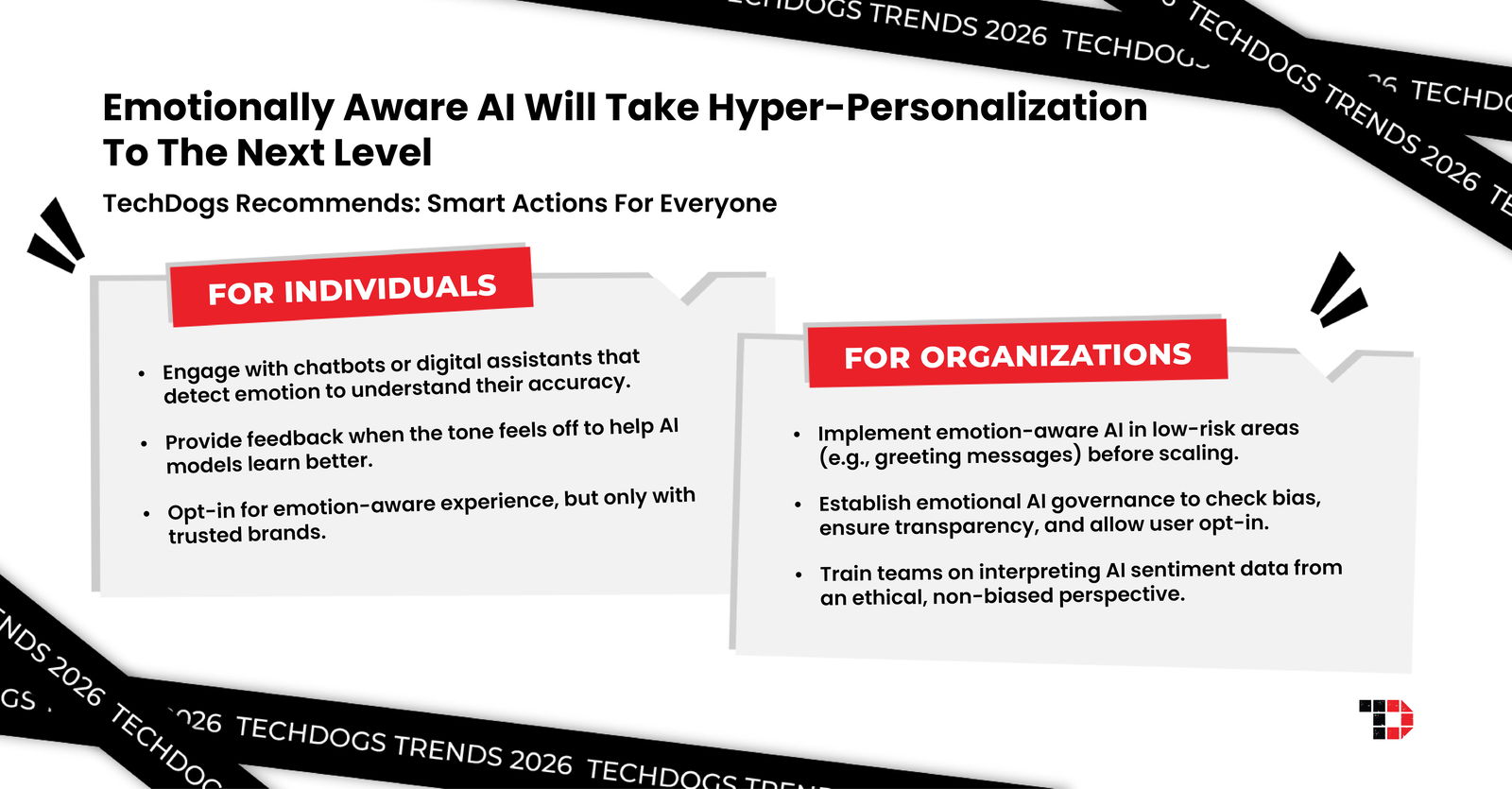
TechDogs Recommends: Smart Actions For Everyone
Trend 2: Immersive Commerce Will Introduce Shared Customer Experiences
We don't need to tell you that e-commerce (also known as digital commerce) is booming, and that demands new ways of thinking about the digital interactions it creates. Consumers no longer want to shop; they want to immerse, explore, and share with the community. That's why mixed reality storefronts, virtual try-ons, and "shoppertainment" strategies are blurring the line between browsing and being part of a shared digital community. This CX trend is being propelled by improved hardware, social platforms embracing immersive tech, and consumers demanding experientiality. In 2026 and beyond, shared immersive shopping will transform and redefine the online shopping experience.
How Is The Industry Responding?
Retail businesses are at the forefront of this trend, launching VR try-ons, immersive storefronts, and AR fitting rooms. IKEA's Place app uses AR to let customers visualize furniture in their homes to scale and in real time, a feature that measurably reduces return rates and bridges the gap between browsing online and buying with confidence. L'Oreal Paris' Makeup Genius app similarly lets users test makeup looks instantly via smartphone, increasing time-on-site and purchase intent simultaneously.
Other companies are partnering with commerce platforms to create shop-in experiences for concerts and live events. For example, Walmart launched Walmart Discovered, a virtual store on Roblox with curated mini stores in its "Walmart Realm" to offer immersive commerce interactions for Gen Z and Gen Alpha consumers.
The appetite for immersive, multimodal interaction extends into customer service too. According to the Zendesk CX Trends 2026 report, 76% of consumers say they would choose a company that lets them drop text, images, and video into the same conversation thread without restarting, a clear signal that customers want experiences that blend media, not isolate it.
Michelle Evans, the Global Head of Digital Consumer Research at Euromonitor International, validates: "Experiential retail bridges the gap between online and offline shopping. Consumers now expect brands to offer interactive, shareable moments that enhance their connection with the product."
The takeaway for brands: immersive commerce is not a luxury experiment reserved for well-funded retail giants. Lightweight AR and community-driven shopping features are increasingly accessible, and the brands that build interaction design fluency today will be the ones customers recognize as leaders tomorrow.
Challenges To Watch
Barriers to immersive digital commerce include high device costs, UX complexity, and unique content production demands. Not every brand has the budget or expertise to create high-quality immersive experiences, and poor execution can feel gimmicky. Plus, user privacy in shared virtual spaces is another concern that has not been fully addressed.
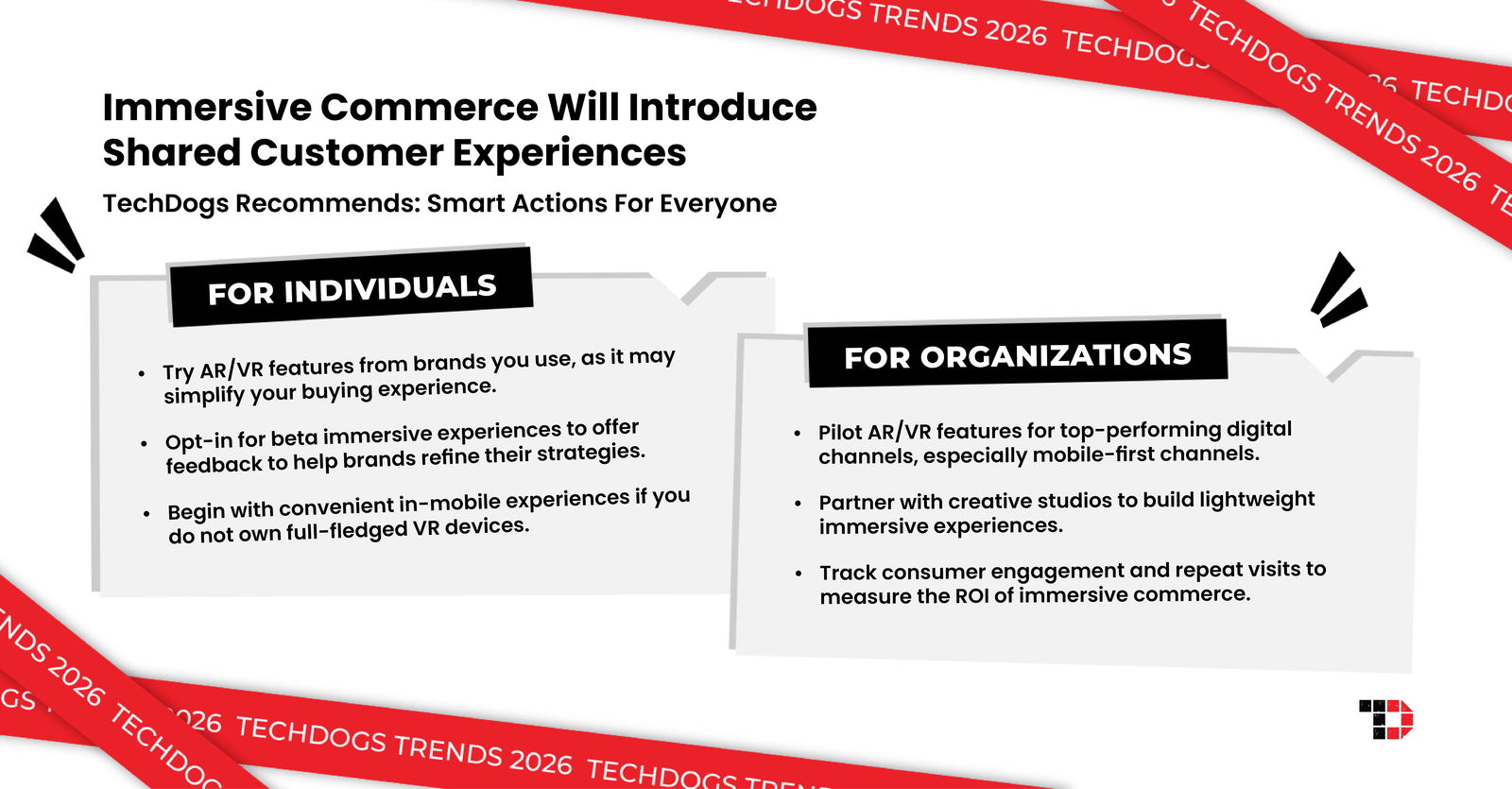
TechDogs Recommends: Smart Actions For Everyone
Trend 3: Cross-Sector Convergence Will Blend Customer Experience Strategies
Cheers worked because it borrowed hospitality warmth from fine dining, the energy of sports entertainment, and the emotional intelligence of a good conversation, and combined them in a neighborhood bar. That is cross-sector convergence: taking what creates emotional resonance in one world and deploying it where customers least expect it, but most appreciate it. Innovation often happens at crossroads, and digital customer experiences are no different.
In 2026, digital CX will borrow heavily from gaming, wellness, healthcare, and entertainment, creating a blended CX strategy with layers of loyalty mechanics, emotion-aware messaging (Trends #1), and interactive storytelling. The result will be next-gen CX experiences that feel refreshing, emotionally responsive, and surprisingly playful, irrespective of the digital channel.
How Is The Industry Responding?
This year, we will see brands apply gamified loyalty to CX touchpoints, adopt narrative storytelling, and add mood-based nudges. Leading retail brands like Bloomingdale's, J.Crew, L'Occitane, and Lacoste have launched gamified virtual stores to reward Gen Z shoppers, with 77% higher clicks to product pages on average, while sales gained 88% after introducing gamification.
These crossovers may seem small, but consumers notice such inventive moves. For instance, Starbucks Odyssey x Polygon pioneered Web 3.0 loyalty by offering crypto-based rewards for higher spending, with NFT participants spending 3.5 times more. Plus, McKinsey says that successful experience-led growth strategies increase customer satisfaction by at least 20% while offering businesses a range of financial benefits.
Joe Wheeler, the CEO of CX/Digital and co-author of the best-sellers "Managing the Customer Experience" and "The Digital-First Customer Experience," speaks about this trend, saying: "Convergence to me is interesting because it's a tricky topic. It's not just that there are a lot of new technologies. The question becomes: How do they relate to each other?"
That question is exactly the right one. The brands winning on CX in 2026 are not just those with the best product or the lowest price; they are the ones whose digital touchpoints feel surprisingly good, because they borrowed what works emotionally from industries their customers already love.
Challenges To Watch
Appropriating mechanisms and strategies from other industries can feel forced if it's not correctly aligned with the brand's CX identity. Additionally, cross-team coordination adds to the complexity, while ethical concerns can arise if cross-sector tactics are used for commercial ends without genuine customer value.
Topics For More Insights
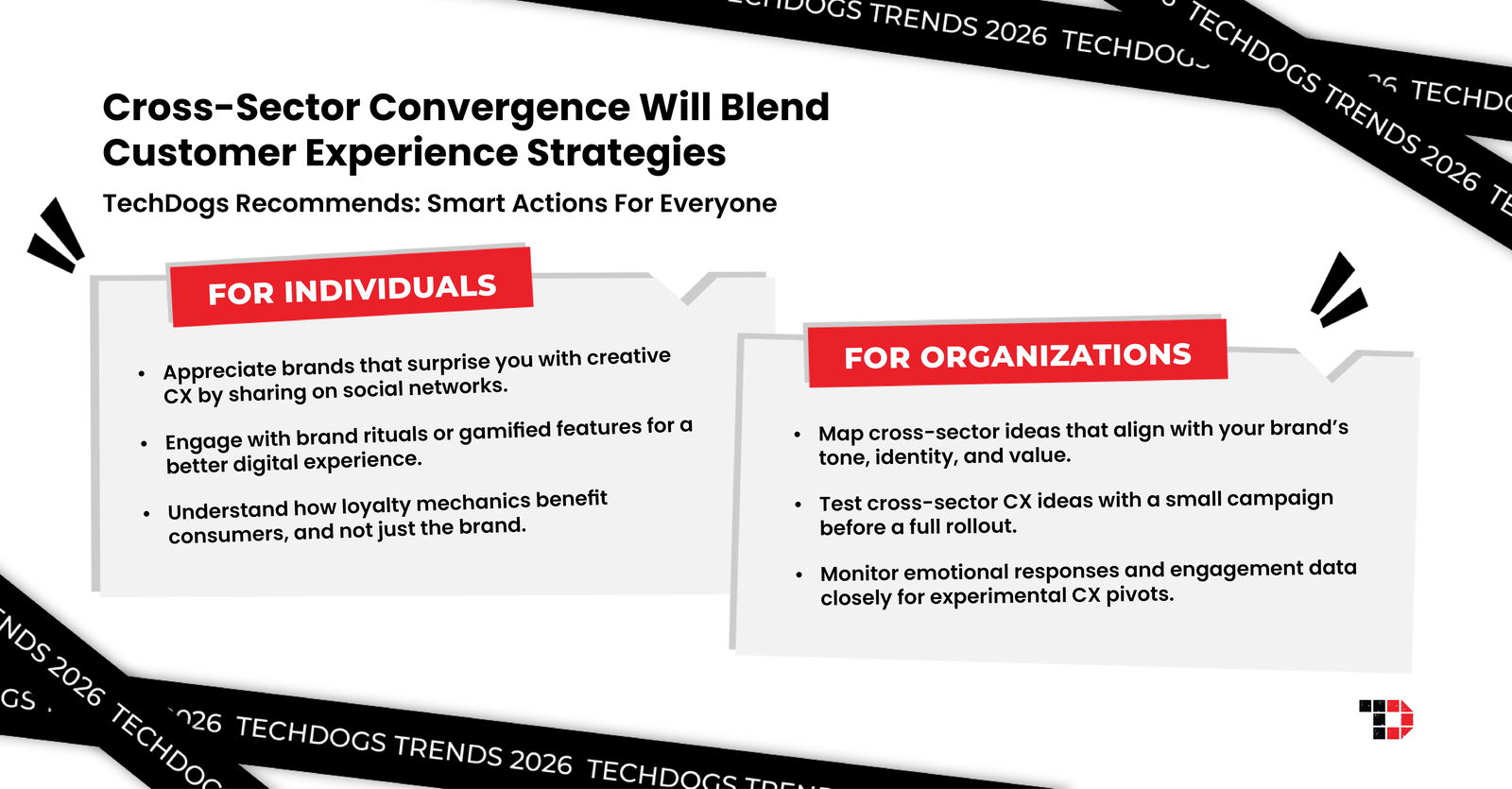
TechDogs Recommends: Smart Actions For Everyone
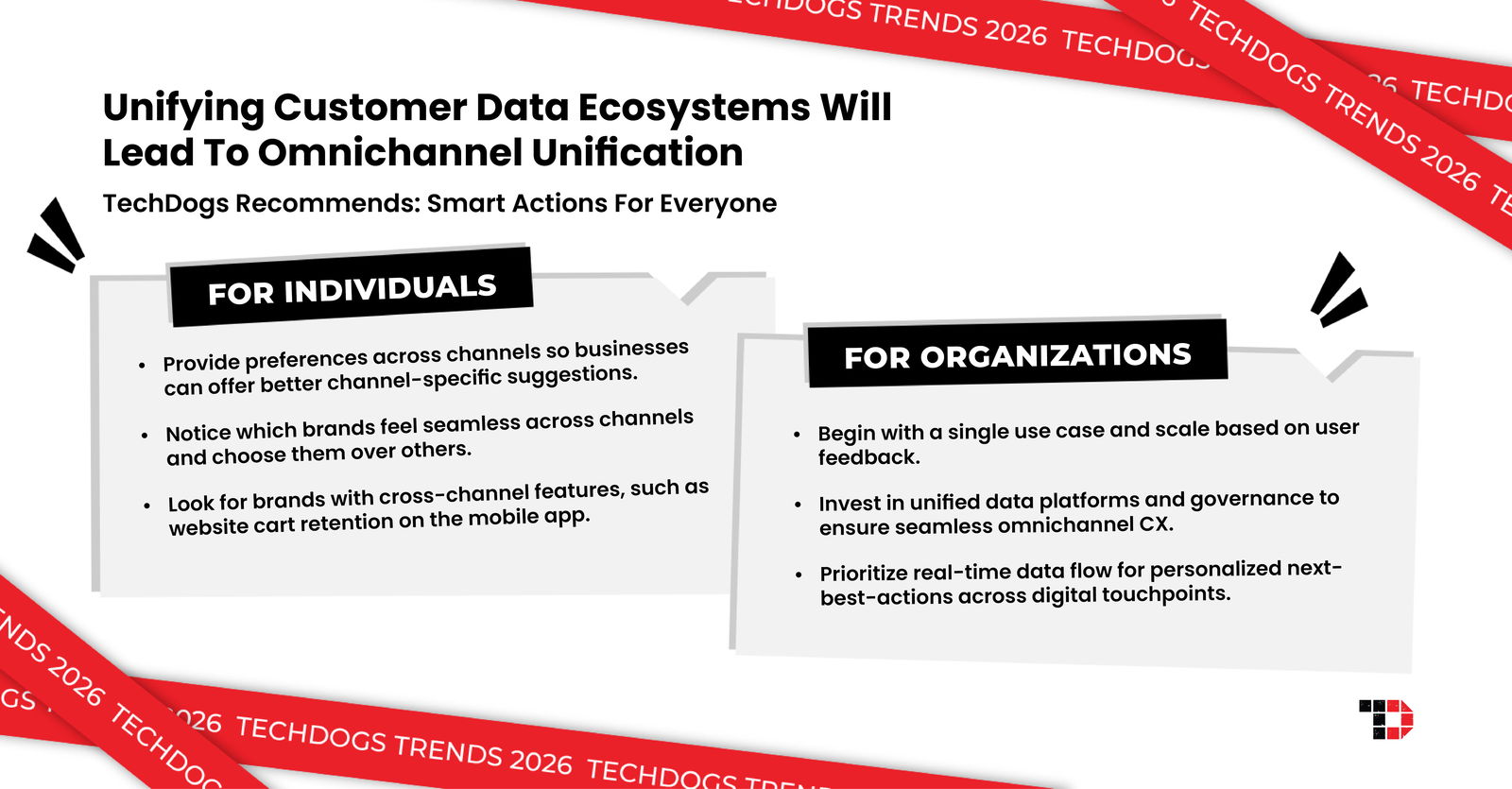
Trend 4: Unifying Customer Data Ecosystems Will Lead To Omnichannel Unification
Siloed customer data is the Achilles' heel of customer experiences, and businesses are working on addressing the issue. In 2026, leading brands are deploying unified data ecosystems to unify marketing, sales, support, and other customer data systems to create cohesive, personalized digital journeys. No matter where a customer starts the journey, or what stage they are in, unified data platforms will integrate real-time interactions, CRM insights, support tickets, and past digital behavior to offer a seamless omnichannel digital experience.
How Is The Industry Responding?
A report by IBM Data Differentiator highlights that 82% of enterprises reported data silos disrupting their critical workflows, as 68% of enterprise data remains unanalyzed. With this in mind, brands are unifying customer data across digital channels to include purchase history, loyalty rewards, personalized recommendations, and all customer interactions.
The business case for fixing this is compelling. Aberdeen Group research finds that companies with strong omnichannel data strategies retain 89% of customers versus just 33% for those with weak implementations, and see 9.5% annual revenue growth versus 3.4% for laggards. The cost of siloed data is not just operational friction; it is measurable customer loss. For instance, Disney's MagicBand wearable links park entries, hotel stays, in-park payments, and photos to guests' profiles, delivering personalized, frictionless experiences in real time.
Customers have made their expectations clear. According to Avaya's 2026 CX research, 96% of consumers want to switch between channels without having to repeat themselves, treating any break in context as a fundamental failure of service, not just an inconvenience.
Anand Narang, Chief Digital and Marketing Officer at Vedant Fashion, explains what successful omnichannel unification means: "There are so many times when you call customer service, 'Sorry, Sir, I can't actually address your query because I don't have you in my system.' What we need to do is build that connective journey so that the same consumer identity, what we call PII, needs to be built across there."
In other words, when every touchpoint knows your name and your history, the experience stops feeling like a transaction and starts feeling like Cheers.
Challenges To Watch
Businesses will face challenges such as data integration costs, unifying with legacy systems, and creating organizational silos. Plus, data quality concerns and regulatory compliance remain significant barriers to creating unified customer data systems.
TechDogs Recommends: Smart Actions For Everyone
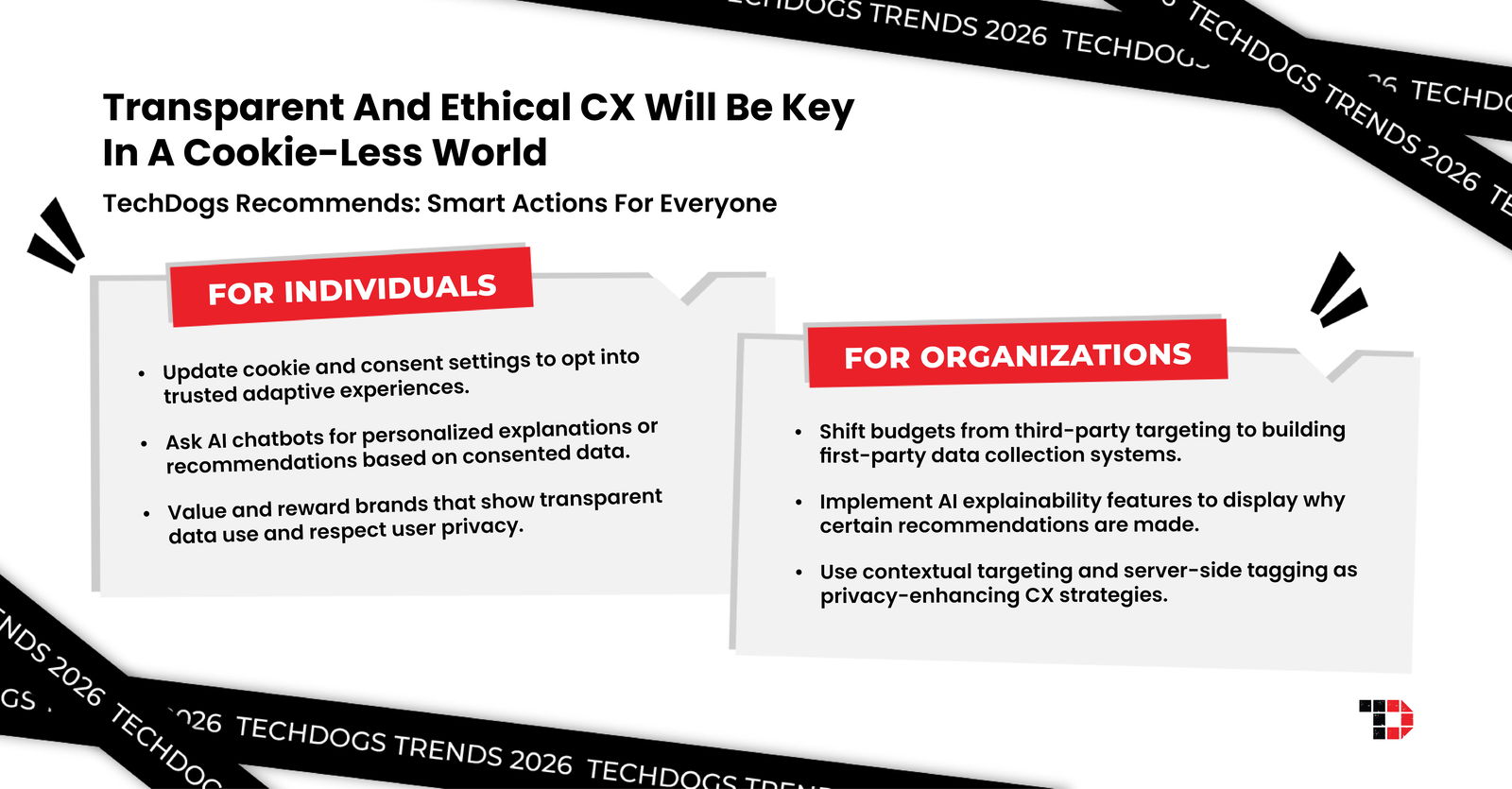
Trend 5: Transparent And Ethical CX Will Be Key In A Cookie-Less World
In an era without third-party cookies, trust is quickly becoming the new digital currency. After all, most online experiences require data-driven decision-making, whether it's hyper-personalization (Trend #1), immersive commerce (Trend #2), or omnichannel unification (Trend #4).
Moreover, with leaders like Google reversing their plan to phase out third-party cookies entirely, now allowing users to opt in or out rather than eliminating the capability, brands still cannot rely on the old tracking model. The Verge and OpenAthens have both reported Google's U-turn, and the practical reality remains: Safari, Brave, and Firefox already block third-party trackers by default, making privacy-first CX a necessity regardless of Chrome's approach. Brands must pursue privacy-first CX strategies, building on first-party data, ensuring explicit consent, and leveraging explainable AI insights to enable ethical contextual personalization.
How Is The Industry Responding?
Despite Google's U-turn on cookies, other top browsers such as Safari, Brave, and Firefox already block trackers, increasing the pressure on marketers to ethically source customer data. Moreover, a survey from Econsultancy shows that 78% of businesses now place the highest value on first-party data for hyper-personalization.
The urgency behind that shift is backed by fresh data. The Zendesk CX Trends 2026 report finds that 95% of customers want to know why AI makes the decisions it does, yet only 37% of brands currently offer any reasoning behind their AI recommendations. Meanwhile, 63% of customers report their demand for greater transparency has risen compared to the previous year.
With hyper-personalization integrated into CX, concerns regarding ethical AI are rising, with TechRadar's "AI Trust Paradox" underscoring that consumers demand transparency and oversight. Ali Miller, the Vice President of Ads Product at Instacart, says: "First-party data that is based directly on what people are telling us, that's what the industry is likely to increasingly rely on to create relevant advertising while being transparent about how consumer data is used for personalization. This highlights how CX strategies of 2026 will be built with fairness and transparency in mind."
The implication: cookie-less personalization is not a constraint; it is a forcing function. Brands that build first-party data infrastructure now will achieve better personalization anyway, without the legal exposure and reputational risk that third-party tracking carries. The trust advantage compounds over time, and it cannot be bought by brands that move late.
Challenges To Watch
First-party strategies will require deep infrastructure investments, including unified customer data platforms, first-party collection mechanisms, and explainable AI models. Apart from accessible language on data collection portals, brands must navigate evolving privacy laws while maintaining the quality of personalization.
TechDogs Recommends: Smart Actions For Everyone
Conclusion
In Cheers, Sam's bar worked not because it had the best drinks, but because every customer walked in feeling recognized. That is the CX goal these five trends are building toward at a digital scale. In 2026, digital CX is introducing consumers to new dimensions of personalization, engagement, and innovation.
This year, the most successful brands are those that make online experiences feel more human, intelligent, immersive, seamless, and trustworthy, no matter the digital channel involved. From emotionally aware AI to immersive shared shopping experiences, cross-sector creativity and unified data ecosystems to trust-centric CX designs, the stage is set for brands to listen more deeply to customers' emotions, help customers share experiences, unify their cross-channel data, and earn trust through transparent, privacy-first practices.
The magic of these digital customer experience trends lies in their ability to enhance the connection between the customer and the brand, beyond just driving conversions and convenience.
Frequently Asked Questions
What Are The Top Digital Customer Experience Trends In 2026?
The top digital customer experience trends in 2026 include emotionally aware AI for hyper-personalization, immersive commerce for shared shopping experiences, cross-sector convergence blending strategies from gaming, wellness, and entertainment, unified customer data ecosystems for true omnichannel journeys, and transparent and ethical CX practices for a cookie-optional world.
Why Is Emotionally Aware AI Important For Customer Experience In 2026?
Emotionally aware AI is crucial in 2026 as it goes beyond simple personalization to understand customer tone, sentiment, and mood in real time. According to Gartner, companies using emotional AI can see up to a 25% increase in customer satisfaction. The Zendesk CX Trends 2026 report also finds that 83% of CX leaders say memory-rich AI agents are the key to truly personalized journeys, and 85% say customers will drop brands over a single unresolved first-contact issue.
How Should Businesses Prepare For A Cookie-Less World In Customer Experience?
Businesses need to prepare for a cookie-less world by investing in first-party data strategies, building transparent consent mechanisms, and adopting ethical AI-driven personalization. With third-party cookies being phased out of some browsers, companies must focus on building trust by clearly explaining how customer data is collected and used. The Zendesk CX Trends 2026 report finds that 95% of customers want to know why AI makes decisions, making explainability a non-negotiable component of privacy-first CX design.
Mon, Nov 3, 2025

Liked what you read? That’s only the tip of the tech iceberg!
Explore our vast collection of tech articles including introductory guides, product reviews, trends and more, stay up to date with the latest news, relish thought-provoking interviews and the hottest AI blogs, and tickle your funny bone with hilarious tech memes!
Plus, get access to branded insights from industry-leading global brands through informative white papers, engaging case studies, in-depth reports, enlightening videos and exciting events and webinars.
Dive into TechDogs' treasure trove today and Know Your World of technology like never before!
Disclaimer - Reference to any specific product, software or entity does not constitute an endorsement or recommendation by TechDogs nor should any data or content published be relied upon. The views expressed by TechDogs' members and guests are their own and their appearance on our site does not imply an endorsement of them or any entity they represent. Views and opinions expressed by TechDogs' Authors are those of the Authors and do not necessarily reflect the view of TechDogs or any of its officials. While we aim to provide valuable and helpful information, some content on TechDogs' site may not have been thoroughly reviewed for every detail or aspect. We encourage users to verify any information independently where necessary.
Loading comments...