
Data Management
Data Analytics Trends Turning Raw Data Into Insights In 2026
Share
TL;DR
-
Conversational GenAI Analytics: Natural language querying and AI-powered dashboards are making data analytics accessible to business users without technical skills, with 75% of analytics content projected to use GenAI by 2027.
-
Real-Time Analytics: Processing data in milliseconds is shifting from a luxury to a baseline business requirement, driven by streaming platforms and event-driven architectures.
-
Advanced Data Privacy and Security: As analytics systems handle more sensitive data across distributed environments, zero-trust architectures and privacy-enhancing technologies are becoming non-negotiable.
-
Edge Analytics for IoT: Processing data close to its source is enabling real-time insights in manufacturing, healthcare, and logistics.
-
Data Storytelling: Combining AI-generated narratives, natural language generation, and immersive visualization is transforming raw data into decisions. 88% of professionals say visualizing data boosts credibility.
Introduction
In Moneyball, Billy Beane and the Oakland A's did not win by having the biggest payroll. They won by reading the data differently. While every other team scouted players by instinct and tradition, Beane used sabermetrics to find undervalued talent that outperformed its price. The result was a 20-game winning streak and a permanent shift in how baseball, and eventually every major industry, thinks about competitive advantage.
That shift in thinking is now playing out across enterprises. The global data analytics market is projected to grow from $104.39 billion in 2026 to $495.87 billion by 2034, according to Fortune Business Insights. The organizations winning are not the ones with the most data. They are the ones reading it faster, more accurately, and making it legible to everyone in the organization, not just the analysts.
Five trends define this shift. Here is what each means and why it matters now.
Trend 1: GenAI And Machine Learning Will Make Data Analytics Conversational
Data analytics is becoming something users can talk to, not just query.
What is conversational analytics? It is the use of natural language querying and GenAI-powered interfaces to let business users generate summaries, predictions, and dashboards through plain-language prompts, without writing SQL or engaging a data engineer. In 2026, natural language analytics is not a premium feature. It is becoming the default interface for business intelligence.
AI and machine learning have moved from back-end tools to front-end enablers. LLMs are democratizing data access, making it possible for any team member to extract insights that previously required a data science team.
How Is The Industry Responding?
Leading platforms including Tableau GPT, Microsoft Fabric Copilot, and ThoughtSpot Sage are pioneering GenAI integration into business intelligence workflows. Databricks integrates Vector Search to make unstructured data as queryable as structured datasets. Tellius offers unified platforms that deliver complex, multi-layered enterprise analysis through a ChatGPT-like interface.
Gartner predicts 75% of analytics content will use GenAI to deliver enhanced contextual intelligence by 2027. By 2026, Gartner also notes that 40% of analytics queries will be created using natural language. Precedence Research projects the global AI in data analytics market will grow from $40.30 billion in 2026 to $310.97 billion by 2034.
"This will enable dynamic and autonomous decisions that have the potential to transform enterprise and consumer software, business processes and models," said Georgia O'Callaghan, Director Analyst at Gartner.
The shift is already underway. Organizations that enable business users to interact directly with data are accelerating decision-making, while those relying on centralized analytics teams are introducing unnecessary delays.
Challenges To Watch
Model hallucinations, inconsistent results across prompt variations, and lack of context-awareness can lead to misinterpretation. Organizations also face growing concerns around data quality, IP ownership, and regulatory compliance when models are trained on proprietary datasets. Integrating GenAI into existing processes can create interoperability issues and require specialized training.
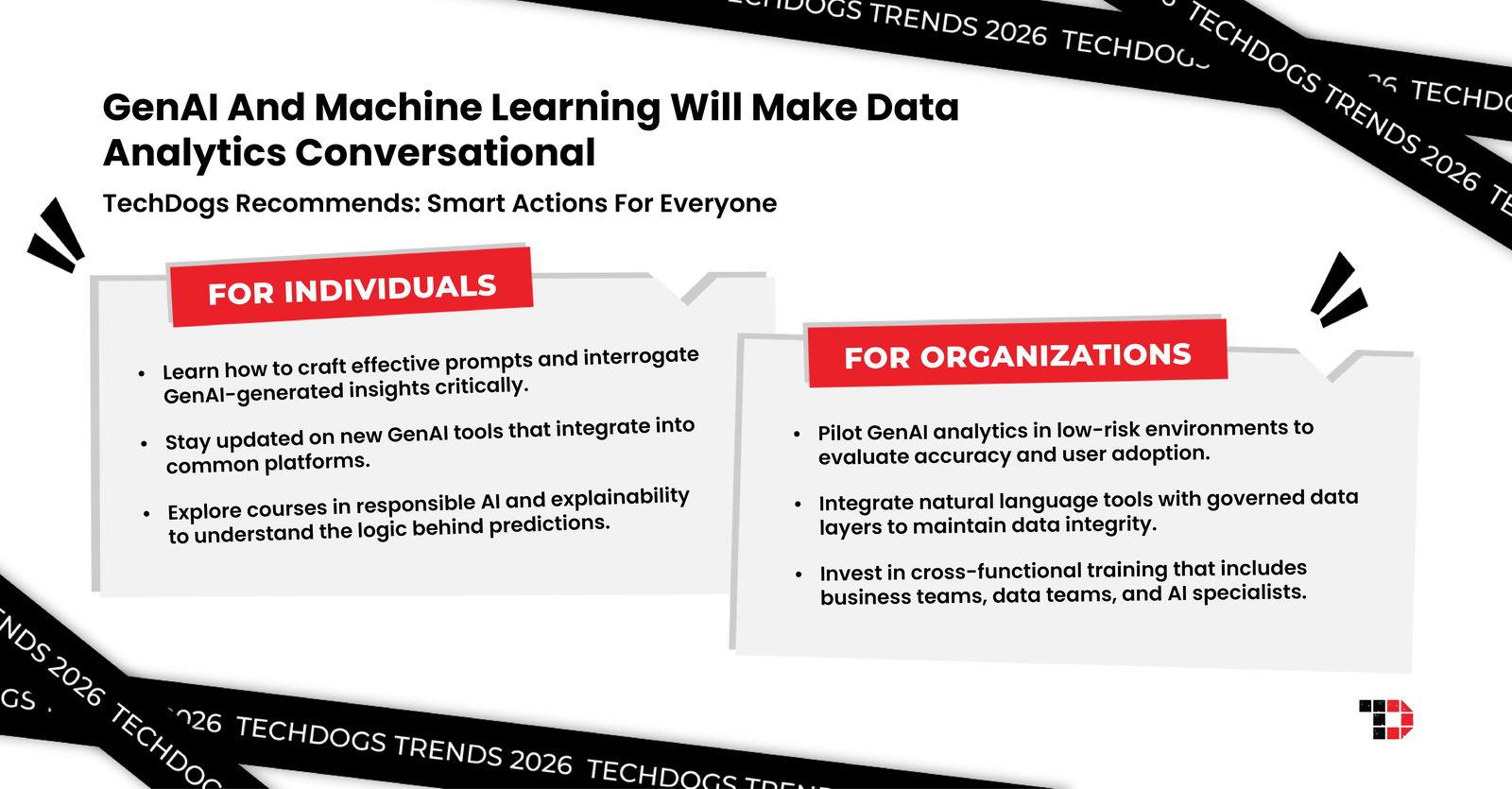
TechDogs Recommends: Smart Actions For Everyone
Trend 2: Real-Time Analytics Will Move From Luxury To Necessity
Speed is becoming the defining factor in data-driven decision-making.
Real-time data analytics: the ability to process, analyze, and act on data in milliseconds rather than hours or days. In 2026, this is not a differentiator for the most advanced companies. It is the baseline expectation for businesses in finance, e-commerce, logistics, and healthcare.
The shift is driven by streaming platforms including Apache Kafka, Pinot, and Apache Flink, cloud data warehouses, and event-driven architectures. Real-time analytics now supports dynamic pricing, fraud detection, and predictive maintenance at a speed that batch processing cannot match.
How Is The Industry Responding?
Real-time analytics is already embedded in high-frequency business operations. Uber uses real-time analytics for surge pricing, fraud detection, and ETA calculations, processing millions of events per second. Amazon Kinesis, Google Dataflow, Snowflake's Dynamic Tables, and Databricks' Structured Streaming all provide sub-second data processing for global enterprises.
Target uses real-time analytics to optimize store operations and assist guests in locating products. McDonald's reduced query time from 2.5 seconds to 0.8 seconds, achieving new levels of operational visibility and responsiveness.
According to Confluent's 2025 Data Streaming Report, 89% of IT leaders see data streaming platforms as critical or important to achieving their data-related goals. The real-time analytics segment is expected to record the highest CAGR in the broader data analytics market through 2034, per Fortune Business Insights.
The advantage is shifting to organizations that can act on data as it is generated. Those still relying on delayed insights are making decisions that are already out of date.
Challenges To Watch
Real-time analytics requires robust data pipelines, low-latency storage, and skilled streaming engineers. Many legacy systems cannot handle streaming demands, leading to costly overhauls. Without proper monitoring and alerting, real-time systems risk cascading failures or false positives.
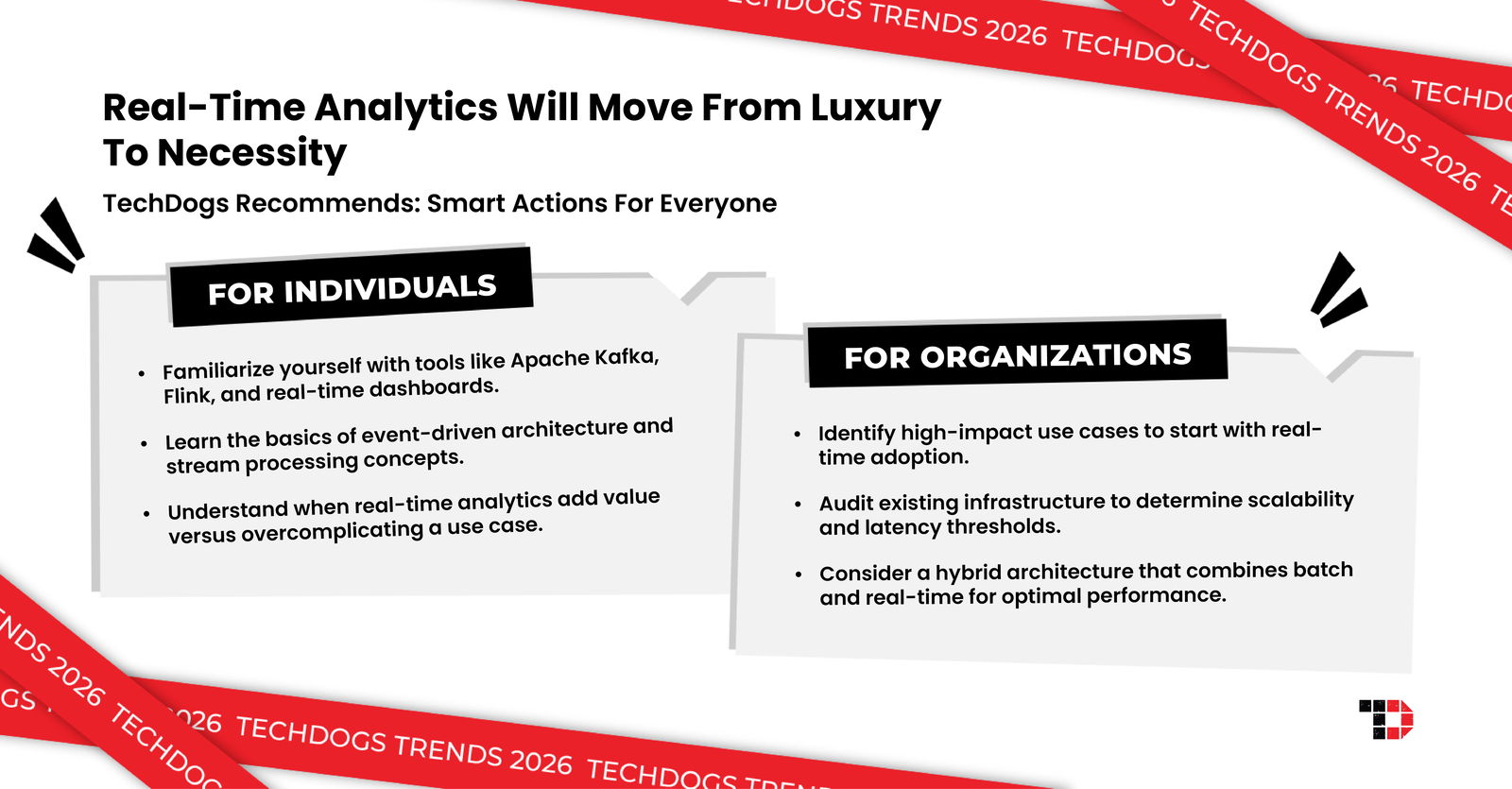
TechDogs Recommends: Smart Actions for Everyone
Trend 3: Businesses Will Prioritize Advanced Data Privacy And Security
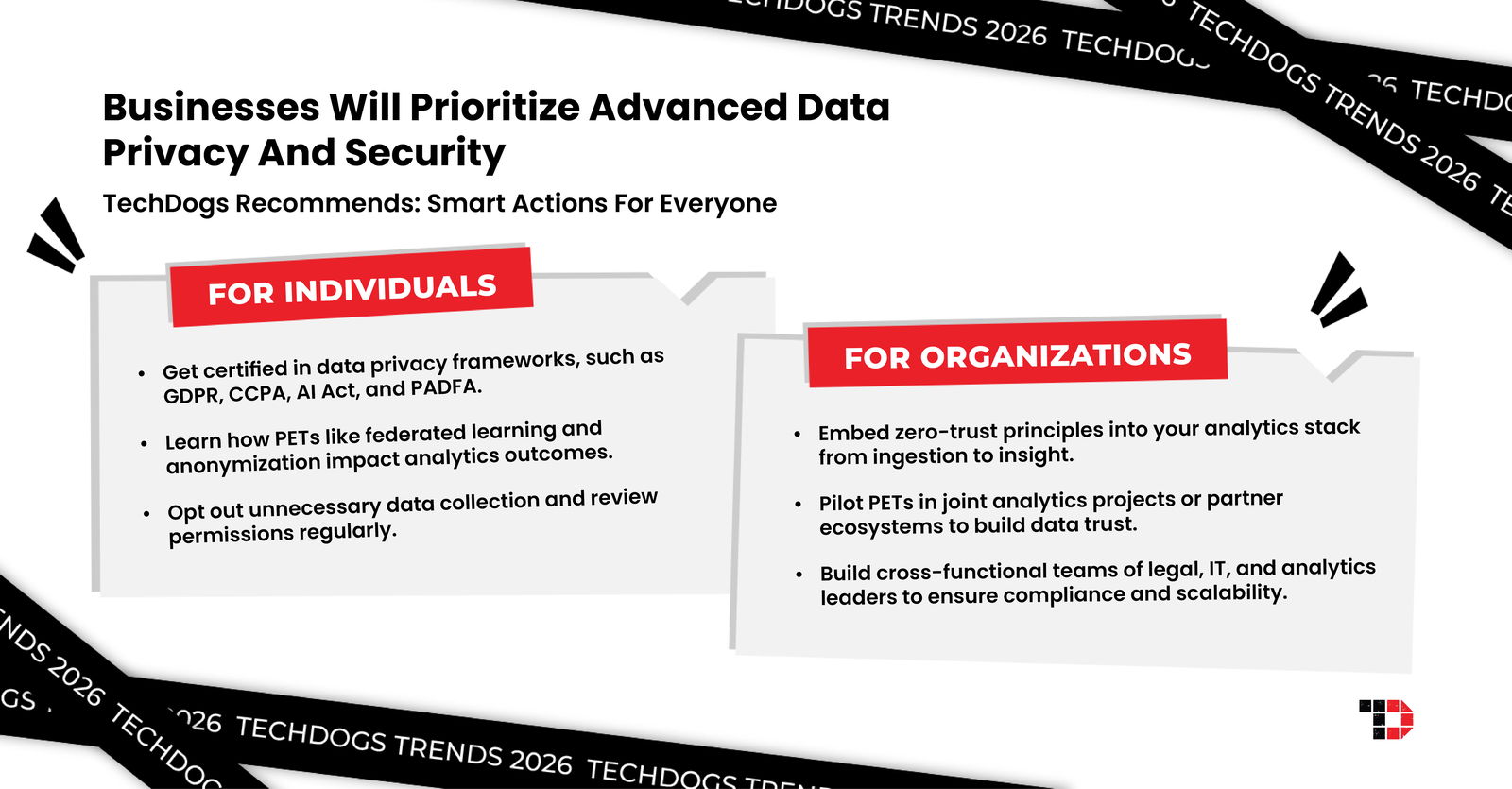
As data becomes more central to business decisions, the risks associated with it are growing just as fast. As analytics platforms handle larger volumes of sensitive data across hybrid and multi-cloud environments, data privacy and security are no longer separate from analytics workflows. They are a core component of how analytics systems are designed, governed, and operated.
With cyber threats becoming more sophisticated, organizations are being forced to rethink how data is accessed, shared, and protected across analytics ecosystems. With regulations including PADFA in the US and the EU AI Act tightening requirements in 2026, privacy is shifting from compliance checkbox to strategic differentiator.
Topics For More Insights
How Is The Industry Responding?
Organizations are actively redesigning their analytics ecosystems to embed privacy and security at every layer.
"With the constant threat of opportunistic threat groups, security teams need full visibility into misconfigurations and insecure identities that could allow an attack to have a devastating effect in a matter of keystrokes," said Scott Caveza, Senior Staff Research Engineer at Tenable.
IBM and Microsoft are embedding zero-trust principles directly into their analytics ecosystems. Cape AI provides tools that encrypt documents and redact sensitive information before sharing with LLMs. AWS and Google offer data clean rooms: secure environments where organizations can analyze combined datasets without exposing raw data. JPMorgan Chase is experimenting with synthetic data for ML model training by blending federated learning and blockchain.
Cisco's 2026 Data and Privacy Benchmark Study, based on 5,200 IT, technology, and security professionals across 12 markets, shows that 90% of organizations have expanded their privacy programs and 93% plan further investment. Data leaks from generative AI are now the leading security concern for 34% of organizations, up from 22% in 2025, per the World Economic Forum's Global Cybersecurity Outlook 2026.
Privacy-enhancing technologies are no longer limited to regulated industries. Any organization using AI-driven analytics now faces similar exposure, and those building privacy controls into their architecture early are gaining both trust and operational advantage.
Challenges To Watch
High computational costs, a lack of internal expertise, evolving regulations, platform upgrades, and integration complexities are the primary hurdles. The diversity of data protection standards across jurisdictions adds operational complexity for global organizations.
TechDogs Recommends: Smart Actions for Everyone
Trend 4: Edge Analytics Will Drive IoT Adoption
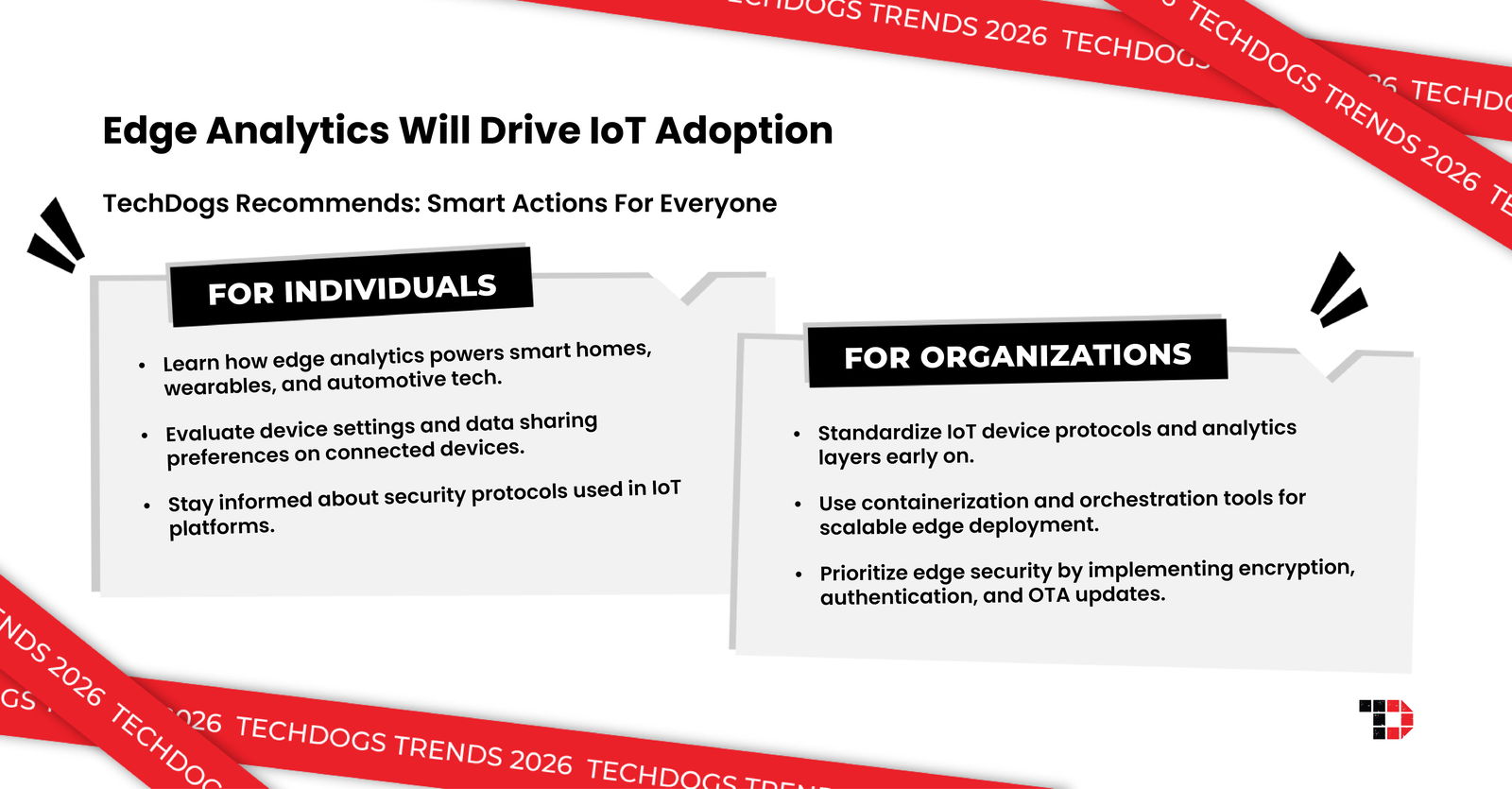
As IoT ecosystems expand, edge analytics in IoT in 2026 is becoming critical for processing data closer to its source.
Edge analytics defines the practice of processing data close to its point of generation, rather than routing it to a central cloud for analysis. For IoT and IIoT devices, edge computing reduces latency, conserves bandwidth, and enables faster responses. In 2026, it is not an advanced infrastructure concept. It is the operational standard for manufacturing, energy, healthcare, and retail, where milliseconds matter and central cloud round-trips are too slow.
How Is The Industry Responding?
Adoption of edge analytics is accelerating as industries seek faster, real-time decision-making capabilities.
The global IoT analytics market is projected to grow from $50.43 billion in 2026 to $201.77 billion by 2034, at a CAGR of 18.9%, according to Fortune Business Insights. Manufacturers adopting edge-first analytics models record 30% higher operational efficiency compared to cloud-only setups, per Mordor Intelligence.
FedEx uses an IoT-powered monitoring solution across warehouses, sorting facilities, and delivery vehicles to provide real-time tracking for sensitive shipments. DHL is using AI-powered computer vision to monitor assets in real time and identify defects before they cause operational disruptions. NVIDIA has launched advanced edge computing hardware and software solutions to support industrial-scale edge analytics deployment.
H&M Group, which operates over 4,000 stores in 75+ countries, invested in and adopted Avassa's edge application management platform to enhance in-store applications and deliver consistent digital experiences at scale. "Retail is one of the fastest-moving industries in edge computing, and we are excited to collaborate closely with H&M Group," said Fredrik Lundberg, CEO and co-founder of Avassa.
Edge analytics is turning IoT data into immediate action rather than delayed insight. Organizations that invest in edge-first architectures are gaining speed and responsiveness that centralized systems cannot match.
Challenges To Watch
Companies face device interoperability issues, limited computing power at the edge, network fragmentation, and security vulnerabilities. Ensuring consistent data quality across a large fleet of devices remains a significant operational challenge.
TechDogs Recommends: Smart Actions for Everyone
Trend 5: Data Storytelling Will Become The New Competitive Advantage
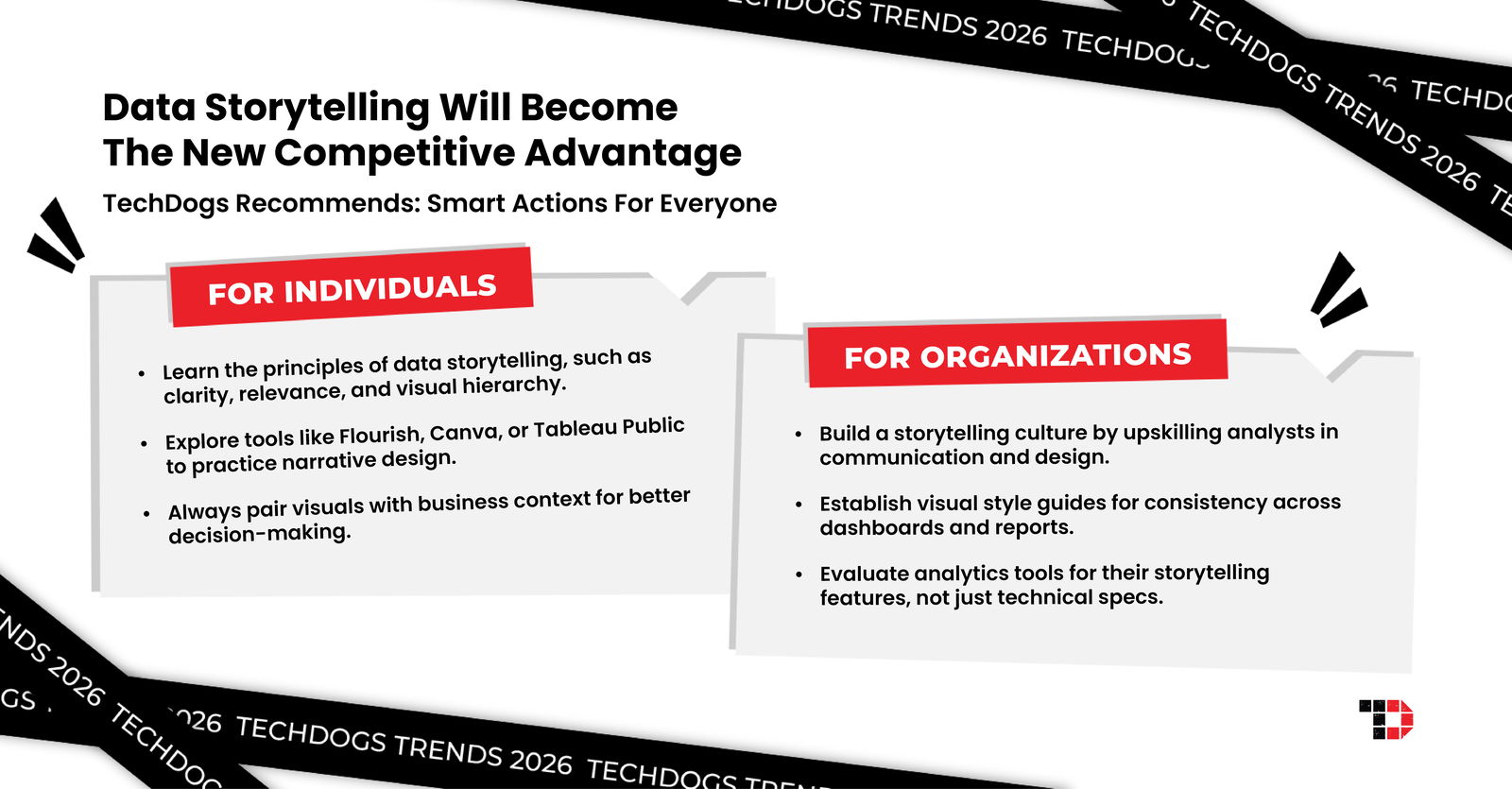
Billy Beane's Moneyball insight was not just that he had better data. It was that he could explain it. He convinced a skeptical front office and coaching staff to trust numbers over instinct, and that persuasion was inseparable from the analysis. Data storytelling in 2026 is that same challenge at enterprise scale: the ability to transform raw insights into narratives that move people to act.
Advanced data visualization and storytelling capabilities are transforming complex dashboards into compelling, actionable insights. Data visualization tools in 2026 now combine charts with automated narratives, AR-driven immersive visuals, and AI-powered explanations to deliver clear and contextual decision support.
How Is The Industry Responding?
Data storytelling is becoming a core capability across modern analytics platforms. Platforms including Power BI, Qlik, and Flourish now offer natural language generation overlays and narrative AI that explain data trends through customizable data visualization. Self-service BI, NLG, and AI-augmented storytelling are enabling analysts to move beyond "what happened" to "what it means" and "what should be done."
Canva's global study, Beyond the Numbers: How Data Storytelling Redefines Communication, found that 74% of professionals say their organizations have become more reliant on data over the past two years, with 89% working with data and spreadsheets every week. 88% say visualizing data boosts credibility, and 83% feel more confident presenting data with visuals. 66% believe AI will enhance their data capabilities further.
"When people have the right tools to turn data into stories, lots of things can change," said Duncan Clark, Head of EMEA at Canva and co-founder of data visualization platform Flourish. "Confidence grows. Decisions improve. Rows and columns gain context, meaning, and impact. Even the most complex dataset can become a visual narrative that informs, inspires, and drives action."
Data storytelling is where analytics value is realized. Organizations that invest in visualization skills, narrative AI, and a storytelling culture are converting insights into action faster than those still relying on static dashboards.
Challenges To Watch
Pushing too hard for visuals can lead to oversimplification that dilutes insights. With AI in the mix, over-reliance on automation can cause professionals to miss nuances and key contextual signals. Not all analysts are trained storytellers, and inconsistent visual design erodes data trust across the organization.
TechDogs Recommends: Smart Actions for Everyone
Conclusion
Billy Beane changed baseball not by collecting more statistics, but by using them differently. He made data legible to everyone who needed to act on it and built a system where insight drove strategy at every level. That is the standard data analytics is reaching in 2026.
Conversational GenAI analytics is turning every business user into a data analyst. Real-time streaming is eliminating the latency between insight and action. Privacy-enhancing technologies are making analytics trustworthy in an era of escalating data threats. Edge analytics is pushing intelligence to where decisions are made. And data storytelling is turning numbers into decisions that stick.
The organizations that win in 2026 will not be those with the most data. They will be those who know what to do with it and can get everyone in the building on board.
Frequently Asked Questions
What Are The Top Data Analytics Trends To Watch In 2026?
The key data analytics trends shaping 2026 include the rise of GenAI and machine learning for conversational analytics, the shift to real-time data processing, a stronger focus on data privacy and security, the rapid adoption of edge analytics for IoT, and the growing importance of data storytelling. Together, these trends are transforming how organizations use data to make decisions, predict outcomes, and enhance customer experiences.
How Is Artificial Intelligence Changing Data Analytics?
AI is revolutionizing data analytics by automating insight generation, enabling natural language queries, and simplifying complex analyses. According to Gartner, 75% of analytics content will use GenAI to deliver enhanced contextual intelligence by 2027, and 40% of analytics queries will be created using natural language by 2026. This shift is making AI in data analytics more accessible, faster, and closely tied to everyday business workflows.
Why Is Data Analytics Important For Businesses In 2026 And Beyond?
In 2026 and beyond, data analytics is crucial because it enables organizations to anticipate trends, make informed decisions, and remain competitive in rapidly changing markets. The global data analytics market is projected to grow from $104.39 billion in 2026 to $495.87 billion by 2034, according to Fortune Business Insights. With AI, real-time insights, and privacy-focused innovations, businesses can transform data into a strategic advantage, turning every dataset into a roadmap for smarter growth and resilience.
Wed, Nov 26, 2025

Enjoyed what you read? Great news – there’s a lot more to explore!
Dive into our content repository of the latest tech news, a diverse range of articles spanning introductory guides, product reviews, trends and more, along with engaging interviews, up-to-date AI blogs and hilarious tech memes!
Also explore our collection of branded insights via informative white papers, enlightening case studies, in-depth reports, educational videos and exciting events and webinars from leading global brands.
Head to the TechDogs homepage to Know Your World of technology today!
Disclaimer - Reference to any specific product, software or entity does not constitute an endorsement or recommendation by TechDogs nor should any data or content published be relied upon. The views expressed by TechDogs' members and guests are their own and their appearance on our site does not imply an endorsement of them or any entity they represent. Views and opinions expressed by TechDogs' Authors are those of the Authors and do not necessarily reflect the view of TechDogs or any of its officials. While we aim to provide valuable and helpful information, some content on TechDogs' site may not have been thoroughly reviewed for every detail or aspect. We encourage users to verify any information independently where necessary.
Loading comments...