
Cyber Security
5 Top Trends That Will Shape Cybersecurity In 2021
Share
Overview
That brings us to a bigger question–what now? What is in store for Cybersecurity in 2021? Will it continue to struggle with the challenges of the new digital world or grow into something stronger than ever? If you are looking for the answers to these questions, this article is for you. Read on to find out what experts expect the face of Cybersecurity to be in 2021.
.jpg.aspx "TechDogs-BELLA CIAO, Cyber Attacks!-\"5 Top Trends That Will Shape Cybersecurity In 2021\"")
Here's a brain teaser for you– what was the most critical part of The Professor's plan during the Royal Mint heist in the hit Netflix Series La Casa De Papel, AKA Money Heist?
A. Hijacking the guarded truck
B. Identifying Alison Parker, daughter of the UK's ambassador as a high priority hostage
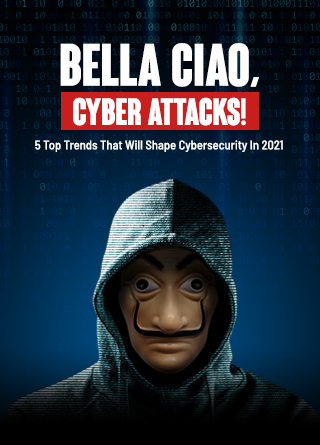
You might say both but we say neither and yes, that was a trick question. The Professor's plan was held firm because of knowledge - knowledge about the bank's weak Cybersecurity system that allowed Rio to hack into the Mint's security system. From there, it was all a walk in the bank, uhh we mean, park. Unlike the bank authorities, The Professor had access to every camera in the bank and was well aware of the threats of the digital world- including the wiretap and the radio signals, so he switched to analog to continue the heist. His team wearing Dali masks helped rip apart the digital walls of the Royal Mint and spoiler alert, the actual fence too but that's not important here.
It makes you wonder how crucial it is to always be on top of the Cybersecurity game. Keeping this in mind, we've put together the latest and the most important trends that will shape and even change the face of Cybersecurity in 2021 and help you stay ahead of the curve. Let's dive right in.
Trend 1: Artificial Intelligence (AI) Would Catch What The Human Eye Misses
Using AI in Cybersecurity has become the need of the hour due to the increasingly convoluted cyber threats over the years. Seriously, cyber threats cyber threats everywhere. If a system is attacked, it's implausible that there are no warning signals or environmental changes that indicate the advancing threat. However, hackers can mask these changes and keep them so subtle that it’s too late by the time Admins and Security Engineers notice it and that just can’t happen! To counter that, Artificial Intelligence to the rescue! AI is rapidly paving its way into Cybersecurity, especially for detecting approaching threats. AI-enabled threat detection would allow organizations to predict new attacks and instantly alert Admins of breaches, for timely action.
According to the 2018 ‘Threat Hunting Report’, 52% of Security Operations Centers (SOC) experienced almost double the number of cyber threats in comparison to the previous year. Invariably, the same report shared that 82% of them are moving towards AI-powered threat hunting techniques to combat it.

TechDogs’ Opinion: Cybersecurity would greatly benefit from “unsupervised learning” (machine learning to perform better on its own). Owing to AI and Machine Learning algorithms, Cybersecurity tools would identify patterns that prevail during the normal functioning of a system. With that learning, these tools would actively spot anomalies in the pattern to recognize threats and unusual behavior thereby reducing malignant attacks. Cool, isn’t it?
Trend 2: Better Security For The Remote World
Who would have guessed a virus so small would bring the world down to its knees and force everyone to lock themselves in their homes? It is true what they say; reality is stranger than fiction. You can think of circa 2020 as the largest ever remote work experiment, which forced organizations to move all infrastructure and systems online and Zoom being just as famous as the Kardashians. Remote work meant IT systems would need to be accessed from all parts of the world. As a result, there were plenty of Remote Desktop Protocol (RDP) endpoints in every IT system, many of which were not secured, making these systems the ideal hacking ground for no-good people.
There was a 127% increase in such exposed RDP endpoints in 2020. Needless to say, the pandemic tore down IT systems and made way for Malicious Cyber Actors. So, in 2021, the focus would be to build security walls taller and thicker than ever.

TechDogs’ Opinion: It is highly possible to witness rapid growth in the use of enterprise Virtual Private Network (VPN) and desktop virtualization. With that, there’d be tools that would accurately detect all endpoints and check whether they’re secure and ensure adequate response to secure them before they catch the eye of cyber miscreants. One could also expect multi-factor authentication and cloud security vendors being in demand for a while.
Trend 3: Everyone Would Seek Managed Detection And Response
As an offshoot of the previous trend, organizations looking for better Cybersecurity for their remote workforce, would seek aid in Managed Detection and Response (MDR) services. These are essentially outsourced Cybersecurity services that act as a shield for your business' data and assets. Three cheers for MDR the savior! Hip Hip Hurray!
Even threats that sneak past the usual security systems can't fool the mighty MDR services and are caught before causing any mischief. Not just that, MDR offers 24/7 threat monitoring and detection which is crucial in the present times for any organization. The demand for MDR services is increasing so rapidly that Gartner predicts 50% of the world's organizations will be using these services by 2025.

TechDogs’ Opinion: MDR services could provide offsite on demand security experts that companies could rely on to detect threats and provide actionable advice to remediate them faster and better. Additionally, one could also expect MDR services to offer threat-hunting and forensic capabilities with contextual, actionable threat indicators to allow organizations to deal with structural security shortcomings.
Trend 4: Ransomware Was, Is And Will Be A Worry For All
For the uninformed, ransomware is the digital equivalent of kidnapping. Those with malicious intent first allure you with a candy, which in this case could be free giveaways and trips, exclusive information of COVID-19, etc. Once you fall for the bait, i.e., clicking on these, your data or access to certain applications is withheld until the ransom amount is paid. Yes, no more selfie posting on Instagram till you cough up the price, sometimes not even after that.
With all the awareness around checking credibility of sources, spammy emails and fishy content, you’d assume that people are now aware of dubious content that can harm their data and security. However, in reality, we’re far from recognizing such baits. There are still plenty of Chandlers out there who click on lucrative emails from unknown senders. Don’t believe us ? PurpleSec findings state, the cost of global damage from ransomware attacks jumped from $8 billion in 2018 to $20 billion in 2020. Not just that, 90% of IT professionals revealed that their clients had suffered a ransomware attack in the past year. Now isn’t that astonishing and scary!
.JPG.aspx "TechDogs-\"Ransomware\" Was, Is, And Will Be A Worry For All-2D Image For Estimated Global Damage From Ransomware")
TechDogs’ Opinion: At present, hackers are still using COVID-19 landscape to lure victims into their trap. The only way ahead is increased awareness and staff training around leading ransomware types and tricks. While added security and tools to identify phishing emails, corrupted attachments and shady websites will continue, ransomware will continue to be the #1 cyber threat in 2021 too.
Trend 5: Businesses Would Trust The Zero Trust Model
Like every spy/ thriller movie that advises to trust no one, the Zero Trust Model, developed by Palo Alto Network's John Kindervag, is based on the principle of 'never trust, always verify.' It takes away the factor of trusting people from the organization's internal network and similarly verifies them as an external person. If only Ned Stark would have known this before ... ofcourse.. We can’t even say it *Sob Sob*. Everyone is a potential threat and needs to be authenticated. While the model has been around for a while, it gained popularity in 2020 with the need for perimeter-less security in remote workspaces.
In the post-COVID world, Zero Trust Model is projected to grow at a compound annual growth rate (CAGR) of 17.4% from 2020 to 2026 and have a market size worth USD 51.6 billion by 2026.
.JPG.aspx "TechDogs-Businesses Would Trust The Zero Trust Model-2D Image Of 'Zero Trust Security'")
TechDogs’ Opinion: The Zero Trust model will be actively adopted by organizations dealing with valuable business information, including the data of users, as the model allows complete visibility and control over information access. This added layer of security will reduce the possibility of a data breach by defining access to sensitive information based on a user’s identity. Doesn’t matter if you’re up against Sterling Archer or The Professor, The Zero Trust model will keep your business data secure.
Summing It Up
The pandemic has shouldered Cybersecurity professionals to re-envision their approach towards Cybersecurity in more ways than one. Clearly, the focus in 2021 would be to make systems secure for distributed teams more than anything else. Along with that, there’d be an ongoing endeavor to detect threats and prevent attacks as quickly as possible.
Mon, May 10, 2021

Enjoyed what you read? Great news – there’s a lot more to explore!
Dive into our content repository of the latest tech news, a diverse range of articles spanning introductory guides, product reviews, trends and more, along with engaging interviews, up-to-date AI blogs and hilarious tech memes!
Also explore our collection of branded insights via informative white papers, enlightening case studies, in-depth reports, educational videos and exciting events and webinars from leading global brands.
Head to the TechDogs homepage to Know Your World of technology today!
Disclaimer - Reference to any specific product, software or entity does not constitute an endorsement or recommendation by TechDogs nor should any data or content published be relied upon. The views expressed by TechDogs' members and guests are their own and their appearance on our site does not imply an endorsement of them or any entity they represent. Views and opinions expressed by TechDogs' Authors are those of the Authors and do not necessarily reflect the view of TechDogs or any of its officials. While we aim to provide valuable and helpful information, some content on TechDogs' site may not have been thoroughly reviewed for every detail or aspect. We encourage users to verify any information independently where necessary.
Loading comments...