
IT Security
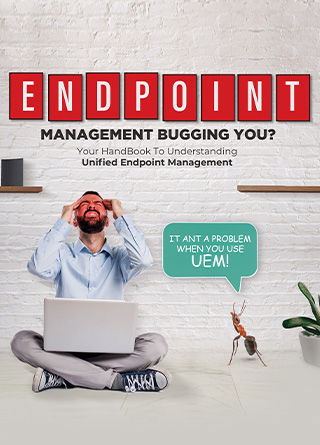
Your Handbook To Understanding Unified Endpoint Management
Share
Overview
.jpg.aspx "TechDogs-\"Your HandBook To Understanding Unified Endpoint Management\"ENDPOINT MANAGMENT BUGGING YOU?")
Have you seen the movie - A Bug's Life? In this movie, we see an ant, Flik, flaunting his positive, motivational and the best-leaders-are-the-best-learners attitude. A Bug's Life takes us on a ride in the adventurous world in which Flik is a misfit ant looking for 'warriors' to protect his colony from greedy grasshoppers. He recruits a group of bugs that turn out to be a clumsy circus troupe at first. Still, Flik motivates them and turns them into warriors who ultimately realize their power and rescue the queen's daughter. #BattleOfBugs
Similar to A Bug's Life, even in real life, some evil grasshoppers (read security issues) keep haunting the systems and leaders like Flik (read entrepreneurs) often struggle to cope. Just like Flik needed an army, entrepreneurs need a process or approach to combat these threats. Flik brought together the army of bugs; similarly, Unified Endpoint Management manages, secures and brings together corporate resources and applications on any device from a single console. It is an approach that refers to securely managing all the endpoints in an enterprise using a comprehensive solution. Sounds like one solid savior, right?
Let's head on and collect more details on brilli-ant Unified Endpoint Management.
What Is Unified Endpoint Management?

...you know it, that Unified Endpoint Management is quite easy to understand, don’t you?
Unified Endpoint Management helps IT and security teams with monitoring, managing and securing all end-user devices on the network consistently using one tool. It is a step beyond mobile device management. You see, as users increasingly work remotely from traditional and mobile devices and organizations integrate IoT (Internet Of Things) and other new technologies, securing and connecting IT environments has become necessary. Unified Endpoint Management has emerged to resolve this problem. Moreover, IT departments also need help integrating legacy systems on these new devices. Unified Endpoint Management decreases the burden of connecting these systems while reducing costs and mitigating risks.
Now it's time to take a quick memory of the ant-ique past of Unified Endpoint Management.
How Did Unified Endpoint Management Evolve?

To find out if this caterpillar actually emerged into a beautiful butterfly if you must watch A Bug’s Life - and to find out the evolution of Unified Endpoint Management, keep reading.
It all began in the 90s when the rise of the Internet took the world by surprise. With the rise of the Internet, global viruses such as Melissa worm and ILoveYou virus also spread their roots. In that era, the endpoint security focus in organizations was limited to antivirus software. IT departments worldwide needed to prepare for the rapid spread of malware, so there was an increased demand for antivirus and personal farewell products.
During the 2000s, developers introduced unified endpoint security to ensure the security of products and services related to patch management, encryption, data loss prevention and access control measures. With the rise of BYOD (bring your own device), an approach was needed to ensure integrated endpoint management of systems, applications and devices.
Just then, Unified Endpoint Management emerged as a solution to that. Initially, it offered to provision and managed the computers and devices people use in organizations. Later, the IoT made “things” far more complex. However, the presence of Unified Endpoint Management tackled the increasing complexity.
Pretty interesting past there, right? Let's return to the pres-ant and discover how Unified Endpoint Management works for enterprises.
How Does Unified Endpoint Management Work?
Woohoo! Let’s figure out why appointing Unified Endpoint Management can be your f-ant-astic decision. (This was the last ant pun, we promise!)
-
Extensive Endpoint Management Integration
Unified Endpoint Management offers you comprehensive integration as it works across multiple platforms such as Windows 10, Chrome OS, Android, iOS and many more. It configures, controls and monitors any device from a single management console. Moreover, it eases the migration from legacy platforms to the updated version.
-
Integrates Data And Applications Protection Across Any Network
Protecting sensitive company data and apps has always been a concern for organizations. Well, Unified Endpoint Management protects your sensitive data and apps with conditional user access, a compliance framework and more effective measures. Besides, it automatically redresses cybersecurity threats and empowers admins to identify them.
-
Modernizing Desktop Management
Unified Endpoint Management transforms desktop operating systems with improved technology to ease deployment. It also securely delivers total cloud policy management with optimized app delivery and automated patching. Unified Endpoint Management enables admins to track, audit and report endpoints for content and applications.
That's quite cool working there, now, let's step ahead and figure out the benefits of Unified Endpoint Management.
What Are The Benefits Of Unified Endpoint Management?
Here's a glimpse of how Unified Endpoint Management can perman-ant-ly fix some issues of your organization with its benefits, such as:
-
Brings Mobile Device Management Under One Roof
One of the most remarkable benefits of Unified Endpoint Management is that it integrates endpoint management tools and mobility management solutions under one roof. Not only does it save you time by reducing the number of tools required for managing devices but it also streamlines device management and security operations.
-
Robust Device Security
Unified Endpoint Management enables users with the capacity to manage security across all devices instead of addressing the security of mobile devices and desktops separately It resolves this issue by managing all devices under one security protocol. UEM also enables an organization to manage and secure all endpoints, including laptops, smartphones, tablets and other devices, from a single console. It allows IT administrators to centrally control access authorization to corporate resources, such as email, applications and data, across all devices.
Seamless Management Of The Internet of Things (IoT)
There's no doubt that IoT has become more ubiquitous in the business world, so managing mission-critical devices have become crucial. Unified Endpoint Management is your helping hand in this task as it supports multiple IoT configurations to ensure that every IoT device operates correctly.

The next section definitely deserves a round of applause as it says all about the flamboy-ant future of Unified Endpoint Management.
What Are The Future Trends Of Unified Endpoint Management?
The seamless blend of low-cost computing, big data, analytics, cloud and mobile technologies has made it possible for the physical and digital worlds to come together. For instance, Internet of Things (IoT) devices will simplify complicated procedures of organizations and boost global communication. Moreover, the enhanced connectivity across the world due to the growth of the 5G network complements the IoT lifestyle. Henceforth, IoT-enabled devices will increasingly be integrated into Unified Endpoint Management.
Research And Markets' study predicts that by 2027, the multi-factor authentication (MFA) market is anticipated to reach $26.7 billion, growing at a CAGR of 15.6% from 2022 to 2027. This study reflects that the multi-factor authentication method in cell phones and computer devices will be popularized to verify users. Besides, the growing demand for AI (Artificial Intelligence) and ML (Machine Learning) empowered MFA will make Unified Endpoint Management way better for identifying suspicious activity and detecting anomalous user behavior in real time.
Summing It Up!
So that's how Unified Endpoint Management can be a great help to organizations. One of its primary benefits is that it speeds up who process of device management and securing organizations. With the help of Unified Endpoint Management, organizations can detect and respond to threats, vulnerabilities and breaches in no time. Besides, it lowers the cost of ownership over time because organizations can manage endpoints at scale more efficiently. The best part is Unified Endpoint Management also boosts the compliance efforts of enterprises. With that, it's time to call it a wrap!
Frequently Asked Questions
What is Unified Endpoint Management?
Unified Endpoint Management (UEM) is a comprehensive approach that aids IT and security teams in monitoring, managing, and securing all end-user devices within an organization using a single integrated tool. It goes beyond traditional mobile device management by encompassing various devices, including desktops, laptops, smartphones, and tablets, as well as emerging technologies like IoT devices. UEM simplifies the task of connecting and securing IT environments, especially as organizations increasingly adopt remote work practices and integrate new technologies into their operations. By providing a unified console for device management, UEM reduces complexity, lowers costs, and enhances security across the enterprise.
How did Unified Endpoint Management evolve?
The evolution of Unified Endpoint Management traces back to the 1990s when organizations primarily focused on endpoint security through antivirus software. With the rise of the Internet and global viruses, there was a growing demand for enhanced security measures. In the 2000s, developers introduced unified endpoint security solutions to address various aspects of security, such as patch management, encryption, and access control, in a unified manner. The advent of bring-your-own-device (BYOD) policies further necessitated the integration of endpoint management across different platforms. Unified Endpoint Management emerged as a solution to manage the increasing complexity of endpoint environments, including the integration of IoT devices.
What are the benefits of Unified Endpoint Management?
Unified Endpoint Management offers several benefits to organizations, including streamlined device management, enhanced security, and seamless IoT device management. By integrating endpoint management tools and mobility solutions, UEM reduces the number of tools required for device management, saving time and resources. It ensures robust device security by managing all endpoints under a single security protocol, thereby simplifying security operations. Additionally, UEM supports multiple IoT configurations, enabling organizations to manage mission-critical devices effectively. With these benefits, UEM facilitates efficient device management, strengthens security posture, and prepares organizations for future technological advancements.
Wed, Feb 22, 2023

Liked what you read? That’s only the tip of the tech iceberg!
Explore our vast collection of tech articles including introductory guides, product reviews, trends and more, stay up to date with the latest news, relish thought-provoking interviews and the hottest AI blogs, and tickle your funny bone with hilarious tech memes!
Plus, get access to branded insights from industry-leading global brands through informative white papers, engaging case studies, in-depth reports, enlightening videos and exciting events and webinars.
Dive into TechDogs' treasure trove today and Know Your World of technology like never before!
Disclaimer - Reference to any specific product, software or entity does not constitute an endorsement or recommendation by TechDogs nor should any data or content published be relied upon. The views expressed by TechDogs' members and guests are their own and their appearance on our site does not imply an endorsement of them or any entity they represent. Views and opinions expressed by TechDogs' Authors are those of the Authors and do not necessarily reflect the view of TechDogs or any of its officials. While we aim to provide valuable and helpful information, some content on TechDogs' site may not have been thoroughly reviewed for every detail or aspect. We encourage users to verify any information independently where necessary.
Loading comments...