
Artificial Intelligence
Everything You Need To Know About Answer Engine Optimization (AEO)
Share
Overview
Remember back in school when we would play a "word guessing" game with friends and then open up the dictionary, only to realize that such a word doesn’t exist.
The Internet later replaced the physical dictionary. With every answer available at our fingertips, we started using smartphones to learn about every word.
To such an extent, people have begun searching for symptoms online. (We highly recommend not doing such things.) The point is: the Internet has become the go-to place to find answers for everything.
While people are searching for correct and reliable answers, there’s another side to this equation: websites and algorithms ranking these sites on search engines. Initially, the quest was how authentic and unique your content is to rank on the first page of search engines. The practice was called Search Engine Optimization.
Well, with AI influencing everything we do, the way people search for answers has also changed. It has led to the introduction of a brand-new practice called Answer Engine Optimization.
What is that? How is it different from SEO? Let's learn everything about that. Read on!
How much Internet is too much Internet?
No, we are not against the concept of the Internet. The Internet serves us well. However, just take a look at these numbers.
According to Semrush, Google sees more than 5 trillion search queries every year. This means 9.5 million searches are happening every minute. These numbers say only one thing: humans breathe on the Internet, and the one who tops the search results rules the world (not literally).
There’s one practice that is emerging on the Internet: Answer Engine Optimization.
What’s that? Let’s understand!
What Is Answer Engine Optimization (AEO)?
Answer Engine Optimization, or AEO, is the process of making your content easier for search platforms and AI systems to understand. Before AI took over, we used to write content for the algorithm, so that the audience could find it. Now, you create content in such a way that it becomes the actual answers users see when they search on the Internet. These answers can be in any format, such as a featured snippet, a voice response, or an AI chat result.
While traditional SEO used to focus on visibility, AEO focuses on usefulness. Mind you. A search engine is not going to extract the exact content from your website and show it as an answer. You need to format your content and structure information in a way that allows the answer engine to identify, extract, and present it to users quickly.
How does one do that? By using clear headings, simple language (like this), and structured data, like FAQs or how-to schemas and voila! Your content is ready to be someone’s answer and change their lives. (Just kidding, unless your content has some life-changing advice!)
Here’s an example.
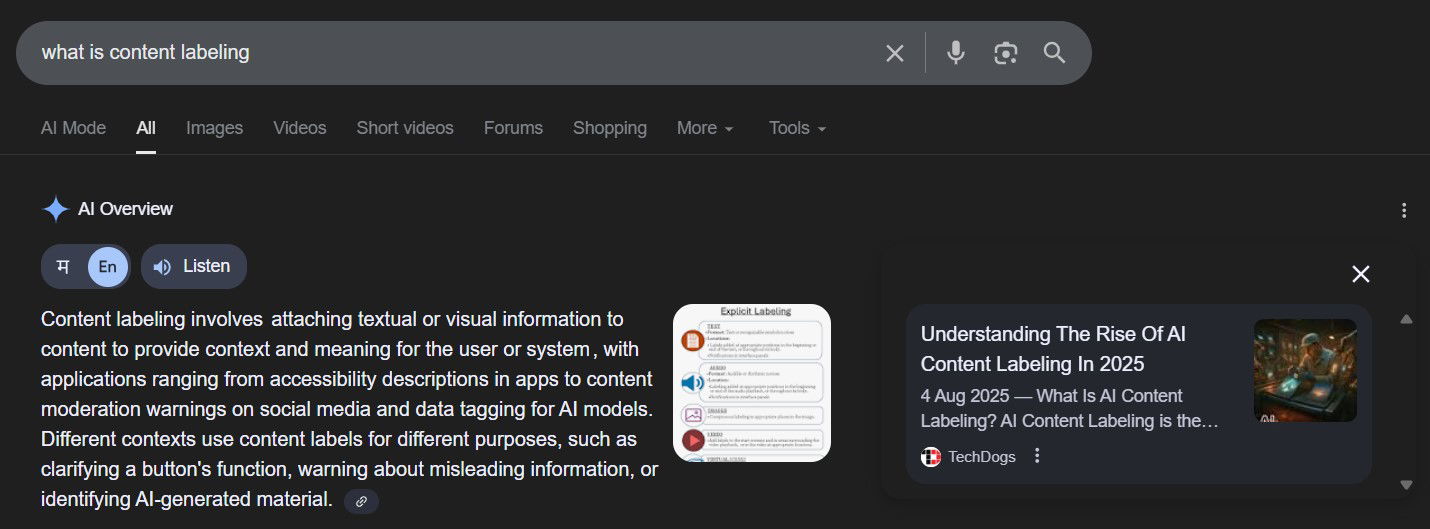
If you search online for “what is content labeling,” the search engine now displays an AI Overview that summarizes the answer directly on the results page. As shown in the image below, the featured response is sourced from TechDogs, taken from our article “Understanding The Rise Of Content Labeling In 2025.” This means the search engine has accurately interpreted and extracted information from our page to provide the best possible answer to users.
Why Is AEO Important Now?
Here are five simple reasons why Answer Engine Optimization (AEO) is more important than ever before.
-
Change In User Behavior
We have come to this place because both technology and users have changed how they handle information. Now, people don't read through page after page. They just ask a question and expect a reliable, correct answer. For that, you need to fight through thousands of web pages on the Internet.
-
Zero-click Searches
Meanwhile, zero-click searches now account for over half of all Google activity. Nearly 65% of users get their answers directly on the results page, never visiting another site. If your content isn’t structured as an answer, users might just never visit your site.
-
AI-driven Searches
There are AI-powered platforms as well. Over 400 million people use ChatGPT and similar tools weekly, while Bing’s app downloads quadrupled after adding AI chat. Gartner predicts that by 2026, a quarter of all organic search traffic will come from AI assistants.
-
Growth In Voice-based Searches
Voice search is another major driver, expected to fuel $80 billion in annual commerce. This is because voice queries tend to be longer and more natural, and AEO prepares content exactly for those types of queries.
-
The Business Impact
Of course, there’s the business impact as well. While AEO can lead to fewer site visits, it often strengthens engagement. Stack Overflow experienced an 18% decline in traffic following the rise of ChatGPT, yet NerdWallet saw a 35% increase in revenue despite lower traffic. This proves that visibility through snippets and AI responses still drives meaningful results.
The bottom line is that no one goes to the bottom of the page. Don’t worry if AEO brings fewer clicks. It will build a stronger brand recall. When your content gives the answers, even your presence can win the conversations.


You might say that even SEO can spark conversations. What’s the difference then? Let’s understand the difference between AEO and SEO.
AEO Vs. SEO: Understanding The Difference
Let’s understand the difference through the table given below:
| Aspect | Traditional SEO | AEO |
| Primary Platforms | Search engines like Google and Bing | Answer engines such as AI chatbots, voice assistants, and featured snippets |
| Query Type | Keyword-focused, typically short | Conversational, long-tail, and question-based queries |
| Core Goal | Improve rankings, visibility, and website clicks | Deliver the most accurate, direct answer to user questions |
| Content Approach | In-depth articles optimized around keywords | Concise, structured answers followed by supporting context or explanation |
| Technical Focus | Crawlability, mobile optimization, metadata, and site speed | All SEO basics plus structured data, schema markup, and content clarity for AI extraction |
| Measurement Metrics | Rankings, organic sessions, CTR, backlinks, conversions | Mentions in AI answers, snippet visibility, voice search presence, and referral traffic from answer engines |
| Content Lifespan | Evergreen content performs consistently over time | Dynamic, favoring regularly updated, contextually relevant information |
Now, with that understood, there’s no debate about how important AEO is in today’s time. So, it’s time to understand how it works!
How Does Answer Engine Optimization Work?
Search engines are quickly evolving into answer engines, powered by artificial intelligence and natural language processing (NLP).
-
Natural Language Processing (NLP)
Through Natural Language Processing, answer engines can understand what a user means rather than just what they type. For instance, when someone asks, “How do I build a home garden?” the system recognizes that it involves specific steps, tools, and timing.
-
Artificial Intelligence And Machine Learning
Models such as Google’s BERT and MUM or Bing’s GPT-4 integration help interpret search nuances. They analyze context, intent, and relationships between topics to deliver the most accurate response.
-
Structured Data
Adding schema markups for FAQs, how-tos, or products helps answer engines to read your content correctly. The clearer your structure, the higher your chances of being selected as the trusted source for an answer.

Now that we have understood how AEO works, let’s explore how it can be implemented.
Strategies For Successful AEO Implementation
Here are five simple steps for successful AEO implementation:
-
Set Goals And KPIs
Start small and stay specific. Define what success looks like, whether it’s earning a few answer mentions or increasing referral traffic. Since AEO reporting is still limited, measure what’s visible: citations, mentions, and referrals. A three-month or quarterly timeline works best to gather initial insights and refine your approach.
-
Develop A Strategy
Audit your current SEO performance and identify conversational questions your audience asks. Use tools like Answer the Public or SEMrush Topic Research to analyze your competitors’ visibility. Decide which answer engines matter most to your audience.
-
Optimize On-Site
Make your site crawlable, create XML sitemaps, and build internal links. Structure your content with headings, lists, and visuals, and add schema markups like FAQ, How-To, or Article. Include multimedia elements such as videos or graphics to improve clarity and engagement.
-
Optimize Off-Site
Promote your best research or content through outreach and social media to earn credible backlinks. Keep your local listings and social media profiles up-to-date and consistent. Encourage genuine reviews on trusted sites, as they help build credibility and provide context for search engines.
-
Evaluate Performance
Regularly check where your content appears. Track citations, mentions, and competitor performance. If visibility doesn’t improve, analyze what makes top-ranked answers stand out and refine your strategy accordingly.
Yes, AEO is new, but it comes with a structured strategy. If one follows, it can really make you stay visible wherever the next question is asked.
The Future of Answer Engine Optimization
AEO is still taking shape, but one thing is clear. It will keep evolving alongside people’s search habits and how AI systems think. Here are a few trends that point to what’s next.


-
AI-Native Search Behavior
Younger users are moving beyond traditional search engines, using tools like ChatGPT, TikTok, and Reddit to find answers. Optimizing content for AI-driven discovery and social platforms will become a vital extension of AEO strategies.
-
Multimodal Answers
Future answers won’t be limited to text. Expect AI-generated responses that blend images, videos, charts, and even audio. Well-labeled, media-rich assets will help your content appear in these new formats.
-
Real-Time Data Integration
Search engines are leaning toward fresher, continuously updated content. Keeping your pages current and maintaining active publishing cycles will help your answers stay relevant and visible.
-
Credibility Scoring
Engines are learning to value trust. Verified sources, author expertise, and clear citations will carry more weight than ever, rewarding transparency and authority.
-
Seamless AI Collaboration
As AI tools integrate deeper into workflows, brands that treat AEO as an ongoing partnership with intelligent systems will stay ahead of the curve.
Now that we have realized AEO is the new SEO, let’s conclude this article.
Final Words
Search is changing faster than ever, and AEO isn’t here to replace SEO, but expand it. By focusing on the user’s question, AEO challenges brands to create content that’s structured, credible, and ready to be quoted as the perfect answer.
Your goal is that when ChatGPT summarizes the top three search results, yours should be one of them. You need to be the voice behind the answer.
Start small, stay curious, and think beyond clicks because the future of visibility lies in valuable answers, not just rankings!
Frequently Asked Questions
What Is Answer Engine Optimization (AEO)?
Answer Engine Optimization (AEO) is the process of structuring and formatting content so AI systems, voice assistants, and search platforms can easily understand it and present it as a direct, reliable answer to user queries.
How Is AEO Different From Traditional SEO?
While SEO focuses on improving page rankings and driving traffic, AEO prioritizes delivering concise, accurate answers. It uses structured data, schema markup, and conversational language to help content appear in AI chats and voice search results.
Why Is Answer Engine Optimization Important Today?
AEO matters because search behavior has shifted toward quick, conversational answers. With zero-click searches, AI tools, and voice assistants dominating, AEO ensures your content remains visible, authoritative, and relevant in this new search environment.
Thu, Oct 9, 2025

Enjoyed what you read? Great news – there’s a lot more to explore!
Dive into our content repository of the latest tech news, a diverse range of articles spanning introductory guides, product reviews, trends and more, along with engaging interviews, up-to-date AI blogs and hilarious tech memes!
Also explore our collection of branded insights via informative white papers, enlightening case studies, in-depth reports, educational videos and exciting events and webinars from leading global brands.
Head to the TechDogs homepage to Know Your World of technology today!
Disclaimer - Reference to any specific product, software or entity does not constitute an endorsement or recommendation by TechDogs nor should any data or content published be relied upon. The views expressed by TechDogs' members and guests are their own and their appearance on our site does not imply an endorsement of them or any entity they represent. Views and opinions expressed by TechDogs' Authors are those of the Authors and do not necessarily reflect the view of TechDogs or any of its officials. While we aim to provide valuable and helpful information, some content on TechDogs' site may not have been thoroughly reviewed for every detail or aspect. We encourage users to verify any information independently where necessary.
Loading comments...