
Cloud
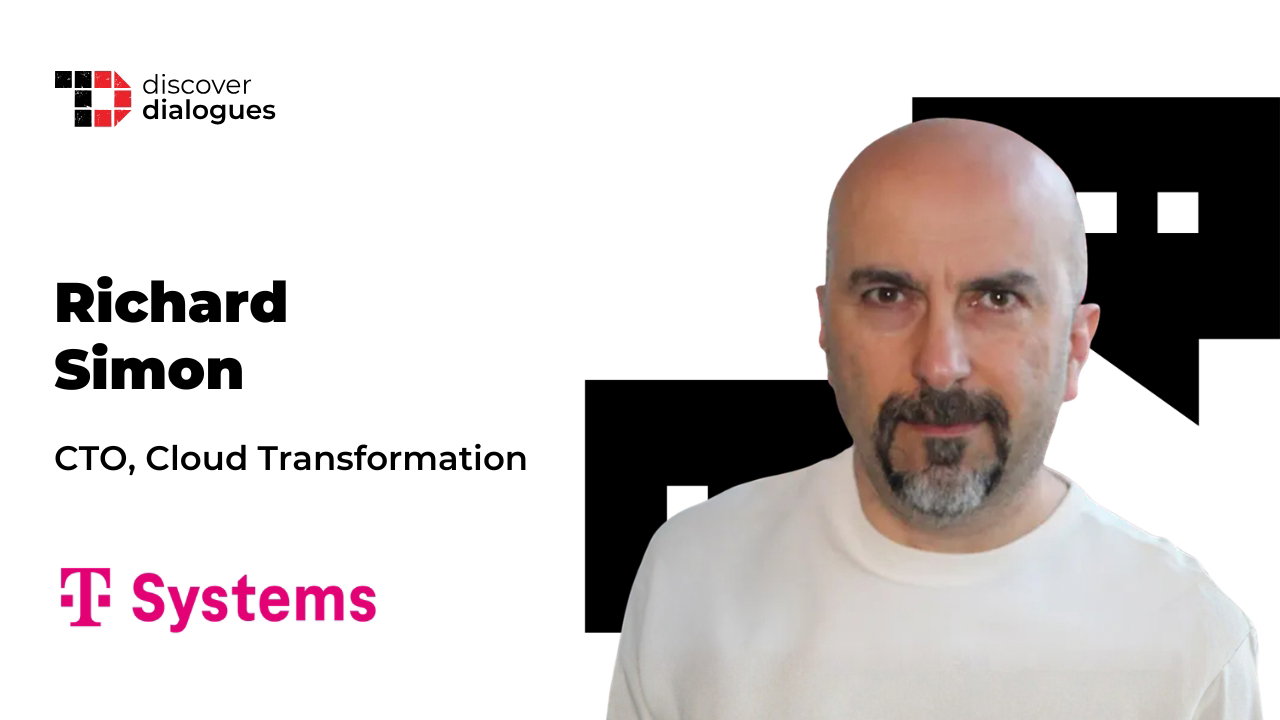
Richard Simon, Chief Technology Officer At T-Systems, On Why Multi-Cloud Strategy Must Start With Business Outcomes
Share
Overview
While the technology landscape continues to evolve quickly, many organizations struggle with strategy and execution. Questions around when to adopt multi-cloud, how to optimize cloud usage, and how to integrate emerging technologies such as generative AI are becoming central to enterprise technology discussions.
In this Discover Dialogues Email Q&A, TechDogs explores how enterprises can approach multi-cloud strategy more thoughtfully, avoid common cloud adoption pitfalls, and understand the role of AI in shaping the future of enterprise IT.
Brief Introduction to Richard:
Richard Simon is the Chief Technology Officer at T Systems and brings more than 35 years of experience in the global IT industry. Over the course of his career, he has worked across engineering, consulting, architecture, and technology leadership roles, giving him a broad perspective on how enterprise technology has evolved over the decades.
Having witnessed the transition from traditional infrastructure to modern cloud and open-source ecosystems, Richard has been closely involved in helping organizations navigate major shifts in enterprise IT. Today, his work focuses on advising enterprises on cloud strategy, digital transformation, and emerging technologies such as AI. He helps organizations align technology investments with long-term business outcomes while ensuring that cloud adoption delivers real operational and strategic value.
TD Editor: Multi cloud is frequently discussed in enterprise technology circles today. However, the term is often used loosely. From your perspective, how should organizations understand what multi-cloud actually means. and why it matters strategically?
Richard Simon: The definition of multi-cloud is actually very simple. It means using two or more public cloud providers within an organization.
Sometimes people introduce additional terms such as hybrid multi cloud or other variations, but those are often more about marketing than meaningful distinctions. In practical terms, multi-cloud simply means that a company is actively using services across multiple public cloud environments.
Where the complexity really begins is in how those environments are managed. Once an organization starts using more than one cloud provider, it must have the right governance, policies, and operational approach to ensure those environments work together effectively.
More importantly, conversation should not start with technology. Organizations should begin by asking why they want to use cloud platforms in the first place. Cloud adoption should always be tied to business outcomes. It should help organizations respond faster to business needs, innovate more quickly, and create better customer experience.
If companies approach multi-cloud purely as a technology decision, they risk creating complexity without achieving meaningful business value.
TD Editor: In recent years, there has also been discussion around cloud repatriation, where companies move workloads back from the cloud to traditional infrastructure. What is driving this trend, and how should enterprises interpret it?
Richard Simon: In many cases, cloud repatriation is the result of poor planning rather than a failure of cloud computing itself.
If organizations migrate workloads to cloud without a clear strategy, they often fail to optimize those workloads for cloud environments. When that happens, systems may technically run in the cloud, but they are not operating efficiently. That can lead to higher costs and performance challenges.
The pandemic accelerated cloud adoption significantly. Many organizations needed to support remote work and digital operations very quickly. As a result, many workloads were moved to the cloud rapidly without taking full advantage of cloud architecture or optimization practices.
When companies later review those environments, they sometimes discover that certain workloads are expensive to run because they were not designed for the cloud in the first place. That leads to conversations about moving them back to traditional infrastructure.
However, that situation should not be interpreted as a fundamental flaw in cloud computing. It is usually a sign that the migration strategy was rushed or incomplete.
Cloud adoption requires a long-term plan. Organizations should think in terms of a clear action plan for the near term, a roadmap for the next few years, and a broader vision for how cloud supports the future of the business.
TD Editor: When organizations do adopt a multi-cloud approach, what should an outcome-driven strategy look like in practice?
Richard Simon: An effective strategy starts with very basic questions. Why are we moving to the cloud? What outcomes are we trying to achieve? How will cloud technologies help the business operate more efficiently or innovate more quickly?
One of the biggest advantages of cloud computing is the ability to experiment and innovate quickly. In a cloud environment, organizations can test ideas very rapidly by deploying temporary environments or new services. If the idea works, it can be scaled and developed further. If it does not work, the environment can be shut down without significant cost or infrastructure investment.
That kind of experimentation is much harder to achieve in traditional data center environments. Provisioning infrastructure can take weeks or even months, which slows down innovation.
Cloud also enables organizations to expand into new markets more easily. If a company wants to operate in a new geographic region, it can deploy infrastructure in the appropriate cloud region instead of building or leasing new data centers. That flexibility can significantly accelerate market expansion and digital services.
TD Editor: Generative AI and large language models are rapidly becoming part of enterprise technology conversations. How do you see these technologies influencing cloud strategies moving forward?
Richard Simon: Generative AI has developed very quickly, and it is already becoming a major part of enterprise technology discussions.
From an implementation perspective, organizations typically have three options.
The first option is building AI capabilities internally. This means using open-source models and creating the infrastructure needed to train and run those models within the organization. This approach offers full control but also requires significant expertise and investment.
The second approach involves fine-tuning existing models. Organizations can take pre-trained models and adapt them using their own data, industry knowledge, or business processes.
The third option is using AI solutions delivered through software services. In this case, technology providers build and train the models while organizations simply integrate those capabilities into their operations.
For many organizations, this third option is the most practical because it allows them to benefit from generative AI without needing specialized expertise in model development.
Regardless of the approach, generative AI is already influencing how enterprises think about automation, productivity, and innovation.
TD Editor: As cloud and AI technologies evolve, what skills or mindset should the next generation of engineers and leaders focus on to remain relevant?
Richard Simon: Curiosity is probably the most important mindset.
Technology evolves constantly, and professionals who remain curious will always continue learning and adapting. It is important to explore new technologies, experiment with tools, and stay informed about emerging trends.
Engineers and architects should also understand how technologies such as generative AI integrate with development tools, DevOps platforms, and engineering workflows. This will become increasingly important as AI capabilities become embedded in many technology platforms.
For leaders, adaptability and humility are also important qualities. Leaders are not always right, and the most effective leaders listen to their teams and remain open to new ideas.
Another important skill is developing informed opinions. As professionals progress in their careers, it becomes important to form viewpoints based on research, experience, and evidence. Being able to explain and support those perspectives helps leaders make stronger decisions and guide their teams more effectively.
If professionals remain curious, adaptable, and willing to learn, they will be well-positioned to navigate the rapid changes happening across cloud and AI technologies.
Wed, Mar 18, 2026

Liked what you read? That’s only the tip of the tech iceberg!
Explore our vast collection of tech articles including introductory guides, product reviews, trends and more, stay up to date with the latest news, relish thought-provoking interviews and the hottest AI blogs, and tickle your funny bone with hilarious tech memes!
Plus, get access to branded insights from industry-leading global brands through informative white papers, engaging case studies, in-depth reports, enlightening videos and exciting events and webinars.
Dive into TechDogs' treasure trove today and Know Your World of technology like never before!
Disclaimer - Reference to any specific product, software or entity does not constitute an endorsement or recommendation by TechDogs nor should any data or content published be relied upon. The views expressed by TechDogs' members and guests are their own and their appearance on our site does not imply an endorsement of them or any entity they represent. Views and opinions expressed by TechDogs' Authors are those of the Authors and do not necessarily reflect the view of TechDogs or any of its officials. While we aim to provide valuable and helpful information, some content on TechDogs' site may not have been thoroughly reviewed for every detail or aspect. We encourage users to verify any information independently where necessary.
Loading comments...